What's new
Fantasy Football - Footballguys Forums

This is a sample guest message. Register a free account today to become a member! Once signed in, you'll be able to participate on this site by adding your own topics and posts, as well as connect with other members through your own private inbox!

*** Official Russia vs. Ukraine Discussion - Invasion has begun *** (7 Viewers)


Often, when Kostiantyn Grygorenko walks the streets of Izium, he spots people he suspects collaborated with the Russians during the five-month occupation of his home town last year.

He used to feel an overwhelming rush of emotions when he saw them. Now, he tries to conserve his energy and nerves and ignore them. But still, it gets to him.

“These people are walking around the town, living among us, and they think they’re not guilty of anything. But I think they’re criminals and should go to jail,” said Grygorenko, editor-in-chief of the local weekly newspaper Izium Horizons.

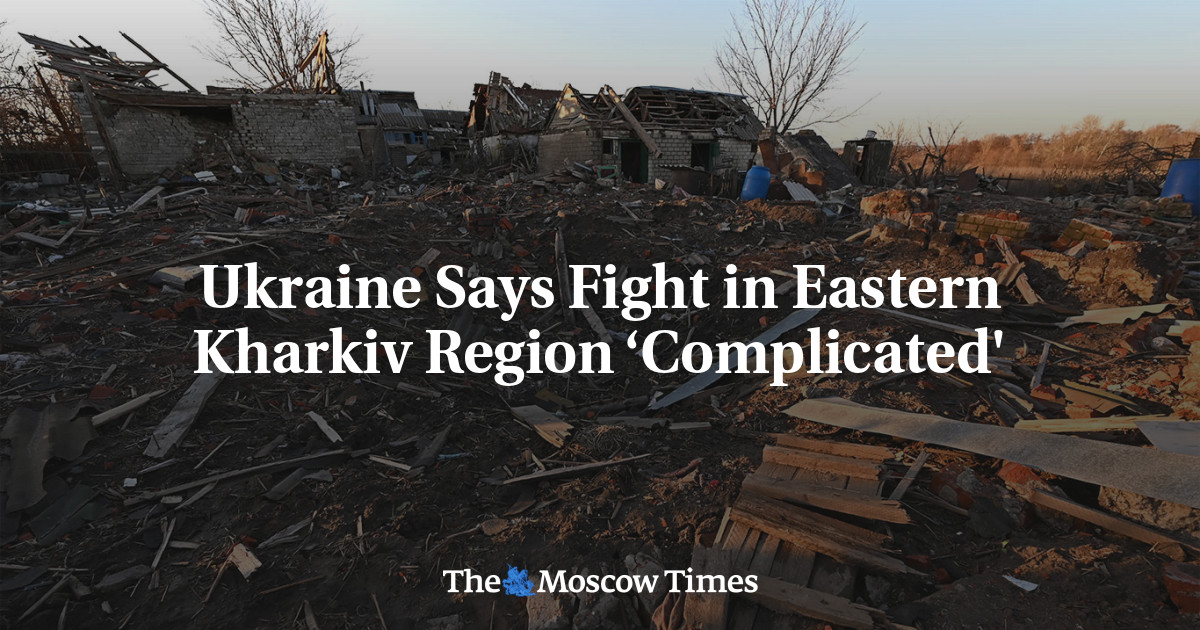
More than a year after the Russians retreated from Izium, much of the city is still in ruins. More than 5,000 houses and 120 apartment blocks have been damaged or destroyed. Schools, bridges and other critical infrastructure remain out of action. “Renovation work will take a decade, and that’s in the absolute best-case scenario,” the city’s mayor, Valerii Marchenko, said in an interview at his temporary office. His old office building, like so much of central Izium, remains gutted.

As well as the material destruction, the 160 days of Russian occupation left an insidious psychological legacy that may take just as long to heal. It’s hinted at by the phone number daubed on walls throughout the town in white paint. The number is for a hotline run by the Ukrainian SBU security service, an invitation to provide information on who did what during the dark days of occupation.

So far, the SBU has opened cases against 30 people in Izium for collaboration, and sent 24 indictments to court, the agency said in a statement. Some people, including a headteacher who agreed to cooperate with the Russians, are in detention awaiting trial. But nobody doubts that more than 30 local people helped the Russians run the town.

“Not everyone was arrested. Some of them fled, others are still out there. Our laws are not adapted to this, and legally they cannot be accused of anything, although they were collaborating,” said Marchenko.
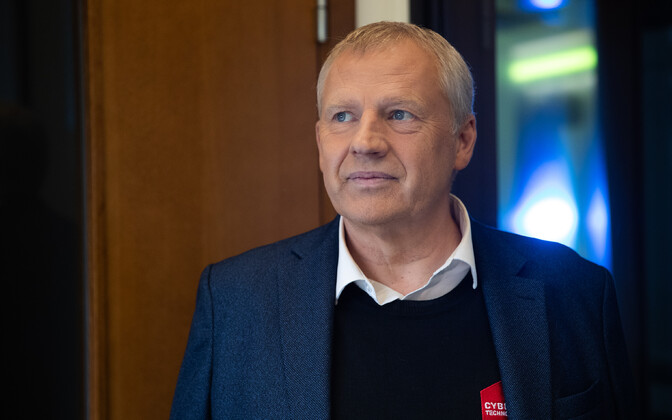

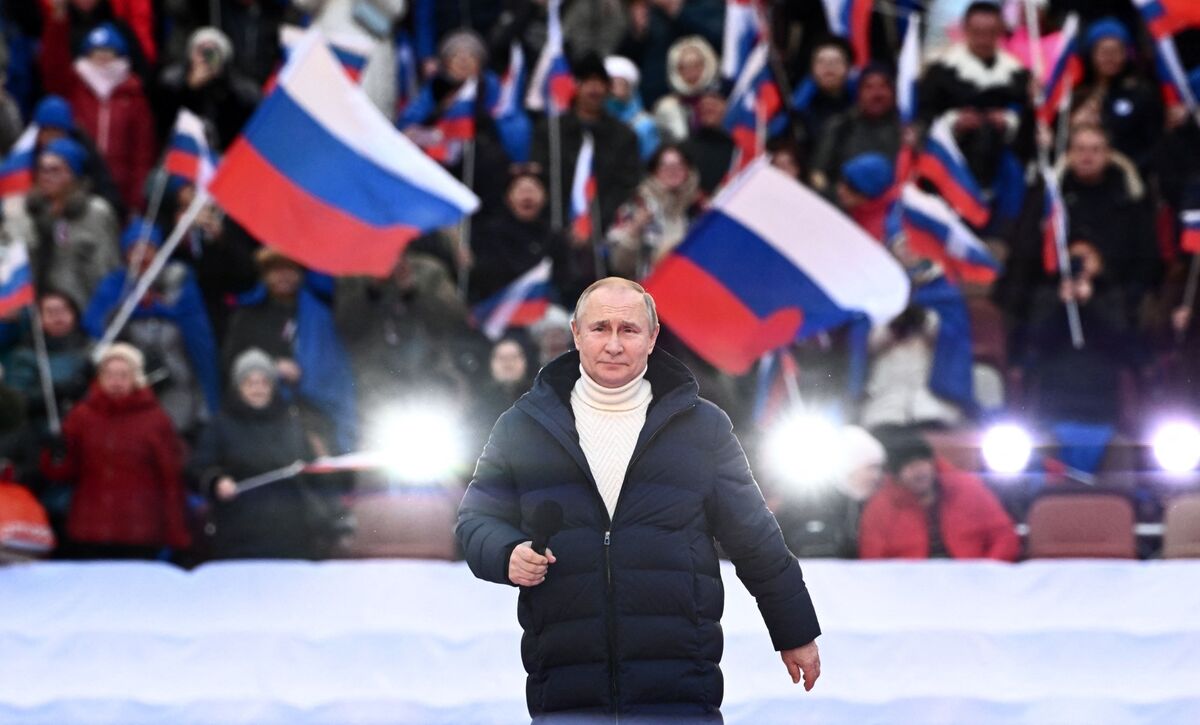
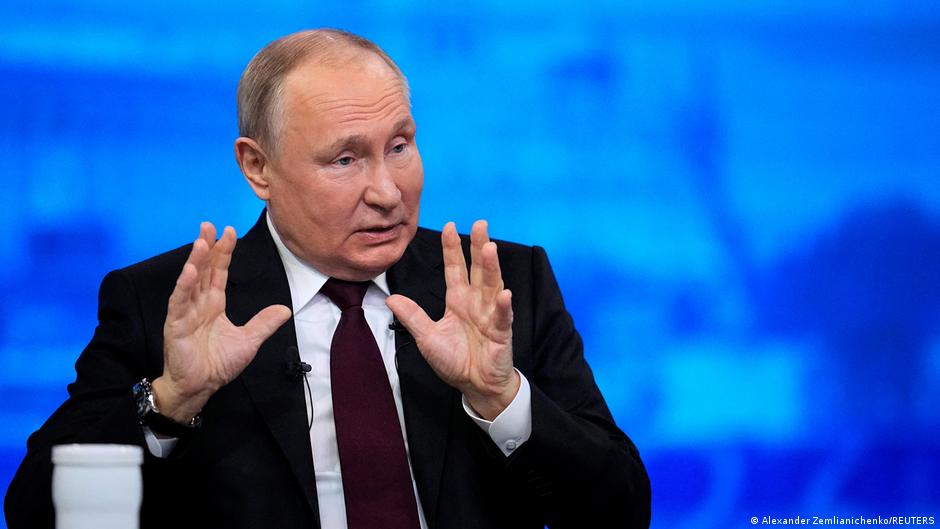
The security expert said, above all, Putin wants to show that Russia's war against Ukraine has been successful.

"It is clear that he is currently trying to emphasize that he is strong, things are moving positively in his opinion. And considering what kind of year he has behind him, he is now restoring faith in Russian President Putin, in someone the Russian people had seen before," said Saks.
 

As a Ukraine aid package continues to stall in the US Congress, America and its allies are assessing what they describe as the potentially debilitating impact on Ukraine’s defense and longer-term prospects of losing the war, multiple US and European officials told CNN.

“There is no guarantee of success with us, but they are certain to fail without us,” a senior US military official said.

The most immediate concern is the impact on Ukraine’s ongoing counteroffensive in the east and south, where Ukrainian forces have struggled to make significant forward progress even when US support was still coming. “If looking at taking and holding further territory,” said one European diplomat, “it is hard to see how that could succeed without continued US support.”

Now, Western intelligence agencies are currently calculating how long Ukraine could hold out without US and NATO help. One senior US military official estimated months, with a worst-case scenario of a significant setback or even defeat by the summer. A Russian victory would not just be dire news for Ukraine, it would be disaster for wider European security and a major blow to the US.

Ukrainian forces are already rationing ammunition, US and Ukrainian officials told CNN, as Russian forces fire back at a ratio of five to seven times greater than Ukrainian forces are able to. A senior Ukrainian military official told CNN that Ukrainian commanders believe the impact on their firepower has led to additional Ukrainian casualties.

Without additional US aid, Western officials assess that Ukraine would first run out of long-range missiles, then air defense missiles and later artillery ammunition and short-range missiles such as shoulder-fired Javelin anti-tank missiles and Stinger anti-aircraft missiles.

Assessments of what a Ukrainian defeat would mean for Europe is causing deep fears among some of America’s closest European allies.

“I don’t think people fully realize what Ukraine’s fall would actually mean,” said a European diplomat. “We would see horrible things: ethnic cleansing and total destruction of Ukraine. Remember what they did in Bucha. So, it is already success if we can prevent that from happening. And that is why we must carry on.”


As Russian forces press forward with an attempt to capture the town of Avdiivka in eastern Ukraine, The Associated Press obtained aerial footage that gives an indication of their staggering losses.

A Ukrainian military drone unit near Stepove, a village just north of Avdiivka, where some of the most intense battles have taken place, shot the video this month.

It’s an apocalyptic scene: In two separate clips, the bodies of about 150 soldiers — most wearing Russian uniforms — lie scattered along tree lines where they sought cover. The village itself has been reduced to rubble. Rows of trees that used to separate farm fields are burned and disfigured. The fields are pocked by artillery shells and grenades dropped from drones. The drone unit said it’s possible that some of the dead were Ukrainians.

The footage was provided to the AP by Ukraine’s BUAR unit of the 110th Mechanized Brigade, involved in the fighting in the area. The unit said that the footage was shot on Dec. 6 over two separate treelines between Stepove and nearby railroad tracks and that many of the bodies had been left there for weeks.


A New York Times investigation traced how Mr. Putin has turned an expected misfortune into an enrichment scheme. Western companies that have announced departures have declared more than $103 billion in losses since the start of the war, according to a Times analysis of financial reports. Mr. Putin has squeezed companies for as much of that wealth as possible by dictating the terms of their departure.
He has also subjected those exits to ever-increasing taxes, generating at least $1.25 billion in the past year for Russia’s war chest.

Video: https://twitter.com/Mike_Eckel/status/1736324724131496024

intense video, of an unspecified Russian armored/infantry (?) unit coming under fire from Ukraine's 14th Separate Mechanized Brigade on Dec. 12, near Synkyvka, Kharkiv region.


"Around 668,000 people left Russia in 2022, a 71 percent increase over the prior five-year average."


In a new interview, Putin has promised "problems" for Finland following its Nato accession


Russian military and allied DNR forces lose an average of 5-6 DJI-type quadcopters during night flights due to icing conditions. Many high-level Russian commanders do not understand these icing conditions and are forcing crews to fly drones anyway.


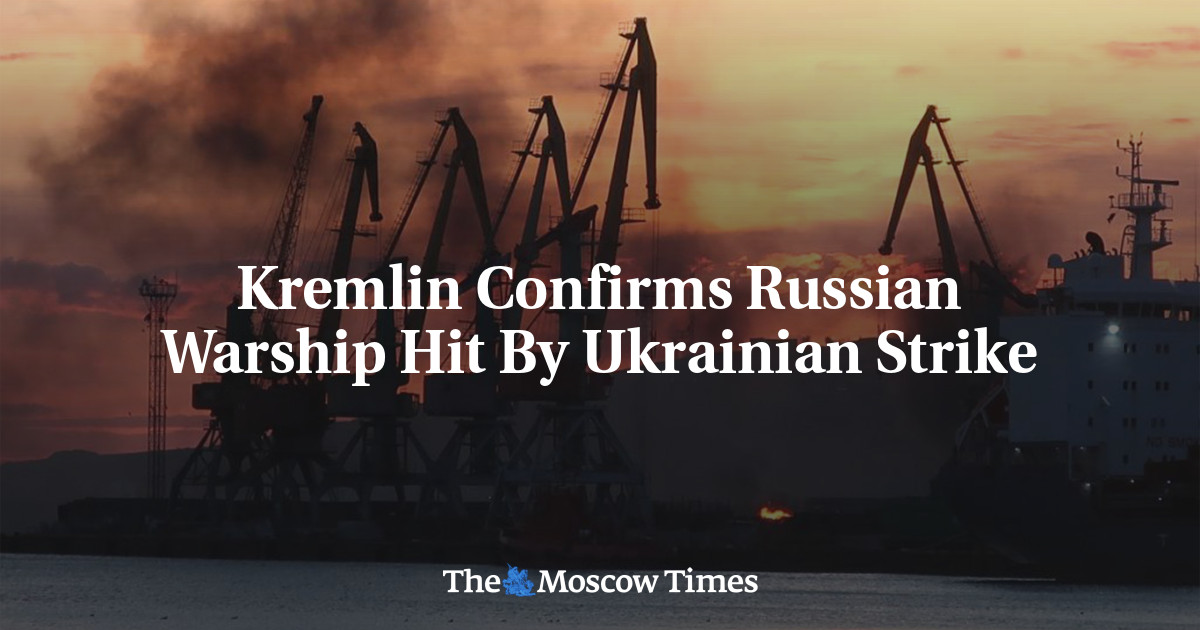
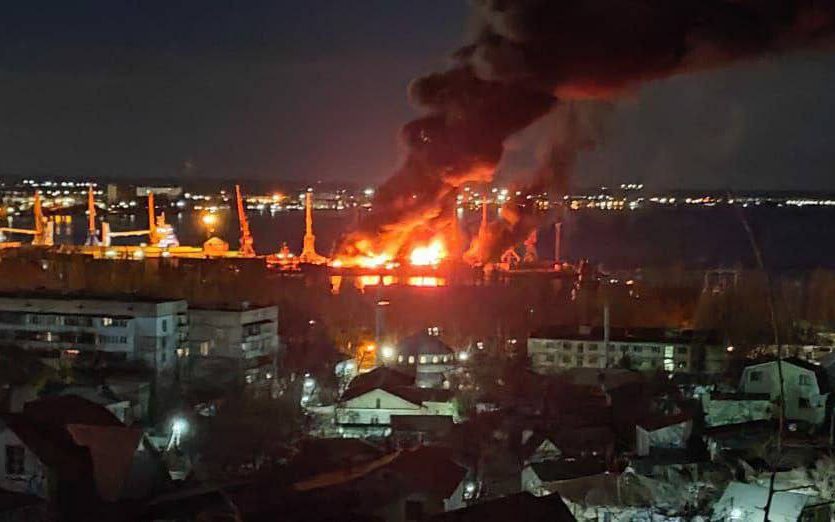
Ukrainian strikes have likely caused the Russian Black Sea Fleet to set conditions for a more permanent basing pattern along the eastern Black Sea coast as it transfers naval assets away from Crimea and expands a small port in de facto Russian-controlled Ochamchire, Abkhazia.


Satellite imagery indicates that Ukrainian strikes caused Russian forces to move BSF assets away from occupied Sevastopol to ports in the eastern part of the Black Sea on an enduring basis.

Russian naval base in Novorossiysk, Krasnodar Krai, Russia.

June 8 vs December 5, 2023.
 

The analytical note from @Deepstate_UA 's summary today again emphasizes Russia's manpower advantage.


Kyrylo Budanov, head of Ukraine’s military intelligence, says the country needs more soldiers, mobilization necessary. He says no amount of recruiting will attract enough troops. “It is not even conceivable to think that we can do without mobilization.”


A Ukrainian analysis of 76 weapons used by Russia finds that, of 2453 components, 1813 (74%) were manufactured by US firms.
96 were Japanese. Just 87 were Chinese.
The Japanese components include integrated circuits, engines, cameras.


Ukraine's security service said on Sunday it had launched a criminal probe under a law on information gathering after a "technical device" was found in an office that could have been used in the future by Commander in Chief Valery Zaluzhnyi.
The security service said on the Telegram messaging app that an investigation had been opened under an article in Ukraine's criminal code on "unlawful acquisition, sale, or use of special technical means for obtaining information".
It added that the device -- initially characterized as a bug by local media -- was considered under preliminary information to be "in a non-operational state", and no means of information storage or remote transmission of audio recordings were found.
"We emphasise that the device was found not directly in Valery Zaluzhnyi's office but in one of the premises that could have been used by him in the future for work," the service said.


The Freedom of Russia Legion, a Ukrainian-based paramilitary group of Russians who oppose President Vladimir Putin, claimed responsibility on Sunday for a cross-border attack a few kilometres (miles) into Russia's Belgorod region.
The group, designated as terrorist in Russia, said it had destroyed a platoon stronghold of Russian troops near Terebreno village, without specifying whether it had destroyed infrastructure or killed soldiers, and said it had left mines behind.


But what lawyers describe as a “deployment lottery” is straining the recruitment process. Army chiefs are struggling to fill places with the willing; some are resorting to conscription raids on gyms and shopping centres. Few of those who are signed up this way make good soldiers. “We’re seeing 45- to 47-year-olds,” complains one senior officer. “They are out of breath by the time they reach the front line.”

There are several examples of successful recruitment campaigns into individual units. The 3rd Assault Brigade, created nine months into the war as a branch of Ukraine’s special forces, is perhaps the most visible. Skyscraper-sized adverts in Ukraine’s cities glamorise life as one of the brigade’s stormtroopers, slaying goblin-like caricatures of evil. But no less important is the brigade’s reputation for competent command, good equipment and low attrition rates. New recruits typically undergo months of training, unlike the one-month standard.
Khrystyna Bondarenko, a spokesperson for the brigade, says it has no shortage of volunteers. By the start of next year the brigade will be Ukraine’s largest, she says, at around the size of a NATO division. (Ukraine’s army does not have divisions.) The majority of its new recruits are under 25, and she turns down 150 applications a month from minors. “No one is saying there are millions of people waiting to fight in Avdiivka [a town in the Donbas that has recently seen fierce fighting],” she says. “But there are people you can work with.”

Ukrainian critics of the government in Kyiv, meanwhile, charge that the country is only “pretending to mobilise.” Viktor Kevlyuk, a retired colonel who oversaw the implementation of mobilisation policy for the western half of the country from 2014—when Russia first invaded—to 2021, says Ukraine risks falling into a trap. Russia will step up its mobilisation after its presidential election in March is over, he thinks. (HUR, Ukraine’s military-intelligence agency, agrees.)
Vladimir Putin has already signed an edict increasing the size of Russia’s armed forces by 170,000. Colonel Kevlyuk argues that Ukraine must respond with a nationwide mobilisation of industry, government and resources. The often-decadent lifestyles of those enjoying safety in Kyiv need to change, he thinks. “This is not a time for imported smoked salmon.”
Throughout the war Volodymyr Zelensky has resisted the maximalist urgings of his soldiers, much to their chagrin. His top generals have, for example, pushed to lower the age at which non-reservists can be mobilised, which currently stands at 27. Others have proposed a stricter implementation of mobilisation laws.
The president has pushed back partly for political reasons: he does not want to irritate the population unnecessarily. But Mr Zelensky is also driven by more noble concerns. “Zelensky wants to do the right thing by Ukrainians,” says a high-level government source. “He doesn’t want to be a dictator”.
 

Frontline Ukrainian troops face shortages of artillery shells and have scaled back some military operations because of a shortfall of foreign assistance, a senior army general told Reuters.
Brigadier General Oleksandr Tarnavskyi was speaking after Republican lawmakers held up a $60-billion U.S. aid package and Hungary blocked 50 billion euros ($54.5 billion) in European Union funding for Kyiv as it battles Russia's invasion.
"There's a problem with ammunition, especially post-Soviet (shells) - that's 122 mm, 152 mm. And today these problems exist across the entire front line," he said in an interview.
Tarnavskyi said the shortage of artillery shells was a "very big problem" and the drop in foreign military aid was having an impact on the battlefield.
"The volumes that we have today are not sufficient for us today, given our needs. So, we're redistributing it. We're replanning tasks that we had set for ourselves and making them smaller because we need to provide for them," he said, without providing details.

The comments underline Kyiv's reliance on Western military aid to fight Russian troops along a 1,000-km front nearly 22 months into the biggest conflict in Europe since World War Two.
Russian forces also face ammunition problems, Tarnavskyi said, without specifying their nature.
Weary Ukrainian troops on the southeastern front have gone on the defensive in some areas but are trying to attack in others, he said.

Tarnavskyi, commander of the "Tavria" operational grouping, led a counteroffensive that forced Russian troops out of the southern city of Kherson and the western side of the Dnipro River in November 2022, Kyiv's last major battlefield success.
He also had a prominent role in a larger-scale push in the southeastern region of Zaporizhzhia this year that made little progress against vast Russian trenches and minefields.
Russia is on the offensive in the east and trying to encircle the strategic eastern town of Avdiivka, whose defence Tarnavskyi oversees.
"Their (Russian forces') intention remains (the same). The only thing is that their actions change, tactics change... attacks are carried out constantly," he said.
The situation in Avdiivka was changing "every day and every night" with Russian forces regularly altering their tactics, having achieved "partial success in some areas at a depth of about 1.5 to 2km", he said.

"I believe that we are firmly maintaining these lines today," he said. "Today, the enemy is pressuring us with their numbers. They have never cared and will not care for their personnel."
Avdiivka is widely seen as vital to Russia's aim of wresting full control of the two eastern provinces of Donetsk and Luhansk - two of the four Ukrainian regions Russia says it has annexed but does not have full control of.

Tarnavskyi said winter conditions - the cold, reduced visibility and lack of cover from trees that have no foliage - were a challenge for both sides.
"But we have many years of experience of conducting military operations in winter conditions. Logistics, and evacuation and movement of equipment and personnel are complicated," he said.
Ukraine increasingly needs the means to defend itself against growing strikes by Russian attack drones, but Ukraine is banking on Western F-16 fighter jets being delivered, he said.
"With the presence of the F-16, it will be totally (different). In my opinion, as an infantry officer, the F-16 is like a Mercedes compared with a Zaporozhets (an old Soviet car)," he said. "Everyone is hoping."


This interview with one of the members of the Avdiivka garrison was recorded in November. "Zam", a company commander, has been in Avdiivka for many months now. He first saw massive Russian columns advancing on his positions on 10 October '23. This interview will give you an idea of the cost of holding off the hordes, and a truthful, unique insight into the mindset of a Ukrainian commander. Source: https://youtu.be/hEnb2-eXlaQ


The U.S. will run out of funding for Ukraine this month if Congress does not act to pass President Joe Biden’s emergency supplemental spending request that has been stalled for weeks on Capitol Hill, a top U.S. official said Monday.


New Ukraine findings from Kyiv International Institute of Sociology (KIIS) poll:
-Generally, criticism of authorities increasing
-Compared to Dec 2022, trust in parliament decreased (35% to 15%) and in govt (52% to 26%)
-Zelensky trust also fell to 62% compared to 84% last year
However, on Zelensky, KIIS poll notes, "on the one hand, we see a significant decrease [in trust], but on the other hand, it remains unequivocally positive with a significant preponderance of those who trust the president compared to those who do not trust him."
Ukraine's Armed Forces retain absolute trust in society. -Last December and now, 96% of Ukrainians trust the military
-In addition, 88% of Ukrainians trust Commander-in-Chief Valeriy Zaluzhny (only 4% don't trust him)

More from the poll here: https://www.kiis.com.ua/?lang=ukr&cat=reports&id=1335&page=1


Since the dissolution of the Wagner mercenary group, Russia has restructured its paramilitary networks in Africa, particularly in the Central African Republic (CAR), which in recent years has become a hub for Russian security services on the continent.
Now under state control, Russia-Africa networks have become more official and the careers of their leaders are easier to identify as most of them come from the Russian Ministry of Defense or the Foreign Intelligence Service (SVR).
That's according to the joint investigation published on Thursday, December 7, by the independent website All Eyes on Wagner (AEOW) associated with Radio Liberty – a media outlet funded by the US Congress – which revealed the names and photographs of some of the key Russian officials responsible for coordinating Russia's actions in Mali, Burkina Faso and CAR.

According to the investigation, Moscow's new strongman in Bangui is Denis Pavlov, a "diplomat" recently appointed to the Russian embassy in the CAR capital. He is in charge of security partnership with the Central African Police Headquarters.
Fluent in French, the diplomat is, in fact, an SVR officer. "We have identified him as the head of the Russian foreign service post in the Central African Republic," confirmed a European diplomatic source onsite to Le Monde. The SVR officer had worked for a long time undercover in the Russian missions to UNESCO in Paris (2006-2007), the UN in Geneva (2011-2012) and most recently the European Union in Brussels, a post he left in the spring of 2023. However, he was not on the list of 48 Russian spies expelled by Belgium in 2022.

According to AEOW, Pavlov's appointment proves that "Russian intelligence services are now taking Central African affairs in hand." It has to be said that CAR is strategic for Russia, the Bangui airport having become Russia's logistics hub in Africa. Present in the country since 2017, Wagner's mercenaries have infiltrated the security structures – for which they provide training.
"Beyond training services, the Wagner Group has been well established in the country’s security ecosystem. According to several sources, its executives enter and leave police offices as if they were their homes, occupy offices and barracks and are accused of violence against armed forces and police forces. They also lead and participate in the operations of the Central African Armed Forces but also the country’s Internal Security Forces," the investigation detailed.
 

Russia is ramping up efforts to capture Kupiansk in Kharkiv Oblast, moving reserves of assault battalions to the area to compensate for heavy losses, Volodymyr Fito, the head of the Army's public relations service, said on air on Dec. 16.

Ground Forces Commander Oleksandr Syrskyi reported on Dec. 11 that Russian forces are trying to capture the village of Synkivka in Kharkiv Oblast, hoping to pave the way for the blockade of nearby Kupiansk.

Liberated from Russian occupation in the September 2022 Ukrainian counteroffensive, Kupiansk has been a key target for renewed Russian offensives, as it serves as a key logistics hub for a potential push further south or west.

According to Fito, Russia is utilizing significant amounts of equipment and personnel for its offensive on Kupiansk, which was previously occupied by Russian forces from late February 2022 to Sept. 10, 2022.

The "equipment is more protected" than the Russian soldiers, who are used in heavy numbers for assaults and combat reconnaissance, Fico said.

Moscow has been concentrating a large force at the Kupiansk-Lyman axis in northeastern Ukraine since the summer, and heavy engagements and shelling have been a common occurrence.


Igor Salikov, a 60-year-old former Russian intelligence colonel who was involved in Russia’s aggression against Ukraine, fled to the Netherlands and expressed his desire to testify in the International Criminal Court (ICC).
Salikov claims that at first he served 25 years in the Russian army, and then served in the Wagner Private Military Company and fought in Syria and several African countries on its side. He was also involved in Russia’s aggression against Ukraine first in 2014, and then in 2022.

He wrote a letter to the ICC in which he confessed his involvement in the annexation of Crimea and the activity of the Donetsk People’s Republic (DPR), mainly falsifying the results at the so-called referendum. He thinks that the Russian forces then were persuaded to invade Ukraine "fraudulently".

Salikov also revealed that he was a witness of Russian war crimes after the beginning of Russia's full-scale invasion of Ukraine in February 2022, specifically executions of civilians, torturing of prisoners of war and kidnapping of children.

"I saw how the people from special services were deporting many children without their parents through the Belarusian border," Salikov said, adding that "entire columns of FSB agents on private vehicles and small buses" were involved in this. However, he does not know the reason for the kidnapping.


Germany approved orders for more than $400 million worth of 155mm artillery shells for Ukraine in recent days, in separate deals with Rheinmetall and an unidentified French company.

The German army placed an order for several tens of thousands of shells for the Ukrainian armed forces under an existing framework agreement with Rheinmetall, with a value of at least €100 million, or $110 million, the company said in a Dec. 18 statement.

That follows a Dec. 14 announcement that the Defence Ministry is buying 68,000 shells for Ukraine from a French armament company for €278 million.
 
Video:


Drones are transforming the battlefield, with both Ukrainian and Russian forces relying on them extensively. Ukrainian drone pilots near Avdiivka are using them to counter what analysts are calling the biggest assault by Russian forces since Bakhmut. Watch this report by DW's correspondent in Ukraine, Nick Connolly.


At the beginning of the year Ukraine's President Volodymyr Zelenskyy said that 2023 would be the year that his country would win the war against Russia but with a failed counter-offensive and in the midst of another winter, DW correspondent Nick Connolly in Kyiv said all indications point to the war grinding on.

"There's definitely a recognition here in Kyiv that was a mistake to give these kinds of timelines. Now there's a real sense that the leadership on all levels is preparing to dig in for the long term, there are lots of things that were put off like elections, like further mobilization," Connolly said, adding "those are now back on the agenda because they simply realized they are going to need new troops next year and probably in the year after."

"There is a kind of consensus, if you talk to people, that carrying on is the least bad option. Making peace now with Russia on Russia's terms — we've had Vladimir Putin basically make it clear that his war aims haven't changed, that he's expecting Ukrainian capitulation," which Connolly said was not what people he had spoken to, wanted to see happen.
On the issue of waning international support and the impact that was having on the morale of Ukrainian troops, Connolly said having been on the frontlines just last week "it was a very mixed picture."

Connolly said that in some instances one would come across more seasoned troops who had in some cases been fighting since before 2014 and were "used to spending winter in the trenches, who are used to dealing with the mice as well as the shellshock and the constant danger of Russian drones."

In other cases there were units comprised of those who had been mobilized and didn't necessarily want to be there and "were really struggling to cope."


Connolly said that fatigue was a critical factor among Ukraine's forces.

"The most important thing is tiredness. The vast majority of the frontline units have been fighting since the beginning of Russia's invasion — almost two years now — and they are just exhausted."

Some of these troops had only had a two week break which some said was not nearly enough time away from the front, Connolly said.


Russia's invasion of Ukraine is prompting Germany to do something unprecedented — to permanently base thousands of troops only about 100 kilometers from the border with Russia and right in the line of fire if the Kremlin ever launches an attack on NATO territory.

German Defense Minister Boris Pistorius was in Vilnius on Monday to sign a deal with his Lithuanian counterpart Arvydas Anušauskas firming up the conditions on which 4,800 German troops plus 200 civilians will be based in the Baltic country.

"With this war-ready brigade, we are assuming a leadership responsibility here in the alliance and on NATO's eastern flank," Pistorius said, adding: "The speed of the project clearly shows that Germany understood the new security reality.”


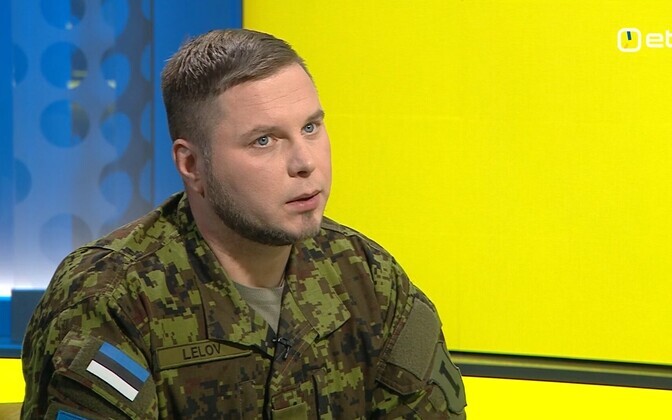
Lt. Col. Tanel Lelov, head of air defense for the Estonian Division, said on the "Ukraina stuudio" talk show that both sides have been making use of small drones in the Russia-Ukraine war, which have turned out to be very effective.

Lelov explained that the sides are trying to hit enemy targets from as far away and with as little casualties as possible, which drones allow them to do.

"Russia is trying to hit targets by combining the use of missiles and drones. Ukraine is also using drones of their own making to hit strategic military targets and disrupt or paralyze Russia's movements and activity along the front," Lelov explained.

He said that Russia has been combining the use of missiles and Shahed drones to try and overload Ukrainian air defenses, adding that the number of missiles and drones used has been growing in time.


Ukraine is using a lot of so-called ordinary drones. "One needs to be resourceful in war, and everything that can be used to put pressure on Russian positions and troops is being used. Multipurpose drones, whether self-made, store-bought or made for military use, are made to carry as much ordnance as they can and drop it where needed. It is a good short-range option as drones can be piloted using onboard cameras," Lelov said.
"Of course, it is possible to scramble the drones but there are usually not enough scramblers to go around, they are relatively expensive and do not have much range. The drones used are often quite small because it makes them harder to detect using radar. That is why they have proved very effective and there might even be one or two drones per soldier," he added.

Drones equipped with thermal imaging cameras are especially useful this time of year because the ground is cooler which makes military vehicles and troops stand out.

Lelov said that small drones are a new trend and allow lethal force to be projected over longer distances, often from relative safety for the operator.

The lieutenant colonel added that Estonia's air defense planning considers the threat of drones. "We are creating capacity to detect and counter such threats."


As they stood shivering on the streets of Kupyansk, just eight kilometres from the Russian front line, Dave and Justin Smith worried that the war they’d come to Ukraine to fight is slowly being lost.

Not because the two Canadians have any doubts about the bravery or the commitment of the Ukrainians they fight alongside, but because they feel the West is becoming distracted and losing interest in the grinding conflict here.

It’s a bitter reality for the two Smiths to contend with, as they battle a Russian winter offensive that’s slowly pushing closer to Kupyansk, an artillery-scarred railway hub in the eastern Kharkiv region. (The two are not related, but have been friends and comrades-in-arms since the day Dave met Justin shortly after arriving in Ukraine.)

The stakes for them, and this country, are getting higher. And the drift in public interest in Canada, the United States and Western Europe is being translated into government policies through a slowing of military assistance to Ukraine, as well as escalating diplomatic pressure on Kyiv to at least start thinking about what a negotiated end to the conflict might look like.

“If you want to lose a war, lose attention. That’s how that happens, and that is Putin’s end game,” Dave said earlier this month, knocking loose some of the mud still caked to his assault rifle after “three-and-a-half days of hell” in the trenches just east of this city. The 39-year-old Torontonian – who will turn 40 on Christmas Eve – said fighting on the front lines of Eastern Ukraine in 2023 is close to what he imagines it must have been like in the trenches of northern France during the First World War.

“Basically, what we’re talking about is a World War One-style stalemate where it’s like, not only can you not run across no man’s land, like in World War One, but the ubiquity of drones has essentially made it impossible to integrate fires and manoeuvre effectively,” said Dave, a 15-year veteran of the Canadian Armed Forces, referring to the military tactic of hitting a target with multiple types of fire – artillery, air and ground assault – at the same time.

The Canadian has taken part in some of the most successful Ukrainian operations of the war – including the liberation of the formerly occupied parts of the Chernihiv region in the north in early 2022, and the city of Kherson in the south later that year – but the situation in Kupyansk reminds him most of the battle for Bakhmut, where the sheer size of the Russian force eventually overwhelmed the Ukrainian defenders after a months-long siege.

“They’re advancing every day. Whether or not they make up ground, or they just try to do so, they’re definitely pushing. And they definitely have the momentum here right now. It’s not easy. It’s tough fighting. It’s muddy. It’s cold, you know, it’s just miserable. And they just have far superior numbers over us.”

The Canadians say they are careful about not drawing too much attention to the houses they use as bases in the city, and try to avoid speaking English in public. They know that some locals weren’t unhappy with the Russian occupation, and suspect that some may be helping the enemy with targeting.

The two veterans – who are joined in Kupyansk by a third Canadian fighter, a 22-year-old Montrealer nicknamed “Speedy” who did not want to be interviewed – say they feel their time and training in the Canadian Armed Forces prepared them well for the fight. They laugh about how closely a mock storm-the-trenches exercise held annually at CFB Wainwright in Denwood, Alta., resembles the reality they’re now living.

But both Smiths agree that it’s a very different thing to fight the kind of battles most Canadian and NATO veterans have experienced in Afghanistan – and other places where Western armies had the artillery advantage and control of the airspace – than to go in knowing your side is outgunned.

The Russian artillery advantage, plus the omnipresent drones, make it almost impossible for the Ukrainians fighting east of Kupyansk to do anything more than try to hold their ground. “We just got the **** shelled out of us the whole time,” Dave said of his most recent stint in the trenches. “There basically is no room for manoeuvre. The moment you pop your head up, there’s a drone on top of you.”


Russia's invasion of Ukraine is prompting Germany to do something unprecedented — to permanently base thousands of troops only about 100 kilometers from the border with Russia and right in the line of fire if the Kremlin ever launches an attack on NATO territory.

German Defense Minister Boris Pistorius was in Vilnius on Monday to sign a deal with his Lithuanian counterpart Arvydas Anušauskas firming up the conditions on which 4,800 German troops plus 200 civilians will be based in the Baltic country.

"With this war-ready brigade, we are assuming a leadership responsibility here in the alliance and on NATO's eastern flank," Pistorius said, adding: "The speed of the project clearly shows that Germany understood the new security reality.”


Nice to see that Germany is willing to put literal skin in the game. Early in the war Germany was a clear laggard in providing meaningful support, but they have been coming on stronger more recently.
 
Nice to see that Germany is willing to put literal skin in the game. Early in the war Germany was a clear laggard in providing meaningful support, but they have been coming on stronger more recently.
Now that the preliminaries are over and Ukraine is starting to scrape the sides of the barrel their collective memory is reawakened from about 78 years ago and what happened the last time the Soviets headed East.
 

Ukraine's military wants to mobilize up to 500,000 more troops to fight Russia's invasion, but Ukrainian President Volodymyr Zelenskyy said Tuesday that he has asked them to spell out their plans in detail on what is “a very sensitive matter” before deciding whether he grants their wish as the war approaches the two-year mark.

Such a major mobilization would cost Ukraine around 500 billion hryvnias ($13.4 billion), Zelenskyy said. Other aspects to be considered include whether troops currently on the front line would be rotated or allowed home leave after almost 22 months of full-scale war.

Ukrainian Ministry of Defense statistics say the Ukrainian army had nearly 800,000 troops in October. That doesn't include National Guard or other units. In total, 1 million Ukrainians are in uniform.


Czech President Petr Pavel expects "significant developments" in Moscow's full-scale invasion of Ukraine next year — and these are not likely to be favorable to Kyiv, he said.
In an interview with Czech online news outlet Seznam Zprávy, Pavel was asked about his profile in POLITICO's annual ranking of the most powerful people in Europe, in which he was described as a "hawk when it comes to both Russia and China" who fully supports Ukraine as well as further NATO expansion.

Asked about his expectations on those issues for the upcoming year, Pavel said: "We have a lot ahead of us, because the development of the conflict in Ukraine shows that we are very likely to see some significant developments next year.

"And the indications so far are that it will not be in the best sense of the word, as we would like it to be," the president warned in an interview published Monday, asserting there would be "a new situation that we will have to deal with."

The comments from the Czech president — who is a former general, senior NATO leader and staunch Ukraine supporter — come at a challenging time for Kyiv.


After Ukraine, the Kremlin's next targets could be Moldova and the Baltic countries, Belgian army chief Michel Hofman has warned.

Russia has "already shown that they have the will to attack a neighbor," Hofman told Belgian news outlet VRT while visiting Belgian soldiers stationed in Romania. Russian President Vladimir Putin's language "is always ambiguous. It is absolutely possible that they will also have other ideas later. Either in the south in Moldova or the Baltic states," he said.

"Europe must urgently prepare and make it clear that it can defend itself" and that "it will ... counterattack if necessary," said Hofman, who is the chief of defense of the Belgian armed forces.


Beyond the potentially catastrophic consequences for Ukraine, some European allies have begun to quietly consider the impact of a failure for North Atlantic Treaty Organization in the biggest conflict in Europe since World War II. They’re reassessing the risks an emboldened Russia would pose to alliance members in the east, according to people familiar with the internal conversations who asked for anonymity to discuss matters that aren’t public.

“There is increasing concern about lack of movement on aid for Ukraine on both sides of the Atlantic and frustration that there is this stagnation with dire battlefield consequences,” said Kristine Berzina, managing director at the German Marshall Fund in Washington. “The possibility of Ukraine losing additional territory and even its sovereignty — that is still on the table.”
Russia is likely to push to take more territory and destroy more infrastructure if Ukraine doesn’t get the weapons it needs to defend itself, according to European officials. Unable to defend itself, Ukraine might be forced to accept a cease-fire deal on Russia’s terms, they said.

In the Baltic states, officials are already telling the public to be ready for the next war because Putin’s forces aren’t going to be destroyed in Ukraine. The discussion has moved from ‘if’ Russia might attack to a focus on concrete preparations for that once-unthinkable prospect. Despite Biden’s public assurances, questions about whether the US and other allies would actually put their troops at risk to defend tiny countries that were once part of the Soviet Union are growing.
“Russia is not scared of NATO,” Estonia’s military chief Martin Herem said in an interview with a local TV station last week, estimating that the Russian military could be ready to attack NATO within a year once the conflict in Ukraine — not a member of the alliance — was over. Other western officials said it would likely take Putin at least several years to make up for the tremendous losses his military has taken in Ukraine, let alone threaten NATO’s much more capable forces.
But the earlier confidence that the invasion would be a ‘strategic defeat’ for the Russian leader has faded, replaced in some quarters by a growing sense that Putin’s bet that he can outlast the US and its allies may prove right.
Finland, which joined NATO this year amid the growing threat from Russia, has stepped up its own defense buildup and is seeking to lock in security ties with the US. Putin Sunday warned that Russia plans to deploy more troops along its border, the longest between Russia and a NATO member. “There were no problems,” he said. “Now there will be.”
One western official described how a Russian victory would trigger an outpouring of refugees heading for the EU, piling pressure on services in those countries and exacerbating tensions between members. At the same time, the official said, the Ukrainian resistance would switch to guerrilla tactics meaning that the fighting would continue at a lower lever, perpetuating the instability on the EU’s eastern border.
Some European countries might seek to strengthen their ties with Moscow or Beijing to avoid having to rely too much on an unreliable US, other officials said.
 

Zelenskiy adds Ukraine will produce one million drones next year.

Ukraine has been working to increase its domestic weapon production since the start of Russia’s invasion in February 2022.

“It’s really bad when we are still left with old Soviet red tape in terms of the logistics,” he said.

Zelenskiy adds; “We will make one million drones next year, we will do that. We will do everything to make this happen.”

Zelenskiy acknowledges that prisoner exchanges have been happening more slowly for specific reasons on the Russian side, but will soon happen more actively

He adds: “This process is becoming more complicated, indeed, you may be right that the authorities are not communicating sufficiently [to relatives].

“This track slowed down due to reasons of the Russian Federation.

“This track will open, we are currently working on a fairly significant amount of our people so that we will be able to return them.”

When asked what does victory mean, Zelenskiy responds: “I have to defend our country in accordance to our constitution” which includes the Donbas and Crimea,.

“The more Russia will retreat, the weaker it will be”, including on the international arena.

“Ukraine will succeed.”

Zelenskiy believes Russia’s war goals have not changed which shows they do not want peace.

He adds that the next “peace formula” will be held with other nations in Davos, Switzerland.

Zelenskiy admits the process of agreeing security guarantees with partners is going slower than expected.

And he dismisses the idea of a partial membership of Nato.

Zelenskiy told the news conference that the country’s elections cannot be conducted during the war.

The idea of holding elections has been widely discussed in Ukraine despite them being prohibited under martial law.

Zelenskiy has repeatedly said holding elections could undermine unity and be easily exploited by Russia.
 

(1 of 3)

On 14 December 2023, the Russian Air Force highly likely carried out the first use of a AS-24 KILLJOY air launched ballistic missile since August 2023. Russia launched at least one missile into central Ukraine, likely targeting a military airfield.
(2 of 3)

One of the six ‘super weapons’ President Putin announced in 2018, KILLJOY has been ear-marked to play a major role in Russia’s future military doctrine. In the Ukraine war, Russia has reserved the weapon for what it perceives as high value, well defended targets.
(3 of 3)

KILLJOY has almost certainly had a mixed combat debut. Many of its launches have likely missed their intended targets, while Ukraine has also succeeded in intercepting attacks by this supposedly ‘undefeatable’ system.


On Monday, the general also criticised Zelensky’s decision to dismiss regional military draft office chiefs as part of a crackdown on corruption. “These were professionals, they knew how to do this, and they are gone,” Zaluzhny said. His comments came after Ukraine’s SBU security service said a listening device had been discovered in Zaluzhny’s office.
Although Zelensky still retains broad support, his trust levels have fallen from 84 per cent to 62 per cent, according to a poll by the Kyiv International Institute of Sociology. In contrast, Zaluzhny enjoys the trust of 88 per cent of Ukrainians, the same poll indicated.
“There is a now a tendency to criticise Zelensky,” said Volodymyr Fesenko, a prominent Ukrainian political analyst. “Until the start of September there was an unspoken taboo on not criticising (the president) during wartime.”
Zelensky is also likely to face questions about efforts to plug gaps at the front and relieve troops who have been in action since the start of Russia’s invasion last year. The average age in many brigades is well over 40, soldiers say.
“I’m on the edge of a breakdown,” a 50-year old Ukrainian soldier told The Times, speaking on condition of anonymity. “I don’t know how much longer I can go on.”


Ukraine Deputy Prime Minister Oleksandr Kubrakov said that 10 million metric tons of products have been exported to 24 countries through the new Black Sea corridor.

Kyiv introduced the corridor, which hugs the western shores of the Black Sea, after Russia withdrew in July from a UN-brokered deal to guarantee the safe shipment of Ukrainian grain.

"From the beginning of the operation we increased the turnover of products from 278,000 tons in the first month to almost 5 million tons," Kubrakov said on the social media site X.

"Despite systematic attacks on the port infrastructure, ports accepted 337 vessels for loading," he said.

Meanwhile, Ukrainian Economy Minister Yulia Svyrydenko said the volume of goods exported had fallen this year by almost 20% compared to the first year of Russia's invasion because of Moscow's blockade of and attacks on seaports.

However, the alternative corridor and ship insurance mechanism had allowed sea exports to increase by 70% in November compared to October, she added.


Commentators have long asked where Ukraine's reply is to the Iranian-made Shahed drones used by Russia . Now a new type of long-range strike drone from Ukraine is starting to hit Russian forces. New images from Ukraine show attacks being launched with new AQ-400 Scythe kamikaze drones made by Terminal Autonomy; the makers confirm that they have carried out strikes but cannot comment on details.
The company, formerly One Way Aerospace, was founded by a multinational team and already mass produces loitering munitions for Ukraine. The company’s vision is to democratize airpower with large numbers of low-cost, mass-produced attributable autonomy. Under a new contract, they are now delivering Scythe drones – currently starting at 50 a month but scaling up rapidly to around 500 a month by Q2 2024.
“Our goal is to produce 1,000 units monthly,” cofounder Francisco Serra-Martins told Forbes. “But it is not realistic to scale in just one quarter.”


The two Nordic countries have signed a joint declaration to send additional combat vehicles to Ukraine in their latest show of support for the embattled country, as another year of repelling Russian forces will soon draw to a close.

The letter of intent, signed on Dec. 18, “means that Denmark and Sweden will use the industrial capability to ensure [additional] deliveries of newly produced Combat Vehicle 90 to Ukraine,” the Swedish defense ministry said in a statement.

“The CV90 has been, and is, a significant addition to Ukraine’s defense since Sweden donated 50 earlier this year,” Swedish Defense Minister Pål Jonson stated.
 

Zelensky also said that he would consider reducing the mobilization age from 27 to 25, but that he would not mobilize women.


Asked if he plans to fire army commander-in-chief Valery Zaluzhny, Zelensky said: “I have a working relationship with Zaluzhny. He should be responsible for the results on the battlefield as a commander, together with the General Staff. There are many questions there.”


Back to the future? One Russian newspaper this morning writes: "The onward march to the USSR has indeed become quite noticeable recently."


Another plane took off fm Kyiv’s Boryspil airport today — reportedly 4th since war began. The flight is an empty flight, evacuating plane after nearly 2 years, but Ukr govt working on plans to open up airport more generally. Would be remarkable signal of defiance…


Putin continues to sound increasingly confident

He has just told decorated servicemen that Russia will "go all the way, defending the interests of our country"


Very informative thread by @DanielR33187703 on how the Russian FPV drones are adapted to EW with simple, commercial and readily available technologies.

Thread: https://twitter.com/DanielR33187703/status/1736895581799551403


The consequences of the West abandoning Kyiv will go beyond Ukraine. The risk is growing that the Kremlin could soon conclude that it has outlasted Ukraine and seen the limitations of the West’s political will and appetite for supporting a protracted war. If that happens, Putin could conclude that the West’s combined intelligence, military planning, weapons, tactics, and defense production will have been put to the test—and failed to turn the tide of the war in the end.

If the Kremlin believes that its brute-force methods, ability to absorb staggering losses of equipment and personnel, and defense industrial base can overmatch Western assistance and political will in Ukraine, the outcome would be dangerous for NATO moving forward, and that must not be allowed to happen. It could significantly erode, if not upend, deterrence.

That would be a faulty conclusion for the Kremlin to make, because Russia is not fighting NATO. Yet the West has little control over what lessons Moscow draws from this and other conflicts. The West holds many technological, economic, and financial advantages over the Russian military by most metrics, if it would fully prioritize and activate these capabilities. Russian strategists and planners themselves were some of the strongest believers in NATO’s economic, political, and military superiority prior to the 2022 invasion of Ukraine. The Russian assessments were informed by a complex set of indicators and assumptions, with corresponding numerical scores to measure and compare state power. The assessments were based on indicators like the military correlation of forces and other expressions of power like political cohesion and the ability of defense firms to increase production in support of a war. As of 2016, one Russian estimate placed U.S. conventional military advantages over Russia at 4:1, political advantages at 5:1 (measures of the authority of the state, cohesion, and other factors that allow a government to execute policies), and economic advantages at 6:1 (GDP and material and financial assets).

If Russia were to snatch victory by exhausting and outlasting Ukraine and the West, Russian strategists will most likely downgrade their assessments about NATO power moving forward on the basis of political cohesion, will to fight, and defense industrial production potential. At the same time, Russian strategists and officials might raise their own scores in some areas, when considering Russian operational performance in Ukraine, despite the serious deficiencies and limitations that have been exposed throughout the war.

How much those comparative assessments change, and whether they impact Russian perceptions about the strength of NATO’s deterrence, will depend on choices that the West makes now. NATO still holds—and will hold—multiple military advantages over Russia, but it has areas it must shore up.
 
The Cost of the Ukraine War for Russia

We estimated that as of late summer of 2022, the war had involved direct costs of almost $40 billion, or 84 percent of 2021 national defense spending. Of this, operations and compensation amounted to $29 billion, and materiel amounted to $11 billion. Furthermore, losses in national income in the economy, as measured by GDP, had amounted to about $30 billion, with annual losses for 2022 likely to be between $103 billion and $160 billion, between 6 percent and 9 percent of 2021 GDP, if not higher. As of the end of June, Russia had experienced $289 billion in financial capital destruction as measured by the market value of companies on the Moscow Stock Exchange. For comparison, in 2021, Russian national defense spending was $47 billion, federal budget revenues were $333 billion, federal budget expenditures were $326 billion, and GDP was $1.776 trillion, all in nominal terms. Regarding costs to Russia, these estimates include both flows (operations and national income) and stocks (materiel and capital destruction). Some of the military costs are likely captured in national income costs, and so we refrain from aggregating them into a single number.

Over the long term with a stalemated war, Russia’s economy and the standard of living of its people are likely to decline. The relative level of technology used in the economy is likely to regress as Russian competitors advance. The main factor sustaining Russia as of late summer 2022 is the export revenues it earns from oil and gas sales, particularly oil. Blocking those could be the most powerful tool in the West’s economic toolkit to hamper Russia’s war effort, but doing so would be politically difficult in a world in which major countries beyond the Western alliance benefit from continued purchases of Russian oil at discounted prices.

Even though the Russian economy is declining because of sanctions and other structural factors, and war operations are proving expensive, we judge these costs to be sustainable for the next several years. War costs alone will not cause Russia to end its Ukraine invasion. More likely, a combination of battlefield losses, economic decline, a drop in living standards, social unrest, and elite dissatisfaction will be among the driving forces behind any potential change in Russia’s war effort.


Q6: Can other countries pick up the slack?

A6:
Europeans and others have committed to providing $51 billion of military aid. If that aid has the same short-term and long-term split as U.S. aid and delivers along the same timelines, that’s about $1 billion per month. That is substantial and critical to Ukraine.

There have been calls for European nations to “step up” and close any gap created by U.S. reductions in aid. Unfortunately, this is highly unlikely. European governments face the same pressures as the United States. Critics on both the left and right argue that the money is needed at home and that this has become a “forever war” that continues at high cost and great suffering but without resolution. New European commitments have dropped precipitously. If the United States reduces its aid, European countries will probably do the same.

Q7: What will be the effect of reductions in military aid?

A7:
Reductions in military aid will cause the Ukrainian military to gradually lose combat power. Already, Ukraine has lost the ability to conduct counteroffensives. By early spring, even local counterattacks will be difficult. Ukrainian cities will suffer more destruction as air defenses weaken and more Russian missiles get through. By early summer, Ukraine will be hard-pressed to hold back Russian attacks. Eventually, its front will crack, and the Russians will make major territorial gains. Complete collapse might follow.

However, Ukrainian leaders won't wait for military catastrophe. They will understand where the war is headed and make a deal with Russia. The obvious deal is an in-place ceasefire with some provisions for continuing negotiations regarding the future status of territories and populations. A plebiscite for Crimea might be a possibility.

This would be a partial Putin victory. Putin had originally hoped to take over the entire country, but he failed. Nevertheless, he controls 17 percent of Ukraine and would claim that he defeated not just Ukraine but NATO and the world.

Despite these partial successes, Putin might not accept this deal. Like the Taliban in Afghanistan, he would know that time was on his side. He might press his advantage to get more, perhaps relief from sanctions, renunciation of reparations, and amnesty for war criminals.


Germany's top federal prosecutor on Wednesday announced a motion to confiscate about €720 million held by a Russian financial institution in a Frankfurt bank account.

"We will not allow Russian funds used to finance the illegal war of aggression against Ukraine to be held unchallenged in German accounts," Justice Minister Marco Buschmann wrote on X, adding: "Liberal democracy defends itself on the side of the attacked and opposes violence with the law."

The motion represents an escalation of Germany’s efforts to sanction Russia. If prosecutors are successful, the frozen Russian funds would flow into Germany’s federal coffers, according to an official with knowledge of the case, providing the government with a potential financial boon.
Until now, Germany has moved only to freeze funds held by sanctioned Russian companies and individuals. The €720 million in question — which, according to the official, is held by a subsidiary of the Moscow Stock Exchange — was frozen after the European Union decided in June 2022 to include the institution in sanctions imposed due to Moscow's invasion of Ukraine.

It's now up to the Frankfurt Higher Regional Court to rule whether Germany can ultimately confiscate the money. The legal proceedings are likely to be drawn out.
 
Running short on Ukraine air defenses, U.S. looks to Japan

Japan is expected this week to formalize a change in policy that will enable it to export several dozen Patriot missiles to the United States, a move that would backfill Washington’s stockpiles. That would give Washington flexibility to send more of the sophisticated air defenses to Ukraine, which is in desperate need as Kyiv gears up for punishing Russian airstrikes this winter.
The change — a modification in defense export rules — will not explicitly mention the Patriot system but will meet a key request by the Biden administration, said U.S. officials, speaking on the condition of anonymity because discussions are ongoing.
Japan manufactures missiles for the Patriot, the U.S. military’s premier air defense system, under license from Raytheon.

The cabinet is expected to announce the change as early as Friday. The Patriots will not go directly to Ukraine. Rather, Japan is considering sending dozens of missiles to the United States so it can replenish its stocks earmarked for Japan and the Indo-Pacific. Tokyo has not yet furnished a timeline, but a decision on a number is expected “relatively soon,” an official said.
The munitions in question are PAC-2 and PAC-3 interceptors. The former are designed to destroy some types of ballistic missiles by exploding nearby, and the latter are hit-to-kill munitions that take direct aim at missiles and aircraft and pack a larger explosive punch. The more advanced PAC-3 interceptors run about $4 million apiece, according to analysts.


Mykola, 25, and Pavlo, 24, studied together at Ivan-Kozhedub National Air Force University in Kharkiv, in northeastern Ukraine, before graduating in 2021 right before the war. Mykola has accrued a total of 400 flying hours, including over 150 in combat missions, as is evident from the black patch on his left shoulder. For someone his age, it represents an enormous amount of experience. Pavlo's blue patch signifies over 100 flight hours during combat missions.
The type of helicopter they fly − older Mi-8s (30 years on average) − has suffered heavy losses since the start of the Russian invasion on February 24, 2022. According to data collected from open-source intelligence, the number of these aircraft in the Ukrainian army (the exact figure remains a military secret) is estimated to have reached as high as 36, some of which are probably no longer in flying condition and have been "cannibalized" for spare parts. At least 25 Mi-8 helicopters have been destroyed or seriously damaged in fighting or shelling.

Russia's anti-aircraft defenses were put in place starting in mid-March 2022 when the front had stabilized. "That's when we suffered the heaviest losses," Pavlo said. Both sides altered their tactics. The Mi-8s became highly vulnerable within a 30-kilometer radius of Russian positions. Previously, according to both pilots, the greatest danger came from friendly fire. "At first, it was quite chaotic and we were careful to avoid flying over our own troops. An algorithm was implemented in March 2022 and this problem disappeared," Pavlo said.
In September, a far more serious threat appeared: Russian fighter aircraft. "Their planes fire R-37 missiles at us from 150 kilometers away, to stay out of range of our anti-aircraft defenses. Their missiles take less than a minute to reach us." Pilots have sometimes been informed that a missile is being fired at their aircraft, but this is far from always being the case. Even if their helicopters are equipped with electronic warfare systems to "fool" Russian missiles, the risk of being shot down has remained high. "This danger is greater than that of anti-aircraft weapons. Their fighters are constantly patrolling the skies," said Mykola.

In the early hours of the war, the two comrades, who do not fly in the same squadron, were tasked with saving as many helicopters as possible whenever a volley of Russian missiles was targeted at Ukrainian airfields. Over the days that followed, they delivered Western anti-tank missiles (NLAW and Javelin) to Kyiv. Their Mi-8s were then armed with rocket launchers to fire salvos at moving columns of Russian armored vehicles, sometimes in concert with fighter jets.
"Our tactics, like those of the enemy, are constantly evolving," they said. "These days we're working from Avdiivka [on the front]. Intelligence gives us the coordinates for where they [the Russians] are massing their troops and tanks in preparation for an assault. They form a target that way for our unguided rockets and we try to hit them before they launch their attack," said Pavlo. "The first few days of the Russian assault on Avdiivka, it was so intense, there was such a concentration of enemy forces, so much smoke and dust that it was hard to fly. I'd never seen anything like it, not even in Bakhmut. Sometimes we flew three missions in one day," said Mykola.
Dozens of videos on the internet have displayed the spectacular flight maneuvers performed by the massive old Ukrainian helicopters at the moment of firing. Nicknamed the "flight of the goat," it consists of flying so low that the Mi-8 skims the ground to avoid being spotted by enemy radar. Having arrived within the firing zone, the pilot pitches the aircraft up sharply for a scant few seconds to climb as quickly as possible. The firing crewman then launches two bursts of rockets and, in the most perilous phase of the flight, the pilot immediately turns left and dives towards the ground to avoid interception. Occasionally, decoys are deployed to ward off a possible missile strike.
Later generations of attack helicopters are capable of firing guided missiles at their targets from greater distances, but the Mi-8s "don't have the capability for carrying such missiles," said Mykola, adding that in recent weeks, the supplies of their dated, unguided rockets have been running low. "We need the latest Western fighter jets to make a difference in the skies. Even if they gave us 20 Apaches, it wouldn't change much on the front line," Pavlo said. The arrival of newer helicopters in good working order would offer at least one benefit: It would increase the Ukrainian pilots' chances of survival.


A group of Russian soldiers’ wives have accused the FSB of forcing their husbands to lie about conditions at the front in Ukraine by threatening to send them to their deaths if they refused.
The “Way Home” group is made up largely of the families of mobilised men, and campaigns for them to be brought back from indefinite mobilisation at the front, which they argue is a violation of Russian law.
“Guests from the FSB have already begun to systematically go to the husbands of our activists,” a post on the group’s Telegram channel said. “Those mobilised are called in for questioning, their phones are taken and not returned and information about their wives is collected. Next comes threats like ‘record a video saying that everything here suits you, or we will send you into an assault without a return ticket’.”
The group, which has tried to organise protests and to flood President Putin’s annual phone-in with questions about when their husbands can return, said that the FSB, the Russian federal security service, had also told soldiers to make their wives “shut up”.
 

Ukraine-Russia war: Rat bite fever strikes Russian troops​

Story by Timothy Sigsworth, Samuel Montgomery

Russian soldiers are suffering from an outbreak of rat-bite fever, Ukraine’s defence intelligence (DIU) has said.

Transmitted by dust from rodent excrement, symptoms of the disease include migraines, high temperatures, reduced blood pressure, rashes, vomiting and bleeding from the eyes.

The streptococcal infection is said to have spread rapidly on the Kupyansk front due to complaints initially falling on deaf ears, as Russian commanders believed soldiers were trying to avoid fighting.

The DIU said: “In the Kupyansk direction of the front of the occupiers, rat-bite fever is mowing down en masse.

“As a result, rat-bite fever significantly reduced the fighting ability of the Russian rats.”
 

Ukraine-Russia war: Rat bite fever strikes Russian troops​

Story by Timothy Sigsworth, Samuel Montgomery

Russian soldiers are suffering from an outbreak of rat-bite fever, Ukraine’s defence intelligence (DIU) has said.

Transmitted by dust from rodent excrement, symptoms of the disease include migraines, high temperatures, reduced blood pressure, rashes, vomiting and bleeding from the eyes.

The streptococcal infection is said to have spread rapidly on the Kupyansk front due to complaints initially falling on deaf ears, as Russian commanders believed soldiers were trying to avoid fighting.

The DIU said: “In the Kupyansk direction of the front of the occupiers, rat-bite fever is mowing down en masse.

“As a result, rat-bite fever significantly reduced the fighting ability of the Russian rats.”
Are we sure this isn't the Black Plague?
 

Ukraine-Russia war: Rat bite fever strikes Russian troops​

Story by Timothy Sigsworth, Samuel Montgomery

Russian soldiers are suffering from an outbreak of rat-bite fever, Ukraine’s defence intelligence (DIU) has said.

Transmitted by dust from rodent excrement, symptoms of the disease include migraines, high temperatures, reduced blood pressure, rashes, vomiting and bleeding from the eyes.

The streptococcal infection is said to have spread rapidly on the Kupyansk front due to complaints initially falling on deaf ears, as Russian commanders believed soldiers were trying to avoid fighting.

The DIU said: “In the Kupyansk direction of the front of the occupiers, rat-bite fever is mowing down en masse.

“As a result, rat-bite fever significantly reduced the fighting ability of the Russian rats.”
Are we sure this isn't the Black Plague?
Didn't that have boils on the body?
 

From today's Russian newspapers: "Don't expect life to get any easier. Have no illusions." On rising inflation: "Now when people go to the shops they've having to work out if they can afford today what they bought last week." #ReadingRussia


Sometimes propaganda is just about repeating the same lie over and over again

Since 24 February 2022, Russian state news agency RIA Novosti has published the sentence "Russia is exclusively striking military infrastructure" 11,628 times


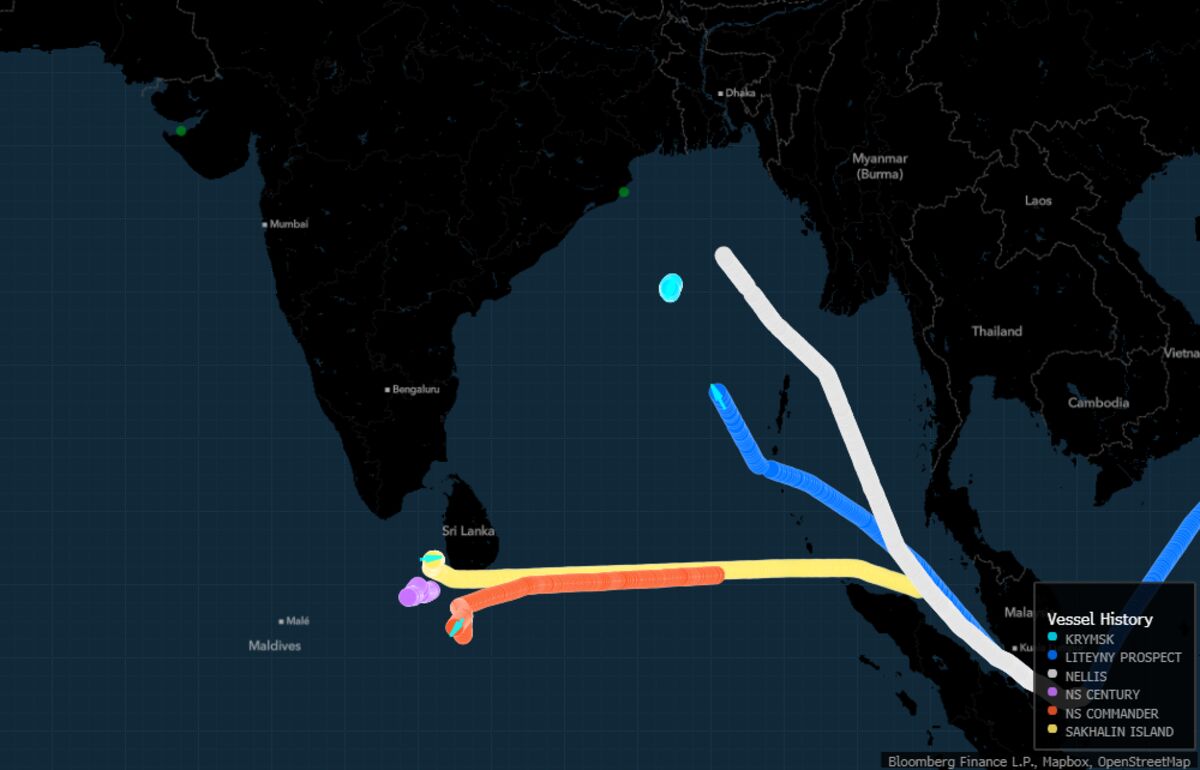
Almost five million barrels of Russia’s Sokol grade crude should have reached Indian refiners over the past four weeks.
None of it has got there, with tankers idling miles from their destinations — in one case for more than a month.
It’s unclear what’s holding the vessels up, but US sanctions on tankers hauling Russian crude in breach of a price cap imposed by the Group of Seven nations might be part of the cause.
The US Treasury sanctioned its first two ships tied to the Russian oil trade in mid-October. It followed with another three in mid-November and a further three at the start of December. Six of the eight sanctioned vessels are owned by Russia’s state tanker company Sovcomflot PJSC.

Video: Aid to Ukraine and the Future of the War with Michael Kofman


Vladimir Putin’s re-election campaign has prompted a fresh drive by Russian officials to curb inflation as disquiet grows over soaring prices for consumer goods and as technocrats move to rein in a weakening rouble.
The Kremlin is increasingly resorting to ad hoc measures aimed at lessening the burden on ordinary Russians, with Putin trumpeting a return to growth nearly two years after his full-scale invasion of Ukraine prompted Russia’s biggest economic crisis in decades.
Ahead of the president’s expected landslide victory in March, Russia’s inflation-fighting toolkit has included everything from hawkish central bank policy and a pause on exits from the country by western companies to what the Kremlin called “energetic measures” to lower the cost of eggs.

The effect of capital outflows on the rouble was so strong that Russia quietly paused approvals for western companies looking to leave the country this autumn, said people briefed on the situation.
A string of western companies have sought to offload their Russian arms since the country’s invasion of Ukraine last year and amid the subsequent sanctions imposed by the US and EU.
But in October, the government subcommittee responsible for allowing such owners to sell Russian businesses and transfer the funds abroad stopped issuing exit permits, four people involved in past and ongoing deals told the FT.
The suspension took place at the request of the central bank, said a person involved in the recent exits. It was restored after a month and a half, the people said. Russia’s finance ministry and central bank did not immediately respond to requests for comment.

Perceived inflation in Russia is higher than the official figure. Households reported inflation of up to 17 per cent — the highest level since October last year — when asked as part of central bank surveys, despite actual inflation being much lower.
The election next year is expected to be a heavily stage-managed event with no real competition for Putin, who is set to extend his rule of 24 years until at least 2030.
But continued price pressures are likely to force his officials to find more unorthodox ways to tame inflation and keep a lid on public resentment, said Konstantin Sonin, economist at the University of Chicago.
“Inflation is the most common cause for citizens’ discontent, hence the increased attention to these measures,” he said.


James asks what happened to the tanks that western governments promised to Ukraine?

Western nations sent around 200 modern tanks and hundreds more armoured vehicles to Ukraine for its highly anticipated summer offensive.

The hope was that Ukraine could use them to break through the heavily prepared Russian defences.

But within the first week of that offensive the losses started to mount. Around a dozen Leopard tanks and US supplied Bradley armoured vehicles were damaged or destroyed in just one day – trapped in dense Russian minefields backed up by artillery fire.

Newly formed Ukrainian mechanised brigades struggled to advance.

Rather than lose entire fleets of precious western armour, Ukraine switched tactics – often using dismounted infantry to try to clear a path through the mines.

It meant small incremental gains rather than a breakthrough.

Ukraine has continued to suffer losses, but not on the same scale as in the first weeks of its offensive.

It still has many of the Western tanks supplied – now bolstered by the arrival of 31 US Abrams tanks and more Leopards from Germany.

But without air support and more mine clearing technology, the western tanks are unlikely to make a decisive difference on the battlefield.

So far the greatest advantage of Western armour has made is in saving lives – giving Ukrainian troops better protection.

And so far Russia has lost more than 2,000 tanks – more than double Ukraine’s losses.
 

Earlier we reported Ukrainian Defence Minister Rustem Umerov saying Ukrainian men aged 25 to 60 living abroad would be expected to report for military service.

"We are still discussing what should happen if they don't come voluntarily," Umerov said.

But now the defence ministry's spokesman has denied that any obligation is involved.

"There is no discussion on the agenda of a call-up from abroad," Illarion Pavlyuk said, quoted by Ukrainian media.

"If citizens of Ukraine want to join [the army], they come to Ukraine to join."


Russian state media continue to portray the fighting in Ukraine as the West waging war on Russia - even though in February 2022 it was Russia that launched a full-scale invasion of Ukraine.

Many Russians are willing to accept, if not embrace, the official narrative. Why? Some believe that, however the war began, it’s their duty to rally round the flag.

For others it’s a case of life’s easier if you believe your country is in the right. But I’ve also met many Russians who try not to think too much about what’s happening, and try to get on with their lives.

My impression is that active supporters of the war – those 100% behind it – are in the minority. Certainly, going around Moscow today there are fewer letter Zs on display than in 2022 (Z being one of the symbols of Russia’s so-called "special military operation".)

Active opponents of the war are in a minority, too - though the threat of arrest and prosecution is a factor in restricting public protest.


Recent surveys suggest that more than half the Russian population wants peace talks. But there is no public pressure to pull out the troops.

As for the Russian authorities, they insist that any peace should be on Moscow’s terms.


Artillery shells fired across the river from the Russia-occupied bank of the Dnipro are the worst threat to residents of the southern Ukrainian city of Kherson, a local official says.

"People here don't worry about air raid alerts so much," Oleksandr Tolokonnikov, a spokesman for the Kherson regional administration, told Ukrainian TV this morning.


"Primarily we listen out for shells fired from the left bank. That's how we know that shells are on the way towards Kherson. People have 5-10 seconds to take cover."

He said Russia continues attacking energy infrastructure, such as power supply lines. Wood and wood-burners are being supplied to affected areas.

According to him, another target is public transport, particularly bus garages - this is similar to the north-eastern city of Kharkiv, where a tram and bus depot was hit yesterday.


On the front line in eastern Ukraine, the bleak mood among soldiers is in striking contrast to the last year’s elated atmosphere when the Kharkiv region and city of Kherson were liberated.

A company commander from the 93rd brigade told me Russian troops attack their positions at least twice a day. However, units that try to stop such attacks are running low on ammunition.

Some soldiers told me that they have to limit fire due to the lack of artillery shells.


Ukrainian troops on the front line have received new Western weapons, such as Swedish howitzer Archer and US-made M109 Paladin artillery systems. But soldiers say that those expensive guns will turn into scrap metal if they have no rounds to fire.

Winter creates new challenges for soldiers. Hypothermia is a new enemy. Low temperatures affect the hardware too – engine oil solidifies and some gun components can freeze.

Access to front line positions is now far more difficult, since roads are covered with snow or completely frozen.

Small cars struggle to reach remote posts. And, due to the constant threat of drones, it is too risky to deliver supplies on big trucks or armoured vehicles.
 

Germany has said it will provide an additional €88.5 million (about $97 million) to help maintain the Ukrainian energy system, which is a major target for Russian attacks.

A joint statement said the Economy Ministry was contributing €54.3 million via the state-owned bank KfW, while the Foreign Minister would give €34.2 million.

Attacks by Russian forces on Ukrainian energy infrastructure last winter caused large-scale blackouts, with Ukrainians struggling to stay warm amid very low temperatures.


Estonia is giving €350,000 for humanitarian aid and to help repair Ukraine's energy infrastructure this winter, the Ministry of Foreign Affairs said on Tuesday.


Ukraine's spies aim to intensify intelligence operations and conduct sabotage strikes deep in Russian-controlled territory next year to bring the war as close to the Kremlin as possible, the head of Ukraine's SBU security service told POLITICO.

“We cannot disclose our plans. They should remain a shocker for the enemy. We prepare surprises,” Major General Vasyl Malyuk said in written responses to questions. “The occupiers must understand that it will not be possible to hide. We will find the enemy everywhere.”

While he dodged specifics, Malyuk did give some hints. Logistics targets and military assets in occupied Ukrainian territory are likely to continue to be a focus. And then there are strikes that hit the enemy across the border.

“We are always looking for new solutions. So, cotton will continue to burn,” Malyuk joked.
Ukrainians use the word "cotton" to describe explosions in Russia and the occupied territories of Ukraine organized by Ukrainian special services. It came from Russian media and officials describing the growing number of such incidents with the word khlopok, which means both “blast” and “cotton” in Russian.


(1/4) In recent weeks, Ukraine has mobilised a concerted effort to improve field fortifications as its forces pivot to a more defensive posture along much of the front line.
(2/4) This follows Ukrainian President Volodymyr Zelenskyy's calls, from late November 2023, for faster fortification in key sectors.
(3/4) In one part of the project, Ukraine has worked to improve defences along its border with Belarus with dragon's teeth, razor wire, and anti-tank ditches as of mid-December 2023.
(4/4) Russia continues local offensive options in several sectors, but individual attacks are rarely above platoon size. A major Russian breakthrough is unlikely and overall, the front is characterised by stasis.
 

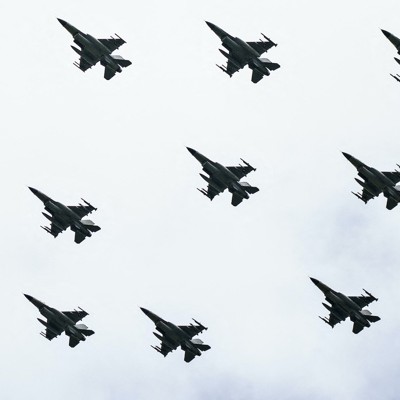
The Netherlands will deliver 18 F-16 fighter jets to Ukraine to help its battle against Russia's invasion, the Dutch government said on Friday.
"Today I informed President Zelenskiy of our government's decision to prepare an initial 18 F-16 fighter aircraft for delivery to Ukraine," caretaker Prime Minister Mark Rutte said in a post on social media platform X.
"The delivery of F-16s is one of the most important elements of the agreements made on military support for Ukraine."
The delivery of the fighter jets is still pending on an export permit by the Dutch ministry of Foreign Affairs and the fulfillment of criteria for staff and infrastructure in Ukraine, Rutte added without giving a timeline for these decisions.
But the announcement made it possible to reserve funds and people to prepare the planes for delivery, the government said.
"I spoke with Mark Rutte to thank the Dutch government for its decision to start preparing the initial 18 F-16 jets for their delivery to Ukraine," Ukrainian President Volodomyr Zelenskiy said on X.


The European Commission said it would provide 500 additional generators to Ukraine to keep vital services running in the war-torn nation.


The Biden administration will blacklist foreign financial institutions that support Russia’s military industrial complex as part of Washington’s efforts to starve Moscow’s war machine.
An executive order to be issued on Friday will enable the US to place sanctions on financial institutions helping Russia secure the equipment and other goods it needs to keep fighting in Ukraine. Banks under sanctions would be denied access to the US financial system.

One senior US official said Russia had spent “considerable time and resources” directing its intelligence services to find ways to evade sanctions and export controls. This included using “both witting and unwitting” financial intermediaries to circumvent restrictions and source critical components.
The Biden administration will work with US and European banks to inform them about the new rules and to make sure they communicate with their correspondent banks about how to avoid the new sanctions — or risk being cut off from the American financial system, the senior official said.
Examples of sensitive items that banks should avoid facilitating include semiconductors, machine tools, chemical precursors, ball bearings and optical systems, the official said.
“What we’re trying to do is go after materials that are key to Russia’s ability to build weapons of war,” a senior US administration official said.
“In order for them to get those materials, they need to use the financial system, which makes the financial system a potential choke point and this is a tool that’s targeted at that choke point.”


"I don't think the Ukrainian state has the resources to bring mobilization-aged people abroad back [to Ukraine]," commented International Center for Defense Studies (ICDS) director Indrek Kannik. "Perhaps one argument making these people – at least some of them – turn back is the fact that once this war is eventually over, people will certainly also consider who was where."

Military expert and MP Igor Taro (Eesti 200) says that this kind of chasing of people suggests that Ukraine is having issues with its mobilization. Taro added that it's beyond him why they would even search for people who left the country.

"It's not like Ukraine is a small country," he noted. "There are still tens of millions of inhabitants there, and the majority of them are in Ukraine. The majority of them are no longer abroad. The large flow of refugees we saw at one point has turned back. And in any case, even when these refugees went abroad, then there were very few men among them."
 

Russia is the more active side in the positional warfare taking place in Ukraine today and could conquer smaller settlements, while this does not amount to operational level success, Col. Tarmo Kundla said.

"The Russian Federation's forces have continued offensive operations all along the front and have found some success near Avdiivka and the villages north and south of the town. It is possible Avdiivka will fall, while it also depends on what Ukraine decides – whether to try and hold it or fall back. The city has not been surrounded yet," Col. Kundla said at a weekly briefing at the Ministry of Defense.

"Even if Russian troops manage to take the city, it will be a tactical victory with solid PR potential, while it will not provide them with major operational level success. It remains unlikely the Russian Federation will be able to seize larger swathes of territory in the Donetsk Oblast in the near future," the colonel said.


Should the Ukrainians pull out of Avdiivka to spare their troops, it will be no disaster as new defensive positions west of the city have already been prepared.

Kundla remarked that Russian forces could also take the settlement of Marinka south of Avdiivka in the coming weeks.

The colonel pointed to Ukrainian information according to which around 25,000 Russian troops have died in Donetsk over the last two months, 80 percent of them in battles around Avdiivka.

Heavy losses have forced the Russians to bring in units that used to be stationed abroad. "It is noteworthy and a clear attempt at making up for losses," Kundla remarked.

The colonel also said that Russia has been attempting to reclaim territory lost around Orikhiv in the south but without success. Ukrainian units are also holding on to their positions on the east bank of the Dnipro River.


"In summary, the war of attrition continues. Russia has the initiative and its units are finding tactical success in some areas of the front line, while it comes at a considerable cost. But it does not give them operational success," Kundla said.


An air defence battery shot down three Russian bombers in southern Ukraine, the Ukrainian military has claimed.
“Today, at noon, on the southern front, we destroyed three Russian Su-34 bomber aircraft,” Lieutenant General Mykola Oleshchuk, Commander of the Ukrainian Air Force, wrote on the Telegram messaging app.
Unconfirmed reports said the aircraft were hit by a Patriot surface-to-air missile defence system, supplied to the United States. It came as Japan, which has a licence to make the missile systems, was reported to be planning to relax its restrictions on arms exports, which could indirectly help Ukraine obtain more weapons.
Oleshchuk said the destruction of the three bombers was “our answer” after Ukrainian forces discovered a shard of a downed Shahed drone, fired by Russia, on which was written “Die, bitches!”
Ukrainian Telegram channels posted photographs said to show the parachute used by a pilot who ejected from one of the aircraft.


From President Zelensky to his military commanders and the residents of bombed-out villages, no one knows how many more years of war Ukraine will have to live through before Russia can be driven from its territory and stopped from bombarding its cities.
“Right now, a victory on the battlefield is extremely unlikely. This war could last for years and years. Russia has the resources for this and their people will put up with it,” said Colonel Roman Kostenko, a military commander and MP who is a member of the Ukrainian parliament’s national security, defence and intelligence committee.
The mood is one of grim acceptance rather than defeatism: there is no talk of surrendering to Russia. Yet the atmosphere is very different from this time last year, when a series of stunning successes for Ukraine’s army in the east and south of the country raised hopes of a swift triumph. However, President Putin, seemingly secure at home and brimming with a newfound confidence, is digging in for the long haul.
“We should hope for the best but prepare for the worst. That’s the reality of it,” said Sviatoslav Yurash, who at 27 is Ukraine’s youngest MP, as well as a private in the army. “When you see the front lines, when you see the casualties that we have, the battles we are forced to fight every step of the way, it’s clear that we are here for a long time,” he said after returning to Kyiv from the battlefield to vote in parliament.

Ukrainian generals said this week that Russia was on the offensive in the east of the country and that troops were being forced to downsize some military operations because of artillery shortages. “We can’t respond to everything the Russians are throwing at us. It’s as painful as hell,” said Yurash.
The scale of Ukraine’s casualties is classified but there is no longer any attempt to disguise that losses are huge. “I don’t even give the new guys call signs any more. Most of them don’t last long,” said a Ukrainian soldier in the Kharkiv region, speaking on the condition of anonymity.

Rustem Umerov, the Ukrainian defence minister, said this week that he did not believe that Washington would abandon Kyiv in its battle against “the forces of evil”. However, Kostenko, who is a commander fighting in the Kherson region, said that he doubted that any western weapons could now dislodge Putin’s troops from their heavily fortified defensive lines.
“I don’t think there is any weapon right now that can have a strong influence on the outcome of the war. ATACMS [army tactical missile systems] missiles can’t bring about a breakthrough. Warplanes? They can only help us achieve parity,” he said. “We are told we will get modern F-16 planes — but F-16s are from the 1970s and Russia has hundreds of 4 ++ generation fighters. I don’t understand who has it in their head that we can defeat Russia with dozens of F-16s.”

Although Kostenko insisted that Ukraine’s military campaign this year had been successful, considering the realities on the ground, he said that Kyiv’s realistic aim for next year should be to avoid losing any more of its territory and carry out as many strikes as possible against Russian naval and ground forces.
“We cannot afford to fight symmetrically with the Russians, go on attacks like the Russians, lose people like the Russians, or recruit people like they do. We need to look for ways where we lose ten times fewer people than they do. That’s the only way we have a chance because mathematically we will simply run out of people faster than they will.”

Zelensky said at his annual press conference on Tuesday that Ukraine’s army had asked for an additional 500,000 civilians to be mobilised to counter Russia’s offensives. At the start of Russia’s invasion last year, there were long queues at military recruitment offices as people sought to sign up to fight. Today, many of those initial volunteers have been killed or injured or are simply exhausted and Ukraine is struggling to replace them.
“Mobilisation is a very big challenge,” said Volodymyr Fesenko, a Ukrainian political analyst. “Many Ukrainians are patriotic but at the same time they are afraid for their relatives, for their children, and do not want them to fight.”

While Putin may seem to have the upper hand, events, particularly in this part of the world, often have a way of confounding expectations. Some Ukrainian officials now believe that a more likely end to the war is political instability in Moscow triggered by the scale of the country’s military casualties. As Alexander Pushkin, Russia’s 19th-century poet, put it: “God forbid that we should see a Russian rebellion, senseless and merciless.”
Yurash said: “The first thing you learn when you learn Russian history is that instability in Russia is not impossible. Moscow can be taken, just not by our armed forces per se, but by the Russians themselves. There are plenty of precedents for Russians changing or destroying their government.”
 

On the tarmac of a Moscow airport in late August, Yevgeny Prigozhin waited on his Embraer Legacy 600 for a safety check to finish before it could take off. The mercenary army chief was headed home to St. Petersburg with nine others onboard. Through the delay, no one inside the cabin noticed the small explosive device slipped under the wing.
When the jet finally left, it climbed for about 30 minutes to 28,000 feet, before the wing blew apart, sending the aircraft spiraling to the ground. All 10 people were killed, including Prigozhin, the owner of the Wagner paramilitary group.
The assassination of the warlord was two months in the making and approved by Russian President Vladimir Putin’s oldest ally and confidant, an ex-spy named Nikolai Patrushev, according to Western intelligence officials and a former Russian intelligence officer. The role of Patrushev as the driver of the plan to kill Prigozhin hasn’t been previously reported.
The Kremlin has denied involvement in Prigozhin’s death, and Putin offered the closest thing to an official explanation for the plane’s fiery crash, suggesting a hand grenade had detonated onboard.
None of that was true.
Hours after the incident, a European involved in intelligence gathering who maintained a backchannel of communication with the Kremlin and saw news of the crash asked an official there what had happened.
“He had to be removed,” the Kremlin official responded without hesitation.

In interviews with Western intelligence agencies, former U.S. and Russian security and intelligence officials, and former Kremlin officials, The Wall Street Journal unearthed new details about the mutiny and murder of Russia’s most powerful warlord and the previously unknown role of Patrushev in reasserting Putin’s authority over an increasingly unstable Russia.
Through the power of state-controlled media and his own persona, Putin has unsettled the West with his image as a determined adversary who rules Russia alone. In fact, he is kept in power by a vast bureaucracy that has proven durable through deepening hostilities with the West and rising domestic divisions over the botched invasion of Ukraine.
Controlling the levers of that machine is Patrushev. He has climbed to the top by interpreting Putin’s policies and carrying out his orders. Throughout Putin’s reign, he has expanded Russia’s security services and terrorized its enemies with assassinations at home and abroad. More recently his profile has grown, backing Russia’s invasion, and his son Dmitry, a former banker, has been appointed agriculture minister and is touted by some as a potential successor to Putin.

In Ukraine, Prigozhin threw his support behind Putin’s invasion, winning key battles, while hurling public criticism at Russia’s commanders for their military losses.
His social media tirades against Chief of General Staff Gen. Valery Gerasimov and Defense Minister Sergei Shoigu—combined with the successful advances of his troops in eastern Ukraine—got him noticed in Moscow and won him powerful enemies, including Patrushev.
In Prigozhin’s tirades against Shoigu, those inside the Kremlin saw Putin’s longtime tactic of keeping his subordinates divided by allowing feuds. But in the war, the warlord’s accumulation of power had made him a danger to the president.
“Everyone told Putin it was a mistake to have a parallel army,” said one former Kremlin official, who had at times worked with both Putin and Patrushev. “When he spits in the face of the military leadership every day—you have yourself a problem.”
Patrushev began to warn Putin about Prigozhin during the summer months of 2022. But the warnings fell on deaf ears while Wagner made progress on the battlefield.
That changed when Prigozhin called Putin and complained rudely about his lack of supplies, said the former Russian intelligence officer, who maintains ties to people close to Putin and his spy chief. Prigozhin needed guns and bullets and his men were dying in large numbers.
The call happened in October with others in the office, the former agent said, including Patrushev, who heard the former caterer scold the president. Later Patrushev would use the call as a reason Putin should distance himself: The warlord had become dangerous, with no respect for the Kremlin’s authority.

By December it was clear Patrushev had won. Even as Prigozhin publicly railed against the military and his lack of supplies, Putin ignored him. Calls went unanswered. By early June, the Kremlin effectively announced plans to dismantle Wagner as a fighting force in Ukraine, ordering its fighters to register with Russia’s defense ministry.
On Friday June 23, Prigozhin launched a mutiny, taking his 25,000 men and tanks from the battlefield in Ukraine and marched them toward the southern city of Rostov-on-Don to take the Russian armed forces’ southern military district headquarters. The plan, on what he called his “march of justice,” was to confront Gerasimov and Shoigu, who had been there for meetings but escaped before Prigozhin arrived.
Prigozhin sent another column of tanks and soldiers toward Moscow.
With Putin at a villa far outside of the city, Patrushev took over, organizing a flurry of phone calls to persuade Prigozhin to stand down, according to Western intelligence assessments and the former Russian intelligence officer.
Patrushev asked officers sympathetic to Prigozhin to try to get through to him. Five calls to Prigozhin from the Kremlin went unanswered. He also looked for mediators, and calls were made to the governments of Kazakhstan and Belarus, both members of a Russian-led military alliance made up of former Soviet states.
The call to Kazakhstan was insurance against a worst-case scenario. The year before, Russia had sent it troops to restore order after violent riots broke out. The hope now was Kazakhstan would return the favor if the Russian military couldn’t hold the rogue army back, said a Western intelligence official and the former Russian intelligence officer. But president Kassym Jomart Tokayev declined, having distanced himself after Russia’s invasion of Ukraine.

In the end, the president of Belarus, Alexander Lukashenko, said in a public statement at the time he agreed to help, calling Prigozhin multiple times over the course of more than six hours and ferrying messages between the warlord and Moscow. Ultimately, he delivered an offer hashed out by Patrushev: If Prigozhin turned his troops around, his men would be allowed to decamp to Belarus.
Lukashenko had several rounds of talks with Prigozhin, as well as Putin, his press service said in a statement to the Journal. “The talks delivered success,” the statement said.
In a late morning television appearance, Putin called Prigozhin and the Wagner leadership traitors, helping persuade him to take the offer, which included retaining control of his overseas operations, such as those in Africa.
While Prigozhin and his fighters hadn’t encountered active resistance from the military, most units they encountered weren’t joining them either. By early Saturday evening, Prigozhin’s mutiny had come to an end.
Prigozhin’s fighters who were heading toward Moscow stopped and some began marching toward camps putatively prepared for them in Belarus. Prigozhin himself disappeared from social media.
For the rest of the summer, an uneasiness settled on Moscow. Few in the Kremlin believed that Prigozhin would get away with an armed mutiny with no consequences.
Patrushev would prove them right.

After the mutiny, the Kremlin did little publicly to limit Prigozhin’s life. He traveled to Africa to check in on his operations there. He was also allowed to continue working in St. Petersburg and around Russia, said Maksim Shugaley, who worked for Prigozhin at a think tank. But, he said, Prigozhin was wary.
“He knew he had enemies and that something could happen to him, but as far as he was concerned he was abiding by the deal,” Shugaley said.

Mowatt-Larssen, the former CIA station chief, said that Prigozhin might have appeared to be free, when in fact he was being closely watched. His mutiny had exposed a deep rift in Putin’s system of running the country, as well as dissatisfaction in the military, which had done little to oppose his march, he said.
“You can see what Putin’s plan was—to keep the dead man walking so they could continue to find out what happened,” he said, meaning the Kremlin was looking for Prigozhin’s collaborators.
In the beginning of August, as most of Moscow went on vacation, Patrushev, in his office in central Moscow, gave orders to his assistant to proceed in shaping an operation to dispose of Prigozhin, said the former Russian intelligence officer. Putin was later shown the plans and didn’t object, Western intelligence agencies said.
Several weeks later, following his tour through Africa, Prigozhin was waiting at a Moscow airport while safety inspectors finished a check on the plane. It was during this delay that a small bomb was placed under the wing, said Western intelligence officials.
 

Low-quality shells supplied to Russia by North Korea are injuring its own troops and damaging artillery, Ukraine says​

Story by ashoaib@insider.com (Alia Shoaib)

  • North Korea has sent Russia large quantities of artillery shells.
  • Some are defective, causing damage to weapons and injuring Russian soldiers, Ukraine's army said.
  • Experts have questioned the quality of North Korean ammunition.
Russia is using low-quality artillery shells from North Korea that are often defective and cause problems on the front lines, Ukraine's army said.

In some cases, the North Korean-supplied shells are damaging the barrels of cannons and mortars and are even injuring soldiers.

It is particularly a problem in the "Dnepr" grouping of forces operating around the southern Kherson region under the command of Col. Gen. Mikhail Teplinsky, according to Ukraine's army.

Teplinsky, the commander of Moscow's Airborne Forces, or VDV, was recently put in charge of the area, where fighting has been raging in recent weeks.

North Korea, one of Russia's few international allies, has sent large it quantities of ammunition. One South Korean lawmaker estimated that Pyongyang had sent at least a million shells, per Politico.

Russian Defense Minister Sergei Shoigu visited North Korea in August to ask for ammunition amid reports that Russian forces were suffering from shortages.

Defense expert Trevor Taylor from the London-based Royal United Services Institute for Defence and Security Studies previously told Politico that it was unclear whether the North Korean ammunition was of a reliable quality.

"North Korea runs a war economy, which we don't," Taylor said. "But whether the ammunition they are supplying is at the standard of reliability and safety that the Europeans would adhere to is another question."

Meanwhile, fears are also growing of a Ukrainian shell famine as Western military aid shows signs of faltering.

During its counteroffensive in the summer, Ukrainian forces were burning through artillery shells at a rate of about 7,000 rounds a day, according to figures from Estonia's defense ministry.

The Kiel Institute, which has tracked aid promised and sent to Ukraine, said in an update earlier this month that while the new US aid package was delayed to next year, the EU's commitment to supply one million rounds of ammunition has stalled.

Israel's war with Hamas could also divert tens of thousands of artillery rounds intended for Ukraine, Axios reported in October.
 

The German ambassador in Moscow, Alexander Graf Lambsdorff, sees no change in Russian President Vladimir Putin's stance on the war in Ukraine.

"Putin has just reaffirmed his war aims," Lambsdorff told the German media outlet Redaktionsnetzwerk Deutschland. "He is not at all willing to negotiate."

There is no indication that Putin will change his stance after the presidential election in March 2024, he added.

According to the diplomat, there are also no signs that Putin could be replaced. Putin's re-election is to be expected, Lambsdorff said. He does not see any cracks in Putin's regime at the moment.

Nor could the German ambassador see "any indication" that the Russian leader's health "might not be good."


Ukraine's ambassador to Germany on Saturday rejected claims that Berlin may be pressuring Kyiv behind closed doors to reach a peace deal with Russia.

The speculation has been fueled by a report in the German magazine Der Spiegel on Friday about a secret "Russia dinner" in the German embassy in Washington in late October, during which German Chancellor Olaf Scholz's closest aide, the head of the chancellery Wolfgang Schmidt, reportedly "euphorically praised" a proposal by U.S. think tanker Samuel Charap to end the war in Ukraine through an imposed negotiated settlement with Moscow.

In a podcast interview with the German public broadcaster RRB, Oleksii Makeiev, the Ukrainian ambassador in Berlin, denied the German government was pushing Kyiv to accept peace talks with Russia that could lead to a permanent loss of Ukrainian territory. The pressure was "also not" happening behind closed doors, Makeiev added.

An official from the German chancellery told POLITICO that Schmidt rejects the "unfounded assertions" in the Spiegel report.


Hackers shut down internet connections in Russian-occupied parts of eastern Ukraine in late October. In some areas, it took Russian telecom providers days to restore connectivity.

Soon after, the IT Army of Ukraine took credit for the cyberattack. The hacker group is the most prominent example of several volunteer "hackivist" groups that have mobilized to support Ukraine in cyberspace.

The covert nature of their operations, many of which are illegal, makes it impossible to fully assess the scope of such groups. But cybersecurity researchers agree that their activities have impacted the war since Russia began its full-scale invasion in February 2022.

"The aim is to discredit the Russian state, to show that it can't protect the services of Russian businesses," said Stefan Soesanto, the head of the cyberdefense project at the Center for Security Studies at ETH Zürich, a Swiss university. "In that sense, they have a real impact, in particular on the psyche of people in Russia."

He added that throughout the war, the activities of groups like the IT Army have become more sophisticated, shifting their focus to fewer but more targeted operations.


The Ukrainian police have arrested a senior Defense Ministry official on suspicions that he embezzled nearly $40 million as part of a fraudulent purchase of artillery shells for Ukraine’s military.
The Ukrainian authorities have been working to clean up the ministry since reports of graft and financial mismanagement led to the removal in September of the minister at the time. Ukraine’s security service announced the arrest of the senior official, whose name was not released, on Friday.
President Volodymyr Zelensky of Ukraine has also made tackling corruption one of his key wartime goals, not only to reassure Ukraine’s Western allies that their billions of dollars in aid are not being siphoned off, but also to ensure an efficient allocation of resources as the country’s military runs short on weapons and ammunition in its fight to fend off Russia’s forces.
 

There are a number of different models for how Russia’s immobilized reserves could be put to use. Daleep Singh, a former top Biden administration official, suggested that the funds should be placed in an escrow account that Ukraine could have access to and be used as collateral for Ukrainian government bonds. Others have argued that countries that hold Russian assets can legally cancel their obligations to Russia and use those assets to pay for what Russia owes for its breach of international law. The go-to precedent is Iraq’s invasion of Kuwait in 1990, where $50 billion in Iraqi funds were seized to compensate Iraq’s victims. Some U.S. and European officials have also backed a plan to pass the profits Russia’s frozen assets are generating on to Kyiv.

Confiscating Russian assets “would create more problems than it would solve,” Bloomberg’s editorial board wrote, setting a dubious legal precedent that could undermine the international economic order. It might also cross a line by showing countries such as China or Saudi Arabia that Western securities depositories may not always be safe. But if non-Western governments were to panic at the seizure of Russian assets and pull out their reserves, they would have done so when the funds were first seized, one Financial Times columnist argued – or when the G7 said the accounts would not be unlocked until Russia compensated Ukraine. Neither event sparked a flight of assets out of the West.


Russian forces have scored small territorial gains along Ukraine’s eastern front in recent weeks, using their manpower advantage in grueling battles and prompting the Ukrainian authorities to consider a push to mobilize up to 500,000 soldiers to sustain the exhausting fight next year.

Nonetheless, Russia’s incremental gains largely result from the sheer mass of its army.
“I would say the motto of their attacks is ‘We have more people than you have ammunition, bullets, rockets, and shells,’” Tykhyi, a major fighting with the Ukrainian National Guard in Avdiivka, said in audio messages, using only his call sign to identify himself, as per Ukrainian military rules.
Tykhyi said Russian forces were using a range of tactics on the battlefield, including frontal assaults, feigned attacks and smoke to hide attacks. He added that Russia was monitoring movements into Avdiivka, meaning that Ukrainian soldiers can enter only at night and “have to turn off their headlights long before” getting in.

Thibault Fouillet, the deputy director of the Institute for Strategic and Defense Studies, a French research center, said both sides were now locked in bloody, inconclusive fighting — a situation that he compared to World War I, when hundreds of thousands of soldiers were thrown onto the battlefield to conquer and defend small patches of land.
Russia’s brutal offensive operations, from Bakhmut earlier this year to Avdiivka today, have enabled it to conquer more land than it has lost in 2023, according to a recent analysis by Estonia’s Ministry of Defense. But much like Ukraine’s limited successes during its counteroffensive, none of these gains have fundamentally changed the balance of power along a front line that has barely moved this year.
Mr. Fouillet said that each side was now hailing the slightest gain as a strategic success for political purposes. “In reality,” he added, “the stakes are low, and the advances are minimal.”


Ukrainian forces are suffering from a shortage of artillery shells on the front line, prompting some units to cancel planned assaults, soldiers said this week, and stoking fears over how long Kyiv’s troops will be able to hold their ground against continuing Russian attacks.
The ammunition shortage is deepening the already palpable anxiety in the Ukrainian capital, as U.S. and European aid stalls and winter sets in.
“Our gunners are given a limit of shells for each target,” said a member of the 128th Mountain Assault Brigade, which is fighting in the southeastern Zaporizhzhia region.
“If the target there is smaller — for example, a mortar position — then they give five or seven shells in total,” he said, speaking on the condition of anonymity because of the sensitivity of the subject.
“The guys are tired — very tired,” he said. “They are still motivated — many people understand that they have no other choice.”
“But you can’t win a war only on motivation,” he continued. “You should have some kind of a numerical advantage, and with the weapons and weapons systems, it only gets worse and worse. How long can we last? It’s hard to say, but it can’t be long. Everyone understands this.”
Artem, 31, a gunner in the 148th Artillery Brigade who fires a 155mm howitzer, said his unit found a “dramatic” difference in stocks of shells after recently relocating from the southern front in Zaporizhzhia to positions in the east.
Artem said his unit was now firing just 10 to 20 shells per day at enemy targets, while previously it used an average of 50 shells, and sometimes up to 90. He spoke on the condition that he be identified only by first name in keeping with Ukrainian military rules.
“If the situation doesn’t change, or even worsens, we will not be able to suppress them and they will push us back,” Artem said. “What can you do with 10 shells per day? It is barely enough to respond to their advances — we are not even talking about attacking their positions.”

Ukrainian soldiers stationed at the front said they have not detected any sign that Russia is facing a similar shortage of artillery shells.

But Ukrainian troops here say they need more of everything, and fast.
“We lack everything,” said the member of 128th Mountain Assault Brigade.
Ivan Zadontsev, a press officer for the 24th Separate Assault Battalion, also known as Aidar, said it had reduced firing by about 90 percent compared with last summer. His battalion needs 122mm munitions for Soviet-era howitzers; Western partners have tried to procure the ammunition for Ukraine throughout the war.

Aidar’s tactics changed around mid-autumn as deliveries of munitions diminished. Although the battalion has faced artillery shell shortages in the past, there are concerns now that reserves will not be replenished.
Like the 148th Artillery Brigade, Aidar is trying to hold defensive lines in the east, near the town of Klishchiivka, which Ukrainian forces liberated from Russian occupation in September. But Zadontsev said that to plan any further assaults “would be stupid … while the Russian army has artillery superiority.”
 

President Vladimir V. Putin’s confidence seems to know no bounds.
Buoyed by Ukraine’s failed counteroffensive and flagging Western support, Mr. Putin says that Russia’s war goals have not changed. Addressing his generals on Tuesday, he boasted that Ukraine was so beleaguered that Russia’s invading troops were doing “what we want.”
“We won’t give up what’s ours,” he pledged, adding dismissively, “If they want to negotiate, let them negotiate.”
But in a recent push of back-channel diplomacy, Mr. Putin has been sending a different message: He is ready to make a deal.
Mr. Putin has been signaling through intermediaries since at least September that he is open to a cease-fire that freezes the fighting along the current lines, far short of his ambitions to dominate Ukraine, two former senior Russian officials close to the Kremlin and American and international officials who have received the message from Mr. Putin’s envoys say.
In fact, Mr. Putin also sent out feelers for a cease-fire deal a year earlier, in the fall of 2022, according to American officials. That quiet overture, not previously reported, came after Ukraine routed Russia’s army in the country’s northeast. Mr. Putin indicated that he was satisfied with Russia’s captured territory and ready for an armistice, they said.

Mr. Putin’s repeated interest in a cease-fire is an example of how opportunism and improvisation have defined his approach to the war behind closed doors. Dozens of interviews with Russians who have long known him and with international officials with insight into the Kremlin’s inner workings show a leader maneuvering to reduce risks and keep his options open in a war that has lasted longer than he expected. While deploying fiery public rhetoric, Mr. Putin privately telegraphs a desire to declare victory and move on.
“They say, ‘We are ready to have negotiations on a cease-fire,’” said one senior international official who met with top Russian officials this fall. “They want to stay where they are on the battlefield.”
There is no evidence that Ukraine’s leaders, who have pledged to retake all their territory, will accept such a deal. Some American officials say it could be a familiar Kremlin attempt at misdirection and does not reflect genuine willingness by Mr. Putin to compromise. The former Russian officials add that Mr. Putin could well change his mind again if Russian forces gain momentum.

In the past 16 months, Mr. Putin swallowed multiple humiliations — embarrassing retreats, a once-friendly warlord’s mutiny — before he arrived at his current state of relaxed confidence. All along, he waged a war that has killed or maimed hundreds of thousands while exhibiting contradictions that have become hallmarks of his rule.
While obsessed with Russia’s battlefield performance and what he sees as his historic mission to retake “original Russian lands,” he has been keen for most Russians to go on with normal life. While readying Russia for years of war, he is quietly trying to make it clear that he is ready to end it.
“He really is willing to stop at the current positions,” one of the former senior Russian officials told The New York Times, relaying a message he said the Kremlin was quietly sending. The former official added, “He’s not willing to retreat one meter.”
Mr. Putin, the current and former officials said, sees a confluence of factors creating an opportune moment for a deal: a battlefield that seems stuck in a stalemate, the fallout over Ukraine’s disappointing offensive, its flagging support in the West, and, since October, the distraction of the war in Gaza. The officials spoke on the condition of anonymity, like others interviewed for this article, because of the sensitive nature of the back-channel overtures.


With all respect to the authors of this article, I believe they have drawn incorrect conclusions. According to their sources, they suggest Putin is ready for a ceasefire, implying he wishes to maintain the current battlefield positions and is seeking an exit strategy. However, from my understanding, this is not the case. Putin's real aim is not to end the conflict but to halt Ukrainian military resistance, which hinges on the cessation of Western arms supplies. His objective is to confront Ukraine without Western aid, thus moving closer to achieving Kiev's capitulation. The article's authors seem to misinterpret Putin's goals; he has no intention of stopping at the territories Russia has already taken. And the conflict itself is not merely about territorial gains, but about the geopolitical future of Ukraine. I see no indication of his intention to abandon this goal. An important caveat, however, is that his strategy is not to enforce capitulation through large-scale military operations, but rather to create the necessary conditions for it. That's the underlying reason they need a ceasefire. I explain it in detail in my latest Bulletin, exceptionally accessible for free. https://rpolitik.com/wp-content/uploads/woocommerce_uploads/2023/12/Bulletin-No.-22-130-2023.pdf…


On Ukraine’s frontlines, how fast you can spot a buzzing enemy quadcopter can determine whether you survive an imminent artillery barrage or an attack by the drone itself. That’s driven intense demand for the low-budget drone detectors cobbled together by Ukrainian software engineers-turned-defense entrepreneurs.

“Every smart person uses” drone detectors, said Yaroslav Markevich, a drone commander in Ukraine's Khartia battalion.

But not everyone who wants one can get one. The devices are manufactured primarily by start-up companies that lack the funding and experience to keep up with demand, and that rely on volunteers—like so much of Ukraine’s wartime defense production.

Drones are ubiquitous across the frontline in Ukraine, from sophisticated military-grade surveillance aircraft to cheap suicide quadcopters. Both Russia and Ukraine likely field at least 50,000 first-person-view (FPV) suicide drones per month, said Samuel Bendett of the Center for Naval Analysis. Next year, Ukraine hopes to produce one million FPV drones, which would effectively double Bendett’s assessment of the current monthly rate of production.

The drones are deadly. At least one out of every five Ukrainian FPV drones hits its target, said Ihor Dvoretskyi, a project manager with Ukraine’s Defense Ministry.

And if a Russian Orlan artillery-spotting drone notices you, “you have three minutes to do something,” said Dmytro, a founder of drone-detecting company Kseonics.

In response to the threat, Ukrainian software engineers have thrown themselves into learning everything from electronic warfare to soldering in order to build drone-detecting devices. Many devices are cheap, costing less than $250 for handheld models, and upwards of $400 for more sophisticated stationary models.

Another Dmytro, the founder of prominent drone-detecting company Drone Spices, first responded to Russia’s full-scale invasion by ginning up psychological operations. Using lists of phone numbers purchased online, he sent text messages to Russian soldiers fighting in Ukraine encouraging them to stop.

But Dmytro found that his texts were “pointless,” he said, because most Russian soldiers believed totally in the war. After other projects, he switched to trying his hand at building drone detectors.

At the time, some Ukrainian soldiers were using software-defined radios like the HackRF to scan the electromagnetic spectrum for telltale signals. Such devices, like the RTL SDR, cost just $34, but weren’t made for military use; they drained batteries, required laptops, and couldn’t tell drones from other emitters, Dmytro said.

Other options, like foreign-made systems, could cost $10,000 to $20,000—too expensive for Ukraine, he said. They were also only capable of identifying commercial drones, not Russian military drones.

Dmytro began by reverse-engineering the Orlan-10, widely used by Russian forces to coordinate artillery. Ukraine had downed a number of the drones, and pictures of its cheap, commercially available components were available in Ukrainian social media forums.

Using his reverse-engineered Orlan, Dmytro designed a drone detector. A software engineer by training with no hardware background, he first attempted to use a sugar box for a case.

The design was a failure, but inspired the company’s name and product line, including detectors such as “Candy” for Orlans, “Salt,” which scans for Russian’s cell signals, and “Cinnamon,” a detector for the popular DJI-brand drones. Each sells for less than $100, which Dmytro said pays for the cost of materials and labor.


Other founders, meanwhile, focused on the commercial photography and racing drones that Russia was using to cause havoc.

Kara Dag, co-founded by tech entrepreneurs Ivan and Eric, produces handheld sensors that can detect a drone up to 2.4 miles away, send out a vibrating alert, and tell users what direction it’s coming from.

Unlike some drone detectors, Kara Dag uses artificial intelligence to help identify a drone’s signals—even if the drone has not previously been identified or if its emission pattern is disrupted by its speed or other factors.


The detectors can also recognize Ukrainian drones by taking data from Russian social media channels that share information about Ukrainian drones, Ivan said.
 

Germany's Foreign Minister Annalena Baerbock reiterated her country's continued support for Ukraine, during an interview with the Potsdamer Neusten Nachrichten.

"The fact that Putin's original plan to capture Kyiv and murder, displace or subjugate over 40 million people has not been successful is due to the incredible bravery of Ukrainians who are determined to defend their country," she said.

And it was also due to "our support as well as that of so many other countries, who are doing what's human:

Helping the victim, instead of turning a blind eye, which would help the aggressor," Baerbock added.

She added that Putin is "deliberately attacking power plants, electricity distribution centers and power lines so that the water supply freezes at minus 10 degrees Celsius and people die of thirst and freeze to death."

"He wants to destroy Ukraine, and that's why we will support it as long as it needs us."


Russia launched 15 drones at Ukraine, mostly in the south of the country, overnight with air defences destroying 14 of them, Ukrainian military said on Sunday.
"As a result of air combat, Ukraine's Air Force and defence forces destroyed 14 shaheds in Mykolaiv, Kirovohrad, Zaporizhzhia, Dnipro and Khmelnytskyi regions," the Ukrainian Air Force said on the Telegram messaging app.
The drones were launched from the eastern coast of the Sea of Azov in Russia, it said.


“Nobody said that air defense would win a conflict, but its absence will lose one,” said Tom Karako, the director of the Missile Defense Project at the Center for Strategic and International Studies, a think tank.

Among Ukraine’s most sophisticated air-defense systems are five long-range Patriot batteries, made by RTX, sent by the U.S., Germany and the Netherlands. Kyiv also has a SAMP/T system, made by European missile specialist MBDA, that was sent by France. Both those Western systems are capable of hitting targets about 60 miles away.
These long-range systems are what Ukraine needs most, according to Philip Breedlove, a retired U.S. Air Force general, who added that the West hasn’t given enough.
“Look at how big Ukraine is and how much they have to defend,” he said.
Most of Ukraine’s Western air-defense systems have middle distance ranges of up to around 25 miles. Those include a number of U.S. Hawk systems, at least 20 Nasams, sent by the U.S., Lithuania and Norway, and at least five of Germany’s Iris-T.
Ukraine’s shorter-distance air defenses include at least 50 Gepards, a tracked radar-operated cannon, and missiles such as the U.S. Stinger and Britain’s Starstreak.
Kyiv also uses Soviet-era long and middle-range systems. While these have been broadly successful, their stock of missiles has been depleted, according to IISS. That has prompted Ukraine and the U.S. to convert some old Soviet launchers to fire Western missiles.
Such an array of different systems could make Ukraine’s air defenses less effective, analysts say. Militaries typically integrate their air defenses.
“You need integrated fire control, so something that controls everything, that says you shoot, you don’t shoot,” said Karako, the Missile Defense Project director.

On a recent evening outside of Kyiv, Ruda’s unit—named Mriya, Ukrainian for dream—watched the sky for Shaheds, a type of Iranian drone used by Russia that slams into its target.
Dressed in bulletproof vests and helmets the team works 24-hour shifts, within which members are given time to rest. The team uses night scopes, thermal imagers and tablets that relay a drone’s journey. Still, in one indication of how rudimentary Ukraine’s defense can be in this otherwise high-tech aerial battle, spotlights track the team’s airborne prey—evocative of World War II-era bombing raids.
The unit fires a range of dated weapons, including a 1933-made copy of a British Maxim gun.
Ukraine was originally caught off guard by the profusion of Shahed drones, and as air defenses improved, Russia has adapted its tactics.
“Shahed used to fly in a straight line and now they change direction and come from different sides,” said Serhiy Sas, 67, a former judge who helped put the Mriya unit together early in the war.
Russia has also started painting the drones black to make them harder to spot and covering them in carbon that can deflect radar waves, said Sas and Ihnat, the Air Force spokesman.


“Russia has launched about 7,400 missiles and 3,700 Shahed attack drones at targets in Ukraine during its 22-month-old invasion, Kyiv said on Thursday…Ukrainian air defences were able to shoot down 1,600 of the missiles and 2,900 of the drones”
 

Commander of the Ukrainian Air Force, Lieutenant General Mykola Oleschuk, says his forces downed another Russian jet. “It has been confirmed that our anti-aircraft missile system hit an Su-34 fighter-bomber in the direction of Mariupol… Merry Christmas!”

Insane story:

He Was Ready to Die, but Not to Surrender:
How a Ukrainian soldier escaped from the embattled Azovstal steel complex in Mariupol and sneaked 125 miles to Ukrainian territory.

After seven days hiding in a dank and dark tunnel deep in the bowels of the sprawling Azovstal steel plant in Mariupol as the city burned around him, Pfc. Oleksandr Ivantsov was on the verge of collapse.
President Volodymyr Zelensky had ordered Ukrainian soldiers to lay down their weapons after 80 days of resistance and surrender. But Private Ivantsov had other ideas.
“When I signed up for this mission, I realized that most likely I would die,” he recalled. “I was ready to die in battle, but morally I was not ready to surrender.”
He knew his plan might sound a little crazy, but at the time, he was convinced he had a better chance of surviving by hiding out than by surrendering himself to Russians, whose widespread abuse of prisoners of war was well known to Ukrainian troops.
So he knocked a hole in a wall to get to a small tunnel, stashed some supplies and made plans to stay hidden for 10 days, hoping that the Russians who had taken control of the ruined plant would let down their guard by then, allowing him to creep through the ruins unnoticed and make his way into the city he once called home.
But after a week, he had gone through the six cans of stewed chicken and 10 cans of sardines and almost all of the eight 1.5 liter bottles of water he had secreted away.
“I felt very bad, I was dehydrated, and my thoughts were getting confused,” he said. “I realized that I had to leave because I could not live there for three more days.”
Mr. Ivantsov’s account of his escape from Azovstal is supported by photographs and videos from the city and factory that he shared with The New York Times. It was verified by superior officers and by medical records documenting his treatment after he made it to Ukrainian-controlled territory. Still, his tale seemed so far-fetched that Ukraine’s security services made him take a polygraph test to assure them he was not a double agent.


European Union (EU) Foreign Affairs High Representative Josep Borrell stated that Russian President Vladimir Putin is not interested in a limited territorial victory in Ukraine and will continue the war “until the final victory.”[1] Borrell reported on December 24 that Putin would not be satisfied with capturing a “piece” of Ukraine and allowing the rest of Ukraine to join the EU.[2] Borrell added that Putin will not “give up the war” and called on the West to prepare for a “conflict of high intensity for a long time.”[3] Borrell’s statements are consistent with ISW’s assessment that Russia is not interested in a ceasefire or good-faith negotiations with Ukraine but retains its maximalist goals of a full Russian victory in Ukraine.[4]

Russian forces are reportedly decreasing aviation activity and their use of glide bombs in Ukraine after Ukrainian forces shot down three Russian Su-34s in southern Ukraine between December 21 and 22. Ukrainian Air Force Spokesperson Colonel Yuriy Ihnat stated on December 24 that Russian forces decreased their use of glide bombs and air strikes in southern Ukraine.[5] Ukrainian military observer Kostyantyn Mashovets stated on December 24 that Russian forces are limiting their use of manned aviation near occupied Crimea, particularly in the northwestern Black Sea region.[6] ISW previously assessed that Russian forces may have recently intensified their use of glide bombs against Ukrainian forces on the west (right) bank of the Dnipro River in part because Ukrainian forces reportedly suppressed Russian long-range artillery in the area.[7] Continued decreased Russian glide bomb strikes in Kherson Oblast may present an opportunity for Ukrainian forces to operate more freely in near rear areas in west bank Kherson Oblast and establish a safer position on the east (left) bank from which to conduct future operations if the Ukrainian high command so chose. Russian forces reportedly use glide bomb strikes so that Russian aircraft can remain 50 to 70 kilometers behind the line of combat engagement, and the decreased Russian use of glide bombs suggests that Russian forces are concerned about Ukrainian air defense capabilities following recent losses.[8] Ukrainian Ground Forces Spokesperson Lieutenant Colonel Volodymyr Fityo stated on December 23 that Russian forces also reduced their use of aviation and increased their use of strike drones in the Kupyansk and Bakhmut directions.[9] Ihnat also stated on December 24 that Ukrainian forces can deploy air defense systems in any direction, not only in those where Russian forces suffered aircraft loses.[10]

Russia appears to be continuing its efforts to build out a military occupation force in Ukraine separate from its frontline units through the use of its newly formed Rosgvardia units. Ukrainian military observer Kostyantyn Mashovets reported on December 24 that the Russian command completed the deployment of the three newly formed regiments of Rosgvardia’s 116th Special Purpose Brigade — the 900th, 901st, and 902nd Special Purpose Regiments — to occupied Donetsk Oblast.[29] Mashovets stated that the Russian command based the 116th Special Purpose Brigade in Chystiakove (70km east of Donetsk City); the 900th Special Purpose Regiment in Melekyne (22km southwest of Mariupol); the 901st Special Purpose Regiment in Snizhne (80km east of Donetsk City); and the 902nd Special Purpose Regiment seven kilometers north of Chystiakove. Mashovets assessed that the 116th Special Purpose Brigade will perform “stabilization functions” in occupied Ukraine on a “permanent basis.” Russian local media reported that Rosgvardia began forming the 116th Special Purpose Brigade specifically for service in occupied Donetsk Oblast in early September 2023.[30] ISW later observed in late October that the 116th Special Purpose Brigade received a Russian T-80BV tank that Wagner Group fighters used in the June 2023 armed rebellion.[31]

The short timeframe and the deployment locations of the new Rosgvardia regiments indicate that the Kremlin is actively attempting to use these forces to solidify Russia’s control over occupied rear areas. Mashovets observed that Rosgvardia likely moved up to 6,000 troops from Russia to occupied Ukraine as part of the deployment of the 116th Special Purpose Brigade, increasing the number of Rosgvardia personnel in occupied Ukraine to 34,300 troops. While ISW cannot independently verify Mashovets’ number of deployed Rosgvardia personnel in occupied Ukraine, Russia’s recent efforts to legalize Rosgvardia’s access to recruiting volunteers, the Kremlin’s approval to provide Rosgvardia heavy military equipment, and the 116th Special Purpose Brigade’s basing in occupied Donetsk Oblast are indicators that Russia is attempting to expand Rosgvardia forces to establish a separate military occupation force.[32] Moscow is likely trying to recruit and deploy military occupation forces to further impede Ukraine’s counteroffensive efforts, establish permanent control over occupied areas, and suppress partisan activity without fixing frontline troops in occupation duty indefinitely.

Russia’s labor shortage, which is partially a result of the war in Ukraine, reportedly amounted to about 4.8 million people in 2023 and will likely continue to exacerbate struggling Kremlin efforts aimed at increasing Russian economic capacity. Kremlin-affiliated outlet Izvestiya reported on December 24 that according to the Institute of Economics of the Russian Academy of Sciences, Russian Federal State Statistics Service (Rosstat) data indicates that the number of workers needed to fill vacant positions in mid-2023 was 6.8% of the total number of employed people, amounting to about 4.8 million people across Russia.[38] Russian President Vladimir Putin noted the connection between labor shortages and the development of Russia’s migrant policy on December 4.[39] ISW continues to assess that the Kremlin is struggling to reconcile inconsistent and contradictory policies that attempt to appease the Russian ultranationalist community by disincentivizing migrant workers from working in Russia while simultaneously trying to increase Russian industrial capacity and force generation.[40]
 
If Russia does eventually conquer Kiev, the insurgency and toll on the occupying forces will be horrific. The Russians will continue to bleed for years to come no matter the outcome in 2024.
 

Any significant damage to the ship will be a welcome bit of good news for Ukraine, with waning Western support now affecting its front-line operations. Given that the Novocherkassk was in dock, it is highly likely it was being loaded with soldiers, equipment or both.
Patrick Bury, a security and defence expert and former Nato analyst, told the BBC News Channel there was speculation that the ship was carrying Iranian-made Shahed drones, which Russia has been using in its attacks on Ukrainian targets.
Speaking on Ukrainian TV, the head of the press centre for Ukraine's southern command, Nataliya Humenyuk, said it was "clear that such a large detonation was caused by more than just the fuel or ammunition of the ship itself".


Ukraine's commander-in-chief said on Tuesday, December 26, that his forces had pulled back to the outskirts of the town of Marinka, a day after Moscow claimed full control of the key town.
"We have now moved to the outskirts of Marinka, and in some places already beyond the boundaries of the settlement," Valeriy Zaluzhny told reporters in Kyiv. Marinka is close to the key Russian-held city of Donetsk in east Ukraine. "We protect every piece of our land but the lives of our soldiers are more important to us," Zaluzhny said, adding that in any case the town "no longer exists" after being destroyed "street by street" by the Russians. Of the troop move, he said: "There is nothing in this that can cause a public outcry."

On Monday, Russian Defence Minister Sergei Shoigu said Russian forces had "completely" captured Marinka, speaking at a meeting with President Vladimir Putin shown on state television. Piles of rubble and gutted apartment buildings over a wide area could be seen in drone images shown on Russian television that were said to be of Marinka.
"I want to congratulate you," Putin told Shoigu. "This is a success" that gives Russian troops "the opportunity to move into a wider operational area," the president said.
Shoigu said that control of Marinka would enable his soldiers to "move further in this direction" and "make it possible to protect Donetsk more effectively from strikes" from Ukrainian forces.
But Oleksandr Shtupun, a spokesman for Ukraine's army, said on Monday it was "incorrect" to claim that Marinka was fully controlled by Russian forces. "The fighting for Marinka continues," he said, adding that there were still Ukrainian soldiers within the borders of the district of Marinka.
 
Some video here: https://twitter.com/RALee85/status/1739552816761319649

The Ukrainian Air Force says it destroyed the Russian Novocherkassk Project 775 large landing ship in Feodosia. The Russian MoD acknowledged it was damaged.

More video: https://twitter.com/Mike_Eckel/status/1739589467202044032


There is basically nothing left of the Novocherkassk. As you can see the entire front half of the vessel is now underwater/completely gone.


On 26 December, as it was anchored at the Crimean port of Feodosia, the Novocherkassk seems to have been hit by one of a number of British-supplied Storm Shadow air-launched cruise missile fired from two Ukrainian Su-24 bombers (which the Russians claimed they subsequently shot down). Moscow has confirmed that the Novocherkassk was damaged, but Kyiv claims it was destroyed. Footage from Feodosia shows large explosions and fires.
On one level, it is legitimate to ask whether this is a big deal. It is not the first time Feodosia has been hit, nor is the loss of a landing ship militarily crucial – given that the days when Russia could plausibly mount amphibious operations against Ukrainian targets are long gone. These large vessels still have some role as transports – Kyiv claimed the Novocherkassk was carrying Iranian Shahed drones, although it is hard to see why, as it had not recently visited other ports and it would be a pretty illogical place for long-term storage. These ships are also relatively easy targets. Novocherkassk’s sister ship, the Minsk, was hit in a similar attack while at anchor off Sevastopol in September, for example. Still, this attack by Ukraine is noteworthy for three main reasons.
First of all, there had been suggestions that Ukraine had originally been supplied shorter-range Storm Shadows compliant with the Missile Technology Control Regime arms control regime, which limits the export of missiles with a range exceeding 190 miles. But this strike seems to confirm that Ukraine has the more capable version with a 340-mile range. Although it is not clear how many of these £2 million missiles Ukraine still has, they will continue to give Kyiv a powerful and long-range capability.
Secondly, the attack demonstrates that Kyiv is committed to a strategy of making occupying Crimea as untenable as possible for Russia. Even were Russian defensive lines to be breached or broken, a direct ground attack on the peninsula would be bloody and hard. Instead, the model is the liberation of Kherson in November 2022. After an assault there failed, the Ukrainians concentrated on isolating the city and hammering its supply lines, until Vladimir Putin’s generals were able to convince him that they had no choice but to withdraw.


Ukrainian army chief General Valeriy Zaluzhnyi said on Tuesday that he was not satisfied with the work of military draft offices that are responsible for mobilising troops to keep up the war effort against Russia.
Zaluzhnyi spoke at his first wartime news conference a day after Ukraine's parliament published the text of a draft law containing reforms to the army draft programme, including lowering the age of men who can be mobilised to 25 from 27.
The bill's publication sparked controversy on social media, which appeared to be the prompt for the typically publicity-shy general into a rare effort to speak to the media.
"I am not currently satisfied with the work of the (draft offices),” he said.
The reforms are highly sensitive for a weary population in the midst of a 22-month-old war, which has no end in sight. Last week, President Volodymyr Zelenskiy said the military had proposed mobilising an additional 450,000-500,000 people into the army.
Zaluzhnyi acknowledged that figure, but told reporters in Kyiv that he would never have revealed such a number publicly, a remark that may renew public speculation of political friction between him and Ukraine's wartime president.
"I would not publicly discuss these figures," he said.
 

Six Ukrainian pilots are learning to fly F-16s in Denmark, the third cohort to be trained on the fighter jet since July, when the U.S. decided to allow European allies to export the plane to Ukraine.

The pilots first traveled to the United Kingdom to hone their English skills, according to a U.K. Defense Ministry press release.

They also received basic flight training in the Grob Tutor aircraft, a propeller-driven trainer. Cockpit time in the Grob is intended to “bring future Ukrainian pilots closer to a NATO standard approach to flying,” said the press release.

A further ten Ukrainian pilots have completed language training in the United Kingdom and are now receiving basic flight training. Additionally, dozens of Ukrainian aircraft technicians are undergoing English training focusing on engineering, the press release added.

“This is a significant step forward from Ukraine’s current Soviet-era capabilities,” said UK Defence Secretary Grant Shapps.

A further eight pilots and 65 maintenance personnel have been training in Denmark since late August. The United States started training an unstated number of Ukrainian pilots on F-16s in late October, the Air Force said.

On Dec. 22, the Netherlands announced it was preparing 18 F-16s for transport to Ukraine. European nations have promised around 60 F-16s to Ukraine, but not all will be ready soon — some nations have promised deliveries only in 2025.


This latest destruction of Putin's navy demonstrates that those who believe there's a stalemate in the Ukraine war are wrong!

They haven't noticed that over the past 4 months 20% of Russia's Black Sea Fleet has been destroyed.

Russia's dominance in the Black Sea is now challenged and the new UK & Norway led Maritime Capability Coalition is helping to ensure Ukraine will win at sea.
 
I thought the Patriot system was intended as a missile defense weapon, not anti-air, but looking it up, it obviously can do both. Pretty impressive.

I do wonder about smaller, shorter range anti-air systems with less expensive munitions to combat swarms of drones.
 
I thought the Patriot system was intended as a missile defense weapon, not anti-air, but looking it up, it obviously can do both. Pretty impressive.

I do wonder about smaller, shorter range anti-air systems with less expensive munitions to combat swarms of drones.

That is a current problem for pretty much all militaries at the time.

Israel probably has the lead in developing a solution (both iron dome and their laser system), but even they will admit there are gaps.
 

Users who are viewing this thread

Back
Top