What's new
Fantasy Football - Footballguys Forums

This is a sample guest message. Register a free account today to become a member! Once signed in, you'll be able to participate on this site by adding your own topics and posts, as well as connect with other members through your own private inbox!

*** Official Russia vs. Ukraine Discussion - Invasion has begun *** (3 Viewers)


#Ukraine, Donetsk front, Avdiivka sector. 13.02.2024.

According to the new Deep State map update, Russian forces were able to cut off the Indurstrialnyi Avenue road in the northern part of Avdiivka.

If these gains are about to be consolidated, that would mean the effective separation of Ukrainian troops located in the town and inside the Avdiivka Coke and Chemical Plant.


Norwegian-Finnish ammunition producer Nammo has activated 5-shift production at its facility in Sweden, meaning 24/7 production of 155mm ammunition. Also French-owned Eurenco is doing the same in Karlskoga. A main reason: supporting Ukraine.

Video: https://twitter.com/Archer83Able/status/1757422764653191373

There are reports that a Ukrainian military helicopter (most likely Mil Mi-8 or Mil Mi-24) was shot down by the Russians near Robotyne on the Zaporizhzhia front.

According to available information, there are no KIA among the crew, only wounded.

Russian channels claimed that the helicopter was downed with an ATGM, although this cannot be currently verified.
A video has appeared of the moment when a Ukrainian military helicopter was shot down in the vicinity of Robotyne on the Zaporizhzhia front.
📍47.457271,35.853790

In the footage, a second helicopter, Mil Mi-24, can be seen flying by. That indicates that the downed helo was also a Mil Mi-24, operating in pair.


GeoConfirmed UKR.

"A Ukrainian helicopter was shot down by the 42nd Motorized Rifle Division of the Russian Federation northeast of Robotyny, Zaporizhzhia region. Crew is claimed to have survived"

47.460068, 35.858258

GeoLocated by @EjShahid and @giK1893


1/4 Russia's Starshe Eddy telegram channel on the importance of drones: "Just a year and a half ago, I would not have thought that FPV drones could solve such problems as isolating the battlefield - and not just at the tactical level, but at the operational level."
2/4 "The supply of ammunition, troop rotation, removal of the wounded from the front line has long become an extremely dangerous quest - previously this only concerned the front line, and therefore there were problems with advancing to great depths."
3/4 "It’s possible to occupy the forested area, but it’s very difficult to carry water, ammunition, and food for several kilometers at night on your own two feet. Now the drones' battery capacity, night-vision camera, repeater power, the ability to launch several drones at one point, machine vision, make it possible to keep the supply lines of troops in the near rear in constant tension."
4/4 "Columns of vehicles moving at night along field roads 10-15 km from the front end become targets for drone strikes, and this is much more dangerous than artillery fire. As soon as drone night raids will turn into massive strikes of 50-100 UAVs in a narrow area, that very isolation of the battlefield, the cornerstone of modern military science, will become possible."


In any case, Germany will this year double the amount of 155 mm artillery ammunition delivered to #Ukraine compared to last year, i.e. according to public information, at least ~ 77k 155 mm shells will be guaranteed delivered to Ukraine. However, 230,000 shells are planned (*¹).

During the last talks in Ukraine, it became clear that 155 mm ammunition is definitely the biggest bottleneck in terms of lack of ammunition. Taurus KEPD-350, on the other hand, is no longer a topic of discussion at all.

One last word on the training of Ukrainian soldiers. Training is currently being intensified in the area of maintenance of supplied weapon systems to increase operational readiness in Ukraine.

Major General Christian Freuding (Head of the Planning and Command Staff & Head of the Situation Centre Ukraine / German MoD) announced these details today in an interview with NTV.
 

Ukraine is using a network made up of thousands of acoustic sensors across the country to help detect and track incoming Russian kamikaze drones, alert traditional air defenses in advance, and also dispatch ad hoc drone hunting teams to shoot them down. This is according to the U.S. Air Force's top officer in Europe who also said the U.S. military is now looking to test this capability to see if it might help meet its own demands for additional ways to persistently monitor for, and engage drone threats.

Gen. James Hecker, head of U.S. Air Forces in Europe (USAFE), as well as Air Forces Africa (AFAFRICA) and NATO's Allied Air Command, provided the details about Ukraine's acoustic sensor network and related air and missile defense issues at a press roundtable that The War Zone and other outlets attended earlier today. This gathering took place on the sidelines of this year's Air & Space Forces Association Warfare Symposium, which opened today.
"At the unclassified level, Ukraine's done some pretty sophisticated things to get after [a] persistent ISR [intelligence, surveillance, and reconnaissance]" picture of "low altitude objects," Hecker explained. This now includes an acoustic sensor system that makes use of microphones designed to pick up and amplify ambient noise, he added.

"Think if you have a series of sensors, think of your cell phone, okay, with power to it, so it doesn't die, right? And then you put a microphone to kind of make the acoustics louder of one-way UAVs that are going overhead," Hecker explained. "And you have … 6,000 of these things all over the country. They've been successful in being able to pick up the one-way UAVs like Shahed 136s and those kinds of things."


While the wreckage from both of those incidents certainly appears to be from the same type of weapon, we should still treat the findings from the Kyiv Scientific-Research Institute for Forensic Examinations with a vast degree of caution.

Firstly, very little has been provided so far as to explain exactly how the wreckage has been identified as being from Zircon.

Secondly, the Zircon itself remains a very shadowy weapon, with no confirmed photos or official renderings that show it in any degree of detail.
In the past, Russian media have used graphics showing the weapon as a ‘waverider’-type hypersonic missile. This is the same principle used in the U.S. Air Force’s experimental X-51 Waverider, in which supersonic shockwaves are used to maintain the flight vehicle’s lift and stability. To achieve this, a conventional rocket motor is understood to bring Zircon to the required speed and altitude, before an air-breathing scramjet high-speed engine takes over.

However, the Kyiv Scientific-Research Institute for Forensic Examinations shows the alleged Zircon fragments laid out against a line drawing of a supposed 3M22 Zircon missile that looks very different.

Rather than the type of pronounced nose that is normally required to ride that wave, the missile appears to have more in common with a very high-speed ramjet-powered design. The two-stage weapon features a cap over the nose that likely conceals an annular air intake, which feeds the main engine once the first-stage booster falls away. A similar approach was used in the Boeing HyFly, a demonstrator for a hypersonic ramjet-powered cruise missile.
Again, we cannot say for sure how accurate the Ukrainian drawing is or what intelligence it is based on.

Putting these issues aside for a moment, it certainly wouldn’t be totally unimaginable for Russia to have exposed Zircon to combat, even if it’s not yet in widespread operational service. Russia has long used combat environments to test new weapons.

Also, while Zircon is best known as an anti-ship weapon, it does have a land-attack role. The war in Ukraine has already seen Moscow’s forces use other types of anti-ship missiles against targets on land. Examples include the Bastion-P, Kh-22/32, and, apparently the Cold War-era Utes. All of these missiles are primarily intended to attack surface vessels but are at least dual-use or can be repurposed to strike certain static ground targets.
 

.@Deepstate_UA's updated map shows further Russian gains south of the Coke Plant. They say Russian forces took advantage of overcast weather over the past few days, and that the resupply routes into the city are under Russian fire control.


Only 3-4 kilometres separate the two Russian axes of advance north of Avdiivka. With the only supply routes under direct Russian fire, Ukrainian forces still in the city are in a very difficult position.


Deep State marks a section of the main supplies route for the Ukrainian garrison in Avdiivka as controlled by the Russians.
Deep State says all supplies routes in Avdiivka are under Russian fire control and that entering or exiting the city is a lottery. It calls on the command to “make decisions aimed at saving lives” instead of turning the town into another “fortress of songs and poems”. The reference is to Bakhmut obviously.

Long combat video here: https://twitter.com/IhateTrenches/status/1757501901837328642


Starlink terminals for use in occupied Ukraine are available from private sellers in Russia starting from $2,600, as per an
@istories_eng report.

Elon Musk denied selling the terminals to the Russian military, but didn't comment on 3rd party imports.
 

Russia can produce munitions and military equipment in sufficient quantities, plus mobilize enough troops, to replace its war losses in Ukraine. However, if Ukraine does not receive significantly more Western aid than it has been doing, there is a serious danger that Russia will be able to grind Ukraine down, according to two senior defense experts.

Ukraine's stubborn resistance goes on. Russia is advancing only very slowly and at great cost, in terms of losses and of the use of munitions.

However, in this type of attritional warfare, Russia currently still has the advantage. Last year, Russia produced 3.5 million shells, while this year this number will probably rise to four million, Col. Ants Kiviselg, commander of the Estonian Defense Forces (EDF) Defense Intelligence Center (Kaitseväe luurekeskus) says.

"In terms of numbers, over a 365 day period, they could put out 10,000 shells [per day], so in that respect they can restore supply. Additionally, last year's conscription shows that they have managed to recruit around 300,000 people or perhaps a little less. Which again demonstrates that they have been able to recruit more than they have lost in terms of their vitality in the war in Ukraine," Kiviselg told ERR's radio news on Tuesday.

The situation is similar with regard to weapons and military equipment, in other words, Russia's resources are not being tired out.

The intelligence center commander added: "From the perspective of a couple of years, a situation where they lose more than they can replace will likely not arise within the Russian Federation."


Russian forces have been purchasing satellite internet terminals made by Elon Musk’s SpaceX in Arab countries and using them at the front line, according to Ukrainian officials, potentially undercutting a major battlefield advantage for Kyiv’s army.
Ukraine’s military intelligence agency, known as HUR, on Tuesday posted online an audio recording it said was intercepted from Russian radio communications. In the recording, two men can be heard speaking in Russian about how to get Starlink, SpaceX’s satellite internet system.
“Arabs bring everything to us: wires, Wi-Fi, router,” says one of the men, who HUR says are Russian troops. The men say the devices cost 200,000 Russian rubles, equivalent to around $2,200.

Musk, who leads SpaceX and is its largest single owner, has denied previous reports that Moscow is purchasing Starlink systems.
“A number of false news reports claim that SpaceX is selling Starlink terminals to Russia. This is categorically false,” Musk wrote on Sunday in a post on X, a platform he also owns. “To the best of our knowledge, no Starlinks have been sold directly or indirectly to Russia.”
SpaceX didn’t immediately respond to a request for comment on the audio recording released by HUR.

Map thread: https://twitter.com/War_Mapper/status/1757575991763915029

Ukraine update for the past week:

🇷🇺 forces have advanced into the central areas of Avdiivka.

🇺🇦 forces in the southeast of the city, and at 'Zenit', are now at significant risk of encirclement if withdrawals are not already underway.
 
Furthermore, what is it costing the US? We are expending materiel that is unlikely to be used, weakening a geopolitical rival, and reinforcing our commitment to defending Europe (through NATO) from aggression. There's very little downside for the US here IMO.

If the Ukrainian people have the will to fight on and defend their territory despite being outgunned and outmanned, how can we not support them?
 
Putin's death and the collapse of the support for losing a generation of men in Russia?
I don't think that's likely but dare to dream
Furthermore, what is it costing the US? We are expending materiel that is unlikely to be used, weakening a geopolitical rival, and reinforcing our commitment to defending Europe (through NATO) from aggression. There's very little downside for the US here IMO.

If the Ukrainian people have the will to fight on and defend their territory despite being outgunned and outmanned, how can we not support them?
You're running out of Ukrainian's and we're printing money we can't afford. I guess I disagree at this point with all of the above but you're entitled to your opinion. Thanks for answering :thumbup:
 
This is just a little foot note from MoP and I understand we cannot discuss politics directly however...
We have some serious issues right now that should not be D vs R but should involve the folks more in the middle that find no real comfort on either side which I believe is the vast majority of working folks that drive this economy and country everyday, they get up and put their pants on and go to work. Rich wealthy people do not have to go into an office or sit on a laptop at home all day

-We have a sitting POTUS that has even had media of late, NYTimes example where people are openly questioning all these gaffes. It's hard for any rational person to look at the TV and not see what everyone else is looking at, that man needs help not grenades right now. It's not fun to talk about and it's even harder when you start discussing it and people assume you are for the overgrown Oopah Loompah and yes I'm trying very hard to keep it clean and unbiased so follow my lead, please

-In the same breath I understand why there is a circle of wagons around this guy because it feels like you are handing it the orange guy and I cringe at the amount of violence that will be unleashed especially in the 30 Big Cities in this country

The whole situation makes me cry, I don't have many places to talk about it and there really are no good answers.
How did we get to this point where these 2 people are all that we have to vote on come November?
Even if someone new emerges in the Summer, when has that ever happened in History? Maybe it has and I'm unaware but I doubt Americans are going to feel good about it.

And I repeat, the violence that likely will erupt the day or two after this Nov election is going to cause a domino effect like we've never seen
I think we are already in a Civil War, my plan is to go into one of the National Parks a couple days prior to Election Day , send in my mail in ballot of course and emerge about a week later and see if there is anything left to come home to.

Think very slowly before responding, we need to put these guns to the side we fire off and have a Civil discussion about what we can do as citizens to change the narrative
If this "family" of online friends cannot come together and find a way to communicate without yelling and screaming and hurling insults at each other, what hope is there for our sons and daughters in this country?

Look at your young men fighting
Look at your women crying
Look at your young men dying
The way they've always done before
Look at the hate we're breeding
Look at the fear we're feeding
Look at the lives we're leading
The way we've always done before


My hands are tied
The billions shift from side to side
And the wars go on with brainwashed pride

For the love of God and our human rights
And all these things are swept aside
By bloody hands, time can't deny
And are washed away by your genocide
And history hides the lies of our civil wars

Please pray with me and if you can't pray then I'll pray for you
Cheers!
 
Putin's death and the collapse of the support for losing a generation of men in Russia?
I don't think that's likely but dare to dream
Furthermore, what is it costing the US? We are expending materiel that is unlikely to be used, weakening a geopolitical rival, and reinforcing our commitment to defending Europe (through NATO) from aggression. There's very little downside for the US here IMO.

If the Ukrainian people have the will to fight on and defend their territory despite being outgunned and outmanned, how can we not support them?
You're running out of Ukrainian's and we're printing money we can't afford. I guess I disagree at this point with all of the above but you're entitled to your opinion. Thanks for answering :thumbup:
I'm very sympathetic to calls for financial discipline - I read this week that we're now spending more on interest payments on the national debt than our military, which is appalling - but I'm not sure what the alternative is your proposing. Cut Ukraine off and let Russia overrun the country? That's way worse, IMO, for a ton of reasons, most of which Z Machine points out. I'd cut our budget deficit in other ways and continue committing supplying Ukraine with what it needs to defend itself and hopefully bleed Russia to the point where they can come to a reasonable peace deal. On the other hand, I'm not in favor of unlimited assistance with the goal of helping Ukraine retake all of its territory - that ship has sailed at this point.
 
Cut Ukraine off and let Russia overrun the country? That's way worse, IMO, for a ton of reasons, most of which Z Machine points out
I don't think you're going to bring Russia to heal by continually dumping arms into Ukraine and as I pointed out above, you are going to run out of Ukrainians long before Russia runs out of Russians, then what? Are signing up to put US boots on the ground then? I'm not.

Fully on board with cutting the deficit in other ways as well BUT this endless stream of cash going to a bottomless pit has to have an end game, that's what I'm asking, what does that look like? And if we are so hell bent on bringing Mother Russia to heal, why not sit down with them to discuss peace? As you said, gaining back land lost is a non-starter so negotiate a peace where the borders are as is today. We're not even hinting at something like that right now, why?
 
-Where does NATO have nuclear weapons in Europe?

As of March/2023...
Today, U.S. tactical nuclear weapons remain at six bases in five NATO member countries, Belgium, Germany, Italy, the Netherlands, and Turkey. The UK and France have their own nuclear forces and no longer host U.S. weapons.

Then there are other countries like Estonia, Latvia, Romania and all this is published on Nato's website

Who does Europe fear is going to invade them so easily?
Iran...no, North Korea...no, must be Syria...no

Just imagine if this type of activity was happening to the North or South of us right now.
No justification for the millions of lives lost in this war but you gotta at least take a look and see if you could sit on your hands watching all of this unfolding over a long period of time
 
Cut Ukraine off and let Russia overrun the country? That's way worse, IMO, for a ton of reasons, most of which Z Machine points out
I don't think you're going to bring Russia to heal by continually dumping arms into Ukraine and as I pointed out above, you are going to run out of Ukrainians long before Russia runs out of Russians, then what? Are signing up to put US boots on the ground then? I'm not.

Fully on board with cutting the deficit in other ways as well BUT this endless stream of cash going to a bottomless pit has to have an end game, that's what I'm asking, what does that look like? And if we are so hell bent on bringing Mother Russia to heal, why not sit down with them to discuss peace? As you said, gaining back land lost is a non-starter so negotiate a peace where the borders are as is today. We're not even hinting at something like that right now, why?
The framing of this is offensive - "we're" not running out of Ukrainians. This is their war and they are defending their homes. They can quit whenever they want if they think the losses are too high and the war is no longer worth fighting.

I didn't say anything about bringing Russia "to heel". I don't even know what that means. Russia lacks the military capacity to overrun Ukraine as long as Ukraine has sufficient western support, mainly in the form of artillery, shells, and missile defense. I'm definitely open to the idea that this shouldn't include big ticket items of limited utility like top end tanks and fighter jets.

I agree with you that there needs to be a realistic endgame. Part of that is Ukraine realizing that it's not going to get the perpetual, unlimited assistance that it is asking for. But I'm not aware of Russia being willing to explore a reasonable peace deal either, and it takes two to tango. Until both Russia and Ukraine get to that point, it's in our big picture, strategic and geopolitical interests to help (with the assistance of other western countries that aren't doing their job at the moment) Ukraine defend itself.
 

Russia still maintains the strategic objective of bringing about the subjugation of Ukraine. It now believes that it is winning. Surrender terms currently being proposed by Russian intermediaries include Ukraine ceding the territory already under Russian control along with Kharkiv, and in some versions Odessa; agreeing not to join NATO; and maintaining a head of state approved by Russia. The only significant concession Russia proposes is that what is left of Ukraine can join the EU.

The process by which Russia aims to bring about this outcome is in three stages. The first requires the continuation of pressure along the length of the Ukrainian front to drain the Armed Forces of Ukraine's (AFU) munitions and reserves of personnel. Parallel to this effort, the Russian Special Services are tasked with breaking the resolve of Ukraine's international partners to continue to provide military aid. Once military aid has been significantly limited such that Ukrainian munition stocks become depleted, Russia intends to initiate further offensive operations to make significant – if slow – gains on the battlefield. These gains are then intended to be used as leverage against Kyiv to force capitulation on Russian terms. The planning horizon for the implementation of these objectives, which is providing the baseline for Russian force generation and industrial outputs, is that victory should be achieved by 2026.

It is vital to appreciate that Russian goals may expand with success, and given that the Kremlin has violated almost all significant agreements both with Ukraine and NATO, there is no assurance that even if Russia got what it wanted out of negotiations it would not subsequently endeavour to physically occupy the rest of Ukraine or be emboldened to use force elsewhere.

Perhaps the most serious limitation for Russia, however, is ammunition manufacture. In order to achieve its aspiration to make significant territorial gains in 2025, the Russian Ministry of Defence (MoD) has assessed an industrial requirement to manufacture or source approximately 4 million 152mm and 1.6 million 122mm artillery shells in 2024. Russian industry has reported to the MoD that it expects to increase 152mm production from around 1 million rounds in 2023 to 1.3 million rounds over the course of 2024, and to only produce 800,000 122mm rounds over the same period. Moreover, the Russian MoD does not believe it can significantly raise production in subsequent years, unless new factories are set up and raw material extraction is invested in with a lead time beyond five years.

This means that to properly resource the armed forces, Russia must – in the short term – further draw down its remaining 3 million rounds of stored ammunition, though much of this is in poor condition. To further compensate for shortages, Russia has signed supply and production contracts with Belarus, Iran, North Korea and Syria, with the latter only able to provide forged shell casings rather than complete shells. Although the injection of around 2 million 122mm rounds from North Korea will help Russia in 2024, it will not compensate for a significant shortfall in available 152mm munitions in 2025. Russian overall artillery production is likely to plateau at 3 million rounds per year of all natures – including MLRS, which is not considered above.

The Russian theory of victory is plausible if Ukraine's international partners fail to properly resource the AFU. However, if Ukraine's partners continue to provide sufficient ammunition and training support to the AFU to enable the blunting of Russian attacks in 2024, then Russia is unlikely to achieve significant gains in 2025. If Russia lacks the prospect of gains in 2025, given its inability to improve force quality for offensive operations, then it follows that it will struggle to force Kyiv to capitulate by 2026. Beyond 2026, attrition of systems will begin to materially degrade Russian combat power, while Russian industry could be disrupted sufficiently by that point, making Russia's prospects decline over time. The latter would require Ukraine's partners to demonstrate a semblance of competence in their measures aimed at countering Russian defence mobilisation, which remains eminently possible in spite of their performance to date.

Adopting an approach that aims to ensure Ukraine's resistance through 2025 not only undermines the Kremlin's theory of victory but also provides sufficient time to establish a rational mobilisation and training process for the AFU such that it can begin to qualitatively outmatch Russian forces, even if the latter continue to increase in overall size. This is critical to building opportunities to continue to threaten Russia's position and thereby force Russia not just to seek negotiations, but to actually negotiate an end to the war on terms favourable to Ukraine. Now is not the time to comply with the Kremlin's understanding of the war's trajectory.


Ukraine said Wednesday that it had sunk a Russian landing ship off the coast of Crimea.

Ukraine's Military Intelligence (GUR) announced that its special operations unit utilized Magura V5 floating drones near Alupka, a city in the far south of Crimea, to hit the Caesar Kunikov Russian vessel.

The Magura V5 drone, resembling a sleek black speedboat, can reach speeds up to 50 miles per hour (80 kph) and carry some 700 pounds in weight.

A video released by GUR shows the ship before and after the attack, featuring a bright explosion and subsequent fire that led to the vessel sinking.

Russian officials have remained silent on the incident. The fate of the Caesar Kunikov's crew, potentially numbering up to 87, remains uncertain. Russian search and rescue efforts have thus far been unsuccessful, according to GUR.

Video of that strike here: https://twitter.com/DefenceU/status/1757691131549126939


Couple of observations.
1. The attack came from multiple angles, spreading Russian defenses and maximize damage.
2. The attack was coordinated to have the drones strike simultaneous as seen by how close certain drones were when explosions took place.
1/3
3 Ukr continues to attack at night.
4 In spite of several attacks, the Black Sea Fleet has not yet come to the conclusion to escort the Ropucha's and have them sail alone. Ships operating independently are prime targets for an USV attack. Escorts provide more defensive fire.
2/2


Ukraine's new army chief said the situation on the battlefield is "extremely difficult," after his first trip to the front, even as Kyiv managed to sink yet another Russian warship in the Black Sea


Newly appointed Commander-in-Chief of Ukraine’s Armed Forces Oleksandr Syrskyi has described the operational situation on the Kupiansk and Avdiivka fronts as “extremely complex and tense.”


For Ukrainian army, the priority in Avdiivka is not “holding on to the heaps of stones and burned iron” but to save soldiers’ lives and move forces to the new defence lines, says Dmytro Lykhovoy, an official spokesman of the Ukrainian armed forces.


UK MOD says it is likely that Russia has modified the K-300 Bastion coastal defense system to launch the new naval Tsirkon hypersonic missile.
 
Last edited:
For those who are proponents of carrying this on seemingly endlessly, what's the end the game?
For a Democracy to not get crushed by Communism.

This war is a civil war of like people. There are brothers and fathers and sons of one another on opposing sides.

This war of Putin's making is about squashing democratic ideals inside Russia.
 
The framing of this is offensive - "we're" not running out of Ukrainians. This is their war and they are defending their homes. They can quit whenever they want if they think the losses are too high and the war is no longer worth fighting.

I didn't say anything about bringing Russia "to heel". I don't even know what that means. Russia lacks the military capacity to overrun Ukraine as long as Ukraine has sufficient western support, mainly in the form of artillery, shells, and missile defense. I'm definitely open to the idea that this shouldn't include big ticket items of limited utility like top end tanks and fighter jets.

I agree with you that there needs to be a realistic endgame. Part of that is Ukraine realizing that it's not going to get the perpetual, unlimited assistance that it is asking for. But I'm not aware of Russia being willing to explore a reasonable peace deal either, and it takes two to tango. Until both Russia and Ukraine get to that point, it's in our big picture, strategic and geopolitical interests to help (with the assistance of other western countries that aren't doing their job at the moment) Ukraine defend itself.
"Their" war but "our" big picture. Cute twist of words.

The Z Machine - "Putin's death and the collapse of the support for losing a generation of men in Russia?"
The Z Machine - "We are expending materiel that is unlikely to be used, weakening a geopolitical rival, and reinforcing our commitment to defending Europe (through NATO) from aggression"

thecatch - "but I'm not sure what the alternative is your proposing. Cut Ukraine off and let Russia overrun the country? That's way worse, IMO, for a ton of reasons, most of which Z Machine points out. I'd cut our budget deficit in other ways and continue committing supplying Ukraine with what it needs to defend itself and hopefully bleed Russia to the point where they can come to a reasonable peace deal."

thecatch - "I didn't say anything about bringing Russia "to heel". I don't even know what that means." If you don't know what that means you defined it pretty well above.

Let's agree that this has to come to an eventual end, whether the Ukrainians run out of cannon fodder or the West bleeds Russia, at some point someone in the freaking room needs to raise there hand and ask, "can we talk?" Right? Can we agree on that? Or we just fomenting perpetual war on the backs of a country we have no strategic interest in other than to weaken our once...ONCE, rival who is nowhere near the super power they once were? All the while China sits back and giggles while we waste treasury, Russia wastes what will soon be two generations and Ukraine will simply turn into a 4th world Dante's pit of hell when it's all said and done. I don't want to get into fight over this but does no one but me see the futility of this?
 
The framing of this is offensive - "we're" not running out of Ukrainians. This is their war and they are defending their homes. They can quit whenever they want if they think the losses are too high and the war is no longer worth fighting.

I didn't say anything about bringing Russia "to heel". I don't even know what that means. Russia lacks the military capacity to overrun Ukraine as long as Ukraine has sufficient western support, mainly in the form of artillery, shells, and missile defense. I'm definitely open to the idea that this shouldn't include big ticket items of limited utility like top end tanks and fighter jets.

I agree with you that there needs to be a realistic endgame. Part of that is Ukraine realizing that it's not going to get the perpetual, unlimited assistance that it is asking for. But I'm not aware of Russia being willing to explore a reasonable peace deal either, and it takes two to tango. Until both Russia and Ukraine get to that point, it's in our big picture, strategic and geopolitical interests to help (with the assistance of other western countries that aren't doing their job at the moment) Ukraine defend itself.
"Their" war but "our" big picture. Cute twist of words.

The Z Machine - "Putin's death and the collapse of the support for losing a generation of men in Russia?"
The Z Machine - "We are expending materiel that is unlikely to be used, weakening a geopolitical rival, and reinforcing our commitment to defending Europe (through NATO) from aggression"

thecatch - "but I'm not sure what the alternative is your proposing. Cut Ukraine off and let Russia overrun the country? That's way worse, IMO, for a ton of reasons, most of which Z Machine points out. I'd cut our budget deficit in other ways and continue committing supplying Ukraine with what it needs to defend itself and hopefully bleed Russia to the point where they can come to a reasonable peace deal."

thecatch - "I didn't say anything about bringing Russia "to heel". I don't even know what that means." If you don't know what that means you defined it pretty well above.

Let's agree that this has to come to an eventual end, whether the Ukrainians run out of cannon fodder or the West bleeds Russia, at some point someone in the freaking room needs to raise there hand and ask, "can we talk?" Right? Can we agree on that? Or we just fomenting perpetual war on the backs of a country we have no strategic interest in other than to weaken our once...ONCE, rival who is nowhere near the super power they once were? All the while China sits back and giggles while we waste treasury, Russia wastes what will soon be two generations and Ukraine will simply turn into a 4th world Dante's pit of hell when it's all said and done. I don't want to get into fight over this but does no one but me see the futility of this?
"Cute twist of words"? There's no internal contradiction there apart from what you are reading into it. It's in our geopolitical interest to thwart a hostile power from taking over a friendly country and preventing a destablizing precedent from being set. That's a particularly important precedent to avoid with respect to China. But the fact that our interests are aligned with Ukrainians' interests in that regard doesn't make it our war. This idea that Ukranians are our pawns fighting a war they have no interest in but for our determination to conduct a proxy fight against Russia is pure Putin-speak.

You're the one who introduced the concept of bringing the Russians to "heel" in this conversation. If we're defining that as forcing Russia to the negotiation table and willing to accept something less than the annexation and/or gutting of Ukraine, sure, I am on board with that goal. Your insinuation was that we're just trying to teach Russia a lesson and undercut its power and influence for its own sake, and to the extent that's right, I don't agree at all.
 
The framing of this is offensive - "we're" not running out of Ukrainians. This is their war and they are defending their homes. They can quit whenever they want if they think the losses are too high and the war is no longer worth fighting.

I didn't say anything about bringing Russia "to heel". I don't even know what that means. Russia lacks the military capacity to overrun Ukraine as long as Ukraine has sufficient western support, mainly in the form of artillery, shells, and missile defense. I'm definitely open to the idea that this shouldn't include big ticket items of limited utility like top end tanks and fighter jets.

I agree with you that there needs to be a realistic endgame. Part of that is Ukraine realizing that it's not going to get the perpetual, unlimited assistance that it is asking for. But I'm not aware of Russia being willing to explore a reasonable peace deal either, and it takes two to tango. Until both Russia and Ukraine get to that point, it's in our big picture, strategic and geopolitical interests to help (with the assistance of other western countries that aren't doing their job at the moment) Ukraine defend itself.
"Their" war but "our" big picture. Cute twist of words.

The Z Machine - "Putin's death and the collapse of the support for losing a generation of men in Russia?"
The Z Machine - "We are expending materiel that is unlikely to be used, weakening a geopolitical rival, and reinforcing our commitment to defending Europe (through NATO) from aggression"

thecatch - "but I'm not sure what the alternative is your proposing. Cut Ukraine off and let Russia overrun the country? That's way worse, IMO, for a ton of reasons, most of which Z Machine points out. I'd cut our budget deficit in other ways and continue committing supplying Ukraine with what it needs to defend itself and hopefully bleed Russia to the point where they can come to a reasonable peace deal."

thecatch - "I didn't say anything about bringing Russia "to heel". I don't even know what that means." If you don't know what that means you defined it pretty well above.

Let's agree that this has to come to an eventual end, whether the Ukrainians run out of cannon fodder or the West bleeds Russia, at some point someone in the freaking room needs to raise there hand and ask, "can we talk?" Right? Can we agree on that? Or we just fomenting perpetual war on the backs of a country we have no strategic interest in other than to weaken our once...ONCE, rival who is nowhere near the super power they once were? All the while China sits back and giggles while we waste treasury, Russia wastes what will soon be two generations and Ukraine will simply turn into a 4th world Dante's pit of hell when it's all said and done. I don't want to get into fight over this but does no one but me see the futility of this?
"Cute twist of words"? There's no internal contradiction there apart from what you are reading into it. It's in our geopolitical interest to thwart a hostile power from taking over a friendly country and preventing a destablizing precedent from being set. That's a particularly important precedent to avoid with respect to China. But the fact that our interests are aligned with Ukrainians' interests in that regard doesn't make it our war. This idea that Ukranians are our pawns fighting a war they have no interest in but for our determination to conduct a proxy fight against Russia is pure Putin-speak.

You're the one who introduced the concept of bringing the Russians to "heel" in this conversation. If we're defining that as forcing Russia to the negotiation table and willing to accept something less than the annexation and/or gutting of Ukraine, sure, I am on board with that goal. Your insinuation was that we're just trying to teach Russia a lesson and undercut its power and influence for its own sake, and to the extent that's right, I don't agree at all.
You literally said that directly above. And if you don't see this as a proxy war then you're not looking hard enough.

Regardless, we agree to disagree pretty much across the board on this. No worries man, I appreciate the back and forth on it. Not enough dialogue like this in this thread.

Appreciate all the hard work the main posters are putting in to keep the news coming in, thanks all :thumbup:
 
I'll try to keep this simple and land the plane because we've had some nice exchanges but now we are peering into this from other angles, let's stick with what is happening here at home.
Most of us have not visited Ukraine or Russia since this war broke out.

Don't make other folks problems our problems and lets keep our eye on the ball. Americans who work hard and pay a lot of taxes and are getting fleeced one way or the other by whichever flag you seem to think is a little or a lot better than the other. Because when you do that you turn your back on half the country

We can't keep doing this, it's tearing this country apart at the seams.
Let's all take a deep breath

@Don't Toews Me is doing a fantastic job presenting a lot of information.
 
Don't make other folks problems our problems
Reminds me of

First They Came by Pastor Martin Niemöller

First they came for the Communists
And I did not speak out
Because I was not a Communist
Then they came for the Socialists
And I did not speak out
Because I was not a Socialist
Then they came for the trade unionists
And I did not speak out
Because I was not a trade unionist
Then they came for the Jews
And I did not speak out
Because I was not a Jew
Then they came for me
And there was no one left
To speak out for me
 
Don't make other folks problems our problems
Reminds me of

First They Came by Pastor Martin Niemöller

First they came for the Communists
And I did not speak out
Because I was not a Communist
Then they came for the Socialists
And I did not speak out
Because I was not a Socialist
Then they came for the trade unionists
And I did not speak out
Because I was not a trade unionist
Then they came for the Jews
And I did not speak out
Because I was not a Jew
Then they came for me
And there was no one left
To speak out for me
Well said my friend, I'm not against you, I'm not the enemy and neither are you.
 

Russia’s Lancet kamikaze drone has been one of their outstanding successes of the conflict. The low-cost, 35-pound loitering munition has proven especially effective at knocking out artillery, but also tanks and other targets up to 40 miles away. The Lancet was recently upgraded with a new lock-on-target mode, possibly making it the first truly autonomous battlefield weapon, able to find and engage targets without human assistance....but there’s evidence that it has not worked as well as planned, and the automated mode may have been disabled.
A close examination of attack videos posted on social media suggests there was a glitch with Russia's Terminators, and may tell us why.
Lancets usually operate in hunter-killer teams with specialist reconnaissance drones, also produced by ZALA, which make the Lancet. The recon team find and locate targets, passing the coordinates to the Lancet operator, who flies to the spot, confirms the target, and guides the Lancet in for the kill.
However, the makers have always boasted about the Lancet’s level of on-board intelligence, and the latest upgrade appears to give a high level of autonomy. In December, military expert Mikhail Kuzovkin told the Russian TV network REN TV that target acquisition is now automatic and does not require operator input.
"That is, the Lancet itself works out the program, without receiving any external target designation,” Kuzovkin stated, claiming that because it does not need a link to the operator the Lancet is now invulnerable to jamming.

The Russian newspaper Arguments and Facts made similar claims in January about Lancet's new autonomy.
“The role of the operator is minimized. It's not artificial intelligence, it's computer vision. This is automatic target acquisition. That is, the device is becoming more and more autonomous,” according to an official quoted by the paper.
Alexandr Zakharov, CEO of ZALA, dislikes the term AI, seeing the development as just a higher level of automation.
“There is no AI in this drone, just algorithms and decision making,” Zakharov stated in an TV interview in July 2023.
An examination of downed Lancets revealed that they are equipped with the NVIDIA Jetson TX2 module, an edge device designed to provide “true AI computing” to small, low-power systems like drones. The TX2 is the size of a credit card is optimized for neural network and machine learning applications with a set of highly parallel GPUs carrying out 30 trillion operations a second. The TX2 drives drones like the Skydio 2, a consumer model described as “freakishly smart” by one reviewer for its ability to plot its own flight path while following a subject and avoiding obstacles without human assistance.
While the American-made TX2 in theory cannot be exported to Russia due to sanctions, it appears to be freely available on Alibaba for about $200 in batches of 100+. ZALA probably do not have too much trouble acquiring them.

The question is just how effectively the TX2 can identify objects on the ground without human oversight.

Lancet attack videos are often posted on social media, giving a good idea of the sort of targets attacked – some 50% of them are artillery pieces or rocket launchers, as the Lancet’s long range making it an highly effective counter-battery tool. It also tells us what an engagement looks like from the operator’s point of view.
In many Lancet video since October, during the final attack the text “Цель захвачена” (“TargetTGT 0.0% locked”) appears on screen, with a moving box which follows the target. This is familiar from modern anti-tank weapons like the Javelin, which the operator locks on to a target before launch.
This “Target locked” symbol can be seen in three of the five Lancet videos here on tank and artillery targets, and in this video from January 31st showing an attack on a truck. It is not seen with more challenging camouflaged targets, which presumably still require operator involvement.
What we cannot tell is whether the target identification is under the control of the operator or autonomous.
“The bounding box following the target suggests the Lancet is using AI for some target recognition, but beyond that I’m not sure we can infer much,” Zak Kallenborn of CSIS's Strategic Technology Program told me. “The Jetson chip appears capable of supporting basic object recognition, but I think it's more a question of how many objects can the Lancet recognize and how reliably.”

The Jetson TX2 may enable a simple seek-and-kill capability against the objects it is able to recognize.
“Basic autonomy to order engagement once a target of a particular type is recognized seems unlikely to require significantly more computing power,” says Kallenborn.
Samuel Bendett, an authority on Russian drones and adviser to both the CNA and CNAS, says that statements that the Lancet is either semi-automatic or fully autonomous are both current.
“I have seen both claims since the MoD wants to promote this as an AI-enabled wonder weapon,” Bendett told me.

However, Lancet may not be so much AI-enabled as AI-disabled.
A video from January 29th shows a Lancet engaging a CV-90 infantry fighting vehicle. The familiar ‘Target locked’ sign appears, and the Lancet appears to be making a straight run at the CV-90 until it diverts at the last second.
“You can see how the relatively new target acquisition system let the operator down,” notes Military Informant, the account that posted the video. “Aiming at a pile of debris instead of an enemy combat vehicle, which is why the miss occurred.”

This is an example of the brittleness of AI-powered vision systems, in which they make mistakes which look ridiculously stupid to human observers. Deep-learning AIs may get confused when an object is seen from an odd angle or may be fooled by something as simple as a sticker. In an extreme case, researchers showed how an AI could be tricked into identifying a plastic turtle as a rifle.
There may be many more similar misses which we have not seen, as these are not usually posted on social media. What we do know is that none of the Lancet videos from the last two weeks or so seem to have the ‘Target locked’ or the accompanying bounding box.
The obvious conclusion is that automated target recognition software was rolled out prematurely and there has been product recall. While the lock was not seen before with complex and confusing shapes like camouflaged artillery, now it does not appear even with simple targets in the open like this infantry fighting vehicle or this tank, both from 3rd Feb.
(It would be nice to be able to claim that this Russian T-90M hit by a Lancet was due to an out-of-control AI, but it seems this was old-school human error as the video dates from before the software upgrade.)
We do not know whether Lancet’s automated recognition is a simple targeting aid, or a sign that Terminator-style robots are being deployed yet. Either way it seems to have been put off until the developers can fix some bugs and have another go; swarming drones with full autonomy are ZALA's ultimate goal as this video shows.
Bendett points out that other Russian groups are developing neural network systems for small drones claimed to "accurately identify objects and equipment in Ukraine, including tanks and infantry fighting vehicles." Far more powerful modules are available than the TX2, which was rolled out in 2019. The technology is coming.

Discussions on autonomous weapons continue at the UN, with optimistic plans for legally-binding international laws regulating them by 2026. By that time such weapons may already have been used on a massive scale.

Canada chips in another $60M for Ukrainian F-16 training as U.S. aid remains gridlocked

Canada is cutting another cheque for $60 million to help train Ukrainian pilots to fly the F-16, Defence Minister Bill Blair announced Wednesday as allies gathered in Brussels ahead of this week's NATO ministerial meeting.

The contribution announced at the Ukraine Defense Contact Group (UDCG) meeting follows the federal government's announcement last month of a $15 million donation to pay for civilian pilot instructors from Montreal-based Top Aces Inc.

The F-16s are being donated by Norway, Denmark and the Netherlands.

Canada does not operate the U.S.-manufactured warplane but they are used by Top Aces, a private company that offers a wide range of fighter jet instruction.

Blair said Wednesday the new funds will help Ukraine pay for critical F-16 supplies and equipment such as spare parts, weapons stations, avionics and ammunition.

Longer read from Gady and Kofman here:


Video: https://twitter.com/Archer83Able/status/1757814419327787393

First confirmation that the long-anticipated GLSDB arrived in Ukraine and is used by the Armed Forces of Ukraine.

The video showing the remains of the weapon was shared by the Russian side.


#Germany will provide #Ukraine in 2024 3-4 times more artillery shells than in the past - the head of the German Defense Ministry Pistorius

Video: https://twitter.com/Archer83Able/status/1757721498792456454

Inside a Ukrainian M2A2 Bradley ODS-SA IFV operating in the Avdiivka area.
 
Interesting: https://www.cnn.com/2024/02/14/poli...n-serious-national-security-threat/index.html

The US has new intelligence on Russian military capabilities related to its efforts to deploy a nuclear anti-satellite system in space, according to multiple sources familiar with the intelligence.

The intelligence was briefed to Congress and key US allies, and some lawmakers say it is serious enough that it should be declassified and made public. While the intelligence is concerning, multiple senior members of Congress briefed on the information on Wednesday emphasized that it does not pose an immediate threat to the US or its interests.

The system remains under development and is not yet in orbit, according to three US officials familiar with the intelligence. It’s not clear how far the technology has progressed, one of the officials said. A separate US official told CNN the threat does not involve a weapon that would be used to attack humans.

It was not immediately clear whether the intelligence referred to a nuclear-powered, anti-satellite capability or a nuclear-armed capability.

While members of Congress downplayed the immediacy of the threat, an anti-satellite weapon placed in orbit around Earth would pose a significant danger to US nuclear command and control satellites, said Hans Kristensen, director of the Nuclear Information Project at the Federation of American Scientists. The US relies on such satellites – which he called “essential” – to ensure constant, seamless control over its nuclear arsenal.

Other countries have tested anti-satellite weapons in the past, but this would be an escalation, Kristensen said, and the US has made clear that it would react “very forcefully” to an attack on its nuclear command and control satellites.

“If it’s orbital, it’s a new level of threat [to the system], whether it’s nuclear or not,” said Kristensen, who added that even conventional weapons on an orbital anti-satellite system could pose a significant threat to the US.


NEW- My sources say that this is a Russian anti-satellite weapons capability designed to destroy or degrade U.S. and allied satellite constellations. Radiation produced by a nuclear explosion would likely cause widespread disruption to these constellations


Nuclear weapons detonated in space are actually quite effective against satellites -- indiscriminately

But, I have noted before Russia has much much less to lose in space these days than the US or China or other space powers, and could consider "wreck space for everyone" options
By "less to lose":
1. Russia has basically zero commercial space sector
2. Sanctions mean they've lost having a launch market
3. They've pretty much given up on space science and are pulling back from human space flight
That's very different than China, which does have big ambitions for commercial use of space and for demonstrating legitimacy / earning prestige through space exploration.
China I think would also care more about the harm laying waste to space would do to its international relations and foreign commercial dealings than would Russia. Doesnt mean China would leave space alone, but more tradeoffs to spoiling than for Russia


.@Deepstate_UA's updated map shows Russian advances in the north and south of Avdiivka. A pocket in the south is at risk of being encircled.

Video: https://twitter.com/Osinttechnical/status/1757939603309240673

Footage released by the Ukrainian 18th Army Aviation Brigade, showing a strike mission in Donetsk Oblast.

A US-supplied Mi-17V-5 and Ukrainian Mi-8MT are guided in by a team of forward air controllers from the Brigade, coordinating and spotting fire using drones.

Pretty large explosion in Kursk: https://twitter.com/Osinttechnical/status/1757898325599133859


And at the moment, said Claudia Major, a defense expert at the German Institute for International and Security Affairs, Europe could not defend itself against Russia in a conventional conflict without the help of the United States.
To be really prepared to fight Russia, said Armin Papperger, the chief executive of the company building the ammunition factory, Europe would need 10 years to rebuild militaries that atrophied during the post-Cold War and whose arsenals were depleted in the rush to save Ukraine.
But even to be “fine,” he told the BBC, would require three or four years of enhanced military spending and production.


The Netherlands is joining a military coalition with allies including Britain that will supply Ukraine with advanced drone technology and bolster its offensive capabilities in the war against Russia, the Dutch defence minister said.
The pledge from the Netherlands comes in addition to F-16 fighter jets, artillery, ammunition and air defence systems provided by the Dutch to Kyiv.
For the Netherlands, there may be additional costs on top of 2 billion euros earmarked already for 2024, Dutch Defence Minister Kasja Ollongren told Reuters in an interview ahead of two days of NATO defence minister meetings in Brussels starting on Wednesday.

Interesting observation: https://twitter.com/DanielR33187703/status/1757842307892851167

Ukraine appears to be making its own flight controllers for FPV drones. This is probably quite important as it enables many possibilities.
 
Interesting: https://www.cnn.com/2024/02/14/poli...n-serious-national-security-threat/index.html

The US has new intelligence on Russian military capabilities related to its efforts to deploy a nuclear anti-satellite system in space, according to multiple sources familiar with the intelligence.

The intelligence was briefed to Congress and key US allies, and some lawmakers say it is serious enough that it should be declassified and made public. While the intelligence is concerning, multiple senior members of Congress briefed on the information on Wednesday emphasized that it does not pose an immediate threat to the US or its interests.

The system remains under development and is not yet in orbit, according to three US officials familiar with the intelligence. It’s not clear how far the technology has progressed, one of the officials said. A separate US official told CNN the threat does not involve a weapon that would be used to attack humans.

It was not immediately clear whether the intelligence referred to a nuclear-powered, anti-satellite capability or a nuclear-armed capability.

While members of Congress downplayed the immediacy of the threat, an anti-satellite weapon placed in orbit around Earth would pose a significant danger to US nuclear command and control satellites, said Hans Kristensen, director of the Nuclear Information Project at the Federation of American Scientists. The US relies on such satellites – which he called “essential” – to ensure constant, seamless control over its nuclear arsenal.

Other countries have tested anti-satellite weapons in the past, but this would be an escalation, Kristensen said, and the US has made clear that it would react “very forcefully” to an attack on its nuclear command and control satellites.

“If it’s orbital, it’s a new level of threat [to the system], whether it’s nuclear or not,” said Kristensen, who added that even conventional weapons on an orbital anti-satellite system could pose a significant threat to the US.


NEW- My sources say that this is a Russian anti-satellite weapons capability designed to destroy or degrade U.S. and allied satellite constellations. Radiation produced by a nuclear explosion would likely cause widespread disruption to these constellations


Nuclear weapons detonated in space are actually quite effective against satellites -- indiscriminately

But, I have noted before Russia has much much less to lose in space these days than the US or China or other space powers, and could consider "wreck space for everyone" options
By "less to lose":
1. Russia has basically zero commercial space sector
2. Sanctions mean they've lost having a launch market
3. They've pretty much given up on space science and are pulling back from human space flight
That's very different than China, which does have big ambitions for commercial use of space and for demonstrating legitimacy / earning prestige through space exploration.
China I think would also care more about the harm laying waste to space would do to its international relations and foreign commercial dealings than would Russia. Doesnt mean China would leave space alone, but more tradeoffs to spoiling than for Russia


.@Deepstate_UA's updated map shows Russian advances in the north and south of Avdiivka. A pocket in the south is at risk of being encircled.

Video: https://twitter.com/Osinttechnical/status/1757939603309240673

Footage released by the Ukrainian 18th Army Aviation Brigade, showing a strike mission in Donetsk Oblast.

A US-supplied Mi-17V-5 and Ukrainian Mi-8MT are guided in by a team of forward air controllers from the Brigade, coordinating and spotting fire using drones.

Pretty large explosion in Kursk: https://twitter.com/Osinttechnical/status/1757898325599133859


And at the moment, said Claudia Major, a defense expert at the German Institute for International and Security Affairs, Europe could not defend itself against Russia in a conventional conflict without the help of the United States.
To be really prepared to fight Russia, said Armin Papperger, the chief executive of the company building the ammunition factory, Europe would need 10 years to rebuild militaries that atrophied during the post-Cold War and whose arsenals were depleted in the rush to save Ukraine.
But even to be “fine,” he told the BBC, would require three or four years of enhanced military spending and production.


The Netherlands is joining a military coalition with allies including Britain that will supply Ukraine with advanced drone technology and bolster its offensive capabilities in the war against Russia, the Dutch defence minister said.
The pledge from the Netherlands comes in addition to F-16 fighter jets, artillery, ammunition and air defence systems provided by the Dutch to Kyiv.
For the Netherlands, there may be additional costs on top of 2 billion euros earmarked already for 2024, Dutch Defence Minister Kasja Ollongren told Reuters in an interview ahead of two days of NATO defence minister meetings in Brussels starting on Wednesday.

Interesting observation: https://twitter.com/DanielR33187703/status/1757842307892851167

Ukraine appears to be making its own flight controllers for FPV drones. This is probably quite important as it enables many possibilities.
My God that is a lot
 

Two officials confirmed to me that Russia recently showcased a new capability in space, Geoff. That is what this threat is all about.

Russia regularly launches space — has space launches. You see one right there. And the officials describe that Russia recently launched a new anti-satellite capability, meaning a satellite that can attack other satellites. The officials tell me that this satellite, which is possibly nuclear-powered, has an electronic warfare capability to target American satellites that are essential for U.S. military and civilian communication.


The precise nature of the system was unclear. One person referred to it as “a new Russian space threat capability.” Some officials were alarmed after examining classified intelligence on Wednesday and warned of ominous consequences; one member of Congress called it a potential “geo-strategic game changer.” Several lawmakers stressed there was no imminent danger, but they urged the Biden administration to take countermeasures soon.
The Russian government has experimented with the use of nuclear explosions or directed energy to disable satellites, according to one U.S. official, who, like others, spoke on the condition of anonymity to discuss sensitive information. Experts have raised concerns that a nation could detonate a nuclear weapon in space to interfere with satellites through the emission of radiation.
Russia also has tested antisatellite weapons. In 2021, after it launched a missile from Earth that destroyed a Soviet-era satellite, a senior U.S. military official warned that Russia was “deploying capabilities to actively deny access to and use of space by the United States and its allies.”


The United States has informed Congress and its allies in Europe about Russian advances on a new, space-based nuclear weapon designed to threaten America’s extensive satellite network, according to current and former officials briefed on the matter.
Such a satellite-killing weapon, if deployed, could destroy civilian communications, surveillance from space and military command-and control operations by the United States and its allies. At the moment, the United States does not have the ability to counter such a weapon and defend its satellites, a former official said.
Officials said that the new intelligence, which they did not describe in detail, raised serious questions about whether Russia was preparing to abandon the Outer Space Treaty of 1967, which bans all orbital nuclear weapons. But since Russia does not appear close to deploying the weapon, they said, it is not considered an urgent threat.

Interesting to note the subtle differences in the reporting from the various sources. The EW comment from PBS does not seem to appear elsewhere. Nuclear armed or nuclear powered?

Back to Ukraine:


French President Emmanuel Macron was expected to finalise a security deal in Ukraine this month, but he postponed the trip for security reasons.

"A bilateral accord is in discussion and will be signed probably soon between President Emmanuel Macron and President Volodymyr Zelenskiy," Sejourne told a hearing in parliament.

As Kyiv seeks NATO membership and fights a two-year-old Russian invasion, diplomats have said Zelenskiy could conclude bilateral security assurances with France and Germany later this week after beginning talks in July.

The French accord would outline the framework for long-term humanitarian and financial aid, support for reconstruction and military assistance. According to two diplomats aware of the talks, France would announce a 200-million-euro fund for civilian projects to be carried out by French companies.

However, it would stop short of providing specific financial commitments on weapons' deliveries as Paris would need to return to parliament for approval, diplomats said.


Along with Defence Minister Rustem Umerov, Syrsky had visited troops fighting around the key flashpoint of Avdiivka. Russia is mounting a major attempt to capture the city and has it surrounded on three sides. Ukrainian army spokesman Dmytro Lykhoviy said on Wednesday that Russia had 50,000 soldiers around the frontline city.

On the recent Black Sea strike:

Russia typically does not respond to Ukrainian claims of successful operations, but military bloggers with close links to the Russian armed forces said it was likely the ship had been hit by Ukrainian forces. "Time after time the Black Sea fleet has turned out to be incompetent and unable to repel attacks from Ukrainian formations," said the Rybar Telegram channel, one of the largest pro-war Russian accounts.
 
Ukraine on verge of losing Avdiivka, strategic city long targeted by Russia

As fighters from the Ukrainian Security Service’s “Alpha” special forces branch drove through the blackness with night-vision goggles last week, Washington Post journalists riding along saw only an occasional flash of light on the horizon — from yet more explosions in the besieged city, which is now the focus of the most pitched fighting in the war. A Russian drone above could not be seen, but a handheld device confirmed its presence.
The ruined coke and chemical plant, once an economic pillar in Ukraine’s eastern Donbas region, is likely to be the last Ukrainian stronghold in Avdiivka, which has been embattled since 2014. Ukrainian troops say it is just a matter of time before they will have to surrender the city, and on Thursday the military said a partial withdrawal has already begun.

Located just 15 miles outside the occupied regional capital of Donetsk, Avdiivka has more strategic value for Russia than Bakhmut. Pushing Ukrainians back from Donetsk city and its residential areas, which Russian President Vladimir Putin claims Ukrainian forces shell regularly, could boost the spirits of Moscow’s forces as the grinding war nears its two-year mark.
“It all comes down to logistics,” said Serhiy, 41, an infantry platoon commander with Ukraine’s 53rd Brigade fighting in the area. “Roads, interchanges, everything: A lot of logistics is tied up in the streets of Avdiivka.”
Russia captured Bakhmut in May. Ukraine’s military and political leadership said continuing to defend Bakhmut cost Russia tens of thousands of casualties. But the battle also depleted Ukraine’s forces.
While a full withdrawal from Avdiivka now seems likely, when Post journalists visited last week, fresh forces from assault brigades were being rotated in to help fend off the Russian attacks and continue Avdiivka’s defense.
Some Ukrainian soldiers are comparing the fortresslike coke and chemical plant to Azovstal, the vast iron and steel plant in Mariupol where Ukrainians made a final defensive stand before surrendering that city in 2022. Dozens of Ukrainians were taken prisoner at Azovstal, but “storming the coke plant will be very difficult and probably not make sense,” said an Alpha drone pilot in Avdiivka, whom The Post agreed to identify only by his call sign, Vitamin.
“They will try to bypass it and encircle it, and then that’s it. Our forces will be forced to withdraw,” he said.

Ukraine’s ammunition shortage is felt particularly hard here, as shocks from incoming Russian artillery fire rattled the building far more often than the sounds of outgoing fire. The periodic blasts were followed by birds’ cawing as they flew away from the area.
The Russians “are currently trying to exert pressure on the right flank of the coke plant, and they are succeeding,” Vitamin said. “They press on, disregarding losses, and our forces are forced to retreat under the pressure.”
The rise in quantity of cheap self-destructing drones on both sides of the fight has made any activity perilous. For the Ukrainians, FPV drones are a more accurate alternative to shells, and they can be made domestically — more quickly and easily than artillery ammunition, which Kyiv still depends on the West to produce and provide. Each drone can cost as little as $400. But the Russians have FPVs, too — and more of them — largely entrenching both forces, who fear that even a single soldier walking around will be targeted.
The Ukrainians used to save their FPV drones for bigger targets — tanks, personnel carriers, artillery systems and so on — but now there is a green light to attack even a small group of enemy infantry. The point is to use the weapons to stop the regular small-group assaults while saving artillery for other targets.


While the two sides staged new missile attacks on each other, Russian forces have laid siege to Avdiivka in the eastern Donetsk region since last year and its position has grown increasingly precarious in recent days.

"The Third Separate Assault Brigade confirms that it was urgently redeployed to strengthen Ukrainian troops in the Avdiivka area," the brigade said in a Telegram post.

"The situation in the town ... was extremely critical," it added.

Russian troops who have nearly encircled Avdiivka have made progress in attempts to enter the town, with reports of street fighting in the outskirts in recent days.

Ukraine's army chief admitted Wednesday that Ukraine was outnumbered on the battlefield.

Commander-in-chief Oleksandr Syrsky described the situation as "extremely difficult" after a visit to troops around Avdiivka.

The battle for the industrial hub, less than 10 kilometres (6 miles) north of the city of Donetsk, has been one of the bloodiest of the two-year war, drawing comparisons with last year's grinding fight for Bakhmut, in which tens of thousands of soldiers were killed.

"The objective situation in Avdiivka remains threatening and unstable. The enemy continues the active rotation of troops and is throwing new forces and resources into the town," the Third Separate Assault Brigade said.

The general staff of Ukraine's army said separately that troops "continue to hold back the enemy, who keeps trying to surround Avdiivka".

It said Russia launched 34 attacks in the area on Wednesday.


The situation in Avdiivka looks critical. Rotating in 3rd Assault stalled the envelopment, but the current trajectory is quite negative. There is also the issue of defensive lines, which don't appear well established behind the pocket (good Kyiv Independent reporting on that).


Russian troops have captured the main entrance to Avdiivka in Ukraine’s Donetsk region. The road now under Russian control is the main supply line for Ukrainian troops in the city.


Ukraine's 3rd Assault Brigade confirms that elements from the brigade have been redeployed to Avdiivka.


Admiral Viktor Sokolov has reportedly been removed from his command of the Russian Black Sea Fleet-- one day after yet another Russian ship was hit and damaged/sunk by Ukraine.
 

While Europe is getting faster at making artillery shells, orders placed for Ukraine still take a year or more to reach the country, according to the Estonian defense ministry.

“If we would go under contract today, then it’s 12 to 18 months" for 155mm delivery, Kusti Salm, Estonia's permanent secretary, said in a Friday interview at his country's embassy in Washington, D.C.

Last year, the French parliament cited delivery times of 10 to 20 months.

Ukraine has reported shortages of 155mm shells since November, as Russia presses an offensive in the eastern city of Avdiivka.

“In a year, we will have something that we ordered today,” Salm said, referring to 155mm shells. “And if we don't do it today, then there's another year we don’t have it.”

European Union members can also purchase 155mm shells for Ukraine from outside the EU. Pakistan, India and South Korea all make the shells.
However, it has been difficult to supply Ukraine with 155mm shells from outside the EU, Salm said. That’s due to the desire to buy European, a lack of European orders, and “another very large obstacle in the room: that is, the willingness of third countries to actually sell,” Salm said.

“This is something that needs a lot of effort to overturn,” he said, “I would assume that a lot of this is associated with international relations with Russia.”


This is one where Berlin is poking Paris — to the outrage of France.

According to the Kiel Institute’s numbers, Paris has pledged only about 3 percent of the €17.1 billion in arms promised by Berlin. The French reply that, unlike Germany, they’re delivering weapons that are “game-changers” on the battlefield, such as long-range Scalp cruise missiles. German Chancellor Olaf Scholz, on the other hand, still refuses to send Taurus cruise missiles to Kyiv.

Paris has been cagey about releasing its own numbers, while insisting that the Kiel Institute is undercounting what it gives.
“There is a French policy that is not very well understood in Berlin: The fact of not wanting to publish the figures,” Nils Schmid, foreign affairs spokesperson for Scholz’s Social Democrats in the Bundestag, told reporters in Paris earlier this month.

The bad blood over the issue was on full display during a late January visit of French lawmakers to the Bundestag, with one of the French participants describing the closed-door exchanges as “acid.”


Ukraine needs $486 billion (€452 billion) to cover the costs of rebuilding after Russia's invasion, the World Bank, the European Union, the United Nations and the Ukrainian government have said.

"The total cost of reconstruction and recovery in Ukraine over the next decade is $486 billion, up from $411 billion estimated a year ago," the European Commission said, summarizing the new report.

The assessment was prepared jointly by the four organizations. It said Ukraine would need $15 billion in 2024 alone for the most urgent reconstruction needs, such as repairing homes and critical transportation links.

Ukrainian Prime Minister Denys Shmygal said confiscated Russian assets should foot most of the bill. Ukraine is calling on the West to unlock some $300 billion in frozen Russian assets to help pay for the massive repair of its infrastructure.


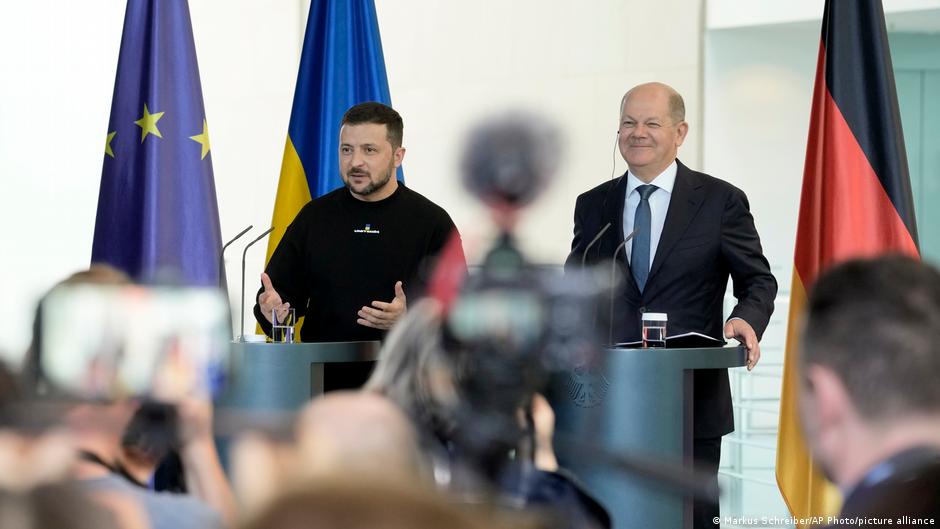
Ukrainian President Volodymyr Zelenskyy is traveling to Berlin for a meeting with German Chancellor Olaf Scholz.

Zelenskyy is also expected to take part in the Munich Security Conference starting at the end of this week, which will be attended by some 40 heads of state and government as well as numerous military experts.

"The situation on the front is parlous," said military analyst Markus Reisner in an interview with DW. The senior colonel in the Austrian army has been observing the war in Ukraine since the start of the full-scale Russian invasion, which will end its second year on February 24.

Reisner says he has identified "at least 15 places" where the Russian army is currently gaining ground. "In the last few weeks, this has been up to six kilometers of terrain in some cases, but only half a kilometer in others," says Reisner.

He explains that this is mainly because Ukraine has less and less precision ammunition and artillery ammunition available. Russia, on the other hand, is taking advantage of its greater artillery power.
 

The Ukrainian Air Force says Russia launched 26 missiles overnight, including 12 Kh-101 / Kh-555/ Kh-55 cruise missiles, 6 Iskander-M / KN-23 ballistic missiles, 2 Kalibr cruise missiles, 4 Kh-59, and 2 S-300.


#Ukraine, Donetsk Oblast, Avdiivka sector. 15.02.2024.

Russian forces (1st Separate Guards Motor Rifle Brigade, former DNR unit) captured Ukrainian positions at the "Zenit" fortified area, located south of the town of Avdiivka, after the Ukrainians withdrew.

📍48.0983333, 37.7541667

The southern approaches to Avdiivka are now fully open to further Russian advance.


The commander of Sonechko Battalion of Ukrainian Main Directorate of Intelligence (HUR MO) says situation in Avdiivka is changing rapidly, but it's under the control. The command also deployed additional units of SSO and HUR MO to the area.


On 14 February 2024, Ukrainian forces conducted a successful uncrewed surface vessel attack on the Russian Ropucha-class landing craft Tsezar Kunikov, which almost certainly resulted in the sinking of the vessel. Three of ten Ropucha-class vessels have now been destroyed by Ukrainian strikes.

The vessel is heavily relied on to provide logistical support to the Black Sea Fleet (BSF) and the Russian war in Ukraine. The loss of the vessel will almost certainly further constrain the limited Russian resources available in the Black Sea and leave the Black Sea Fleet logistical chain vulnerable to additional attacks. It also further reduces the redundancy available to support logistical movements between mainland Russia to the Crimean Peninsula when the Kerch bridge is closed.

Ukraine’s ingenuity has highly likely deterred Russia from operating freely in the western Black Sea and enabled Ukraine to seize the maritime momentum from Russia.


1/2 Russia's Special Technological Center increased the production ofOrlan-10 UAVs by 3-4 times and of Orlan-30 by 25 times since 2021. It also produces over a thousand Orlan-10 drones every year, while the Russian military operates less than a thousand Orlan drones in Ukraine.

2/2 Meanwhile, the Izhevsk Unmanned Systems, part of the Kalashnikov Group and the manufacturer of Kub and Tachyon drones, "will increase production output 10 times in 2024 enabled by computer numerical control machine tools whose numbers have grown several-fold."


Norwegian soldiers will start training Ukrainian marines in small boat operations this spring, writes Norwegian Ministry of Defense in a press release.
“These are small boat operations. It is about the coastal zone, river crossings & the areas important for Ukraine”
“The training is 1st step in the maritime coalition Norway leads with Great Britain. We must contribute where we can make a difference. Norway can supply the expertise in demand. We are taking this cooperation further and establishing a special training scheme” 🇳🇴Defense Minister
 

Key Observations in Avdiivka (2024-02-14):
1. Russian forces possess a significant numerical advantage in both personnel and vehicles. During the initial assault, as Russians advanced toward well-fortified Ukrainian positions across open, frequently mined fields, with tree lines providing the only natural protection, they sustained disproportionately higher losses in vehicles and personnel than the defenders of Avdiivka. The high casualty rate was a result of several errors and unrealistic expectations during the initial phase. For instance, a platoon from the 15th Separate Guards Motorized Rifle Brigade was assigned the task of penetrating three kilometers deep into Ukrainian defenses on the first day of the assault. However, in reality, the brigade lost approximately 40 BTRs (Armored Personnel Carriers) between October 10th and 19th. Concurrently, after sustaining considerable casualties, Russian brigades like the 15th, 21st, and 114 decided against involving additional troops. They chose not to deploy extra battalions from these brigades, abandoning the notion of quickly surrounding Avdiivka with mechanized forces.
2. The situation for the Russians improved upon entering the city. Around the 21st of January, they began infiltrating the residential areas of Avdiivka. Leveraging underground communications, the Russians, with an element of surprise, successfully took control of several rear positions held by Ukrainian troops in Avdiivka. This flexible approach compelled defenders to retreat, ultimately enabling the Russians to establish a foothold in Avdiivka. Casualty ratios tend to equalize once the enemy enters urban areas, especially if they have artillery and air support, allowing them to progress street by street while severing supply routes.
3. Initially, Russian assaults, aiming at a large pincer movement along with mechanized and infantry attacks, faced significant setbacks. This was largely attributed to the underestimation of the determination of Ukrainian troops to defend their positions and an overestimation of the strength of Russian forces in the northern flank. Despite continuous pressure on the Northern and Southern areas between October and December, the inability to complete the encirclement led the Russians to shift their focus inside Avdiivka itself. Thanks to partial air superiority, Russian forces conducted multiple airstrikes with guided aerial bombs. The lack of ammunition for counter-battery fire allowed Russians to deploy large numbers of artillery that weakened Ukrainian defenses. After identifying weak spots, multiple groupings moved in converging directions to achieve envelopment.

4. Russian troops incurred high casualties by any standard, which is evidenced by the necessity for the 25th Combined Arms Army to transfer its equipment to the 2nd and 41st Combined Arms Armies to sustain ongoing assaults. However, contrary to a myth, Russian forces didn’t perform constant frontal assaults. The enemy has adapted to become more creative and flexible. Realizing the limitations of overpowering positions with powerful mechanized strikes, they started to separate Ukrainian forces into smaller pockets and divided them across distinct sectors. Instead of a direct push in Stepove, an area the enemy struggled to control, as predicted by our team months ago, they identified a weak spot in the northeast of Avdiivka. Here, they pushed to expand their zone of control to the railroad and beyond.
5. The target area of KAB (airdropped guided bomb) hits has expanded. Russian aerial bombs are not limited to Avdiivka but have extended to nearby villages in rear areas, including Ocheretyne, Novoselivka Persha, and Novobakhmutivka.
6. Several reports from various units that managed to capture prisoners of war indicate that recruits were enlisted in December and January. Information that we have reveals that a group of ~10 prisoners was recruited in mid-January. While these soldiers might lack experience, the influx of recruits ensures non-stop pressure on exhausted Ukrainian units, draining their resources and forcing them to retreat.

7. According to various estimates, between 37-42 KAB bombs were dropped on Avdiivka in a single day this week. Despite their inaccuracy, these highly destructive bombs cause extensive damage due to their explosive load, leading to the damage or destruction of nearby buildings. In the imagery captured on February 14th, it is evident that numerous buildings have sustained significant damage
8. With Russians nearing the creation of multiple pockets in the city, limited options remain—either withdraw from enveloped positions or attempt to break the encirclement through a counter-attack. However, organizing a successful counter-attack is extremely challenging in such an environment, given the amassed Russian forces, including the elements of the Guards Tank division, Ukraine would need to concentrate forces in a narrow strip of land for a frontal or flank counter-attack without the advantage of artillery or air support.

What’s next?
The most logical course of action at this point would likely be a withdrawal and evacuation from Avdiivka. While this may be viewed unfavorably from a political perspective, the initial months of defending Avdiivka inflicted substantial damage on the Russian military, preventing them from advancing deep into Ukrainian territory as originally planned.
The Russians failed to achieve a breakthrough, rapidly encircle Avdiivka, and access the operational space to strike Ukrainian rears and logistic routes supplying other forces across Donetsk oblasts. Instead, as of February 9, 2024, more than 655 vehicles suffered varying levels of damage or were destroyed, captured, and abandoned on the outskirts of Avdiivka, as reported by OSINT analyst Naalsio, known for meticulously recording geolocated and video-confirmed losses. Between October 10th and November 28th, our team has identified and reported more than 211 damaged or abandoned Russian vehicles near Avdiivka.

This provided an opportunity for Ukraine to fortify and strengthen areas beyond Avdiivka, albeit the construction of fortifications is still incomplete. Avdiivka is Ukraine's last gateway to Donetsk—a potential foothold for offensive operations to liberate the city. Despite the theoretical promise, this prospect is becoming increasingly unrealistic in light of the current frontline situation.
 

The move to shore up Avdiivka has drawn parallels with Ukraine’s dogged but ultimately unsuccessful defence last year of Bakhmut, a town 50km to the north.
Russia lost up to 30,000 men in its nine-month offensive, many of them fighters for the Wagner private military company of late warlord Yevgeny Prigozhin who later mutinied against Moscow.
The favourable casualty ratio Ukraine initially enjoyed narrowed as the battle wore on. It lost many experienced troops, which US officials said undermined its summer counteroffensive. Defending Avdiivka could prove similarly costly at a time when Ukraine’s army needs to replenish its ranks through mass mobilisation.
“In October and perhaps through December and early January, it could be argued Ukraine was inflicting disproportionate attrition on the Russian attackers,” Henry Schlottman, a military analyst, wrote on Substack. “Now, this argument is much harder to make.”
Kyiv’s grip on Avdiivka will be even harder to maintain because of the shortage in western artillery ammunition. Some units have already been forced to drastically reduce their firepower.
Russian urban warfare often involves destroying all buildings with artillery to deprive Ukrainian defenders of cover before sending in light assault forces. Without ammunition, Ukrainian cannot fire back at Russian artillery positions.

The fall of Avdiivka would hand Russian leader Vladimir Putin his most significant military victory since Bakhmut — and a timely one given Russia’s presidential elections on March 15-17.
Avdiivka is a gateway to nearby Donetsk, a city occupied by Russian forces and their proxies since 2014. The town was well fortified by Ukrainian troops and its defunct coal and chemical plant provided a formidable defensive position. But Russian advances from the east, south and north have made the town less tenable.
The loss of Avdiivka would make it harder for Ukraine to eventually recapture Donetsk, the largest city in the occupied Donbas region, and deprive Ukrainian artillery of a position to strike the city’s communication lines.
Schlottman cautioned that the deployment of Ukrainian reinforcements could still herald a withdrawal from Avdiivka but there were also “rational reasons” for Zelenskyy and Syrsky to try to hold it. It would allow time to prepare defensive positions further to the west. And it would provide a potent symbol of Ukraine’s ability to resist Russian forces, thereby boosting morale.

The question for the Ukrainian leader and his top commander is at what cost. They will have to strike a “tricky” balance between force preservation and inflicting more damage on the enemy than they suffer themselves while defending sovereign territory, said Mykola Bielieskov, research fellow at Ukraine’s National Institute for Strategic Studies, speaking in a personal capacity.
“I hope that the Ukrainian leadership has learned the lesson of weighing all considerations — military, political — when adopting decisions regarding a specific frontline segment,” he said.

Syrsky’s appointment as commander-in-chief prompted a backlash in parts of the Ukraine military, with some soldiers decrying his alleged willingness to expend the lives of his own troops for tactical gains. They also blame him, as commander of Ukraine’s ground forces, for delaying a withdrawal from Bakhmut after Zelenskyy made defending it a top priority.
Syrsky was also the general in charge of operations at Debaltseve in 2015, when 6,000 Ukrainian troops were encircled by Russian forces and their proxy militia and were forced into a chaotic retreat from the town north-east of Donetsk. More than 260 Ukrainian soldiers were killed.
The battle of Avdiivka would provide insights into how Syrsky can close the “gap between the desired political outcomes of his president with Ukraine’s dwindling military resources”, according to Mick Ryan, a retired Australian Army major-general and military strategist.
“Like Bakhmut, the president appears to not want to give up Avdiivka even if the military situation indicates a withdrawal may now be the best option to preserve the remaining fighters. Not giving up territory and preserving combat forces in the current environment will be very difficult to achieve.”


Leader of pro-🇺🇦 Russian Volunteer Corps (RDK) says their unit was also deployed in Avdiivka.


Russia likely uses North Korean KN-23 missile in its morning massive attack on Ukraine

🇰🇵KN-23 has several advantages over🇷🇺domestically produced Iskander, in particular, a lighter launch weight of 3.4 tons and a longer confirmed launch range of 690 km.


Information appeared that the ballistic missile that fell in Kyiv region is reportedly a North Korea KN-23 one. All the trees in the 40 meter radius burned down from the impact, — Defence Express.

Imagine what would happen if it hit a residential building.

📹: BBC Ukraine, Reuters


Ukraine will buy modern Turkish KAAN fighter jets in the future - Ukrainian Ambassador to Turkey Vasyl Bodnar

Ukrainian Ambassador to Turkey Vasyl Bodnar told CNN Türk in an interview that Ukrainian engineers are working in a program to create an engine for the Turkish Kaan fighter jet.

In the future, Kyiv wants to purchase these fighters on par with the F-16.

Production should begin in 2028. The first test flight of the Kaan was supposed to take place on December 27, 2023, but was postponed due to the need to conduct additional tests.
 

.@Deepstate_UA's updated map shows Russian advances south of the Coke plant, the withdrawal form the Zenit area/pocket, and expanded grey zone in the east. They say not all of the Ukrainian soldiers were able to withdraw from Zenit.


DeepState: The main Ukrainian forces left their positions at the "Zenit" fortified area south of Avdiivka, but not all of the soldiers managed to get out.


According to RU channels UA withdrew from the Filtration Plant in the east and Zenith in the south. This is good news, since avoiding an encirclement should be a priority at this point. It seems the coke plant and Kvartal high-rises are the current UA strongholds.


Dmytro Lykhovii, spokesperson for the Tavriia Operational Strategic Group, said that Russia has concentrated more troops on the Orikhiv front than on the Avdiivka front and will likely attempt to retake the Robotyne salient Ukraine liberated this summer.

One of the problems with the end of Ukraine's counteroffensive is that much of the terrain that was seized was not particularly defensible terrain.


Those who read our Ukraine Conflict Monitor know that we warned about this situation. We now assess that it is highly likely that Russians will intensify ground attacks aiming to retake Robotyne and erase Ukranian summer '23 gains. The situation is dire across the entire front.


Ukraine’s top military-intelligence officer said Russian invasion forces in his country are using thousands of Starlink satellite internet terminals, and that the network has been active in occupied parts of Ukraine for “quite a long time.”
Lt. Gen. Kyrylo Budanov’s comments in an interview suggest that Russia is starting to acquire Starlink terminals, made by Elon Musk’s SpaceX, at a scale that could cut into a major Ukrainian battlefield advantage. Ukraine’s government said last year that around 42,000 terminals are used by the military, hospitals, businesses and aid organizations.
Starlink, which is more secure than cell or radio signals, is considered so vital to Ukrainian operations that the Pentagon struck a deal with SpaceX last year to help fund access for Kyiv’s forces. Up to now, Russian forces have had no similarly secure communications system.
Russian private firms buy the terminals off intermediaries who pass off purchases as for personal use and deliver the equipment to Russia via neighboring countries, including former Soviet republics, Budanov said. Russian army units down to company level were seeking to acquire Starlink terminals, often by collecting money for the purchases, he said.
“It’s an open market,” said Budanov, who heads Ukraine’s military-intelligence agency, known as HUR. “It’s not a military item.”
A search for Starlink terminals on Russian search engine Yandex.ru yields numerous dealers in Moscow and outside the Russian capital who promise to install the systems across the country and the Russian-occupied territories of Ukraine.
One website, strlnk.ru, promised “tested performance” in the occupied areas of Crimea, Luhansk, Donetsk and Kherson with monthly fees starting at $100 a month. The website provided contacts for a dealer, including a Russian cellphone number and a Yandex email. A representative of the firm declined to speak to a Wall Street Journal reporter.

Another website that uses the name of a German appliance company sells Starlink terminals for nearly 300,000 rubles, or just over $3,000.
 

As Ukraine has scrambled to source ammunition, arms and equipment for its defence, Russia has presided over a massive ramping up of industrial production over the last two years that has outstripped what many western defence planners expected when Vladimir Putin launched his invasion.
Total defence spending has risen to an estimated 7.5% of Russia’s GDP, supply chains have been redesigned to secure many key inputs and evade sanctions, and factories producing ammunition, vehicles and equipment are running around the clock, often on mandatory 12-hour shifts with double overtime, in order to sustain the Russian war machine for the foreseeable future.
The transformation has put defence at the centre of Russia’s economy. Putin claimed this month that 520,000 new jobs had been created in the military-industrial complex, which now employs an estimated 3.5 million Russians, or 2.5% of the population. Machinists and welders in Russian factories producing war equipment are now making more money than many white-collar managers and lawyers, according to a Moscow Times analysis of Russian labour data in November.
As Russia’s war in Ukraine drags into its third year, the massive Russian investment in the military, projected this year to be the largest as a share of GDP since the Soviet Union, has worried European war planners, who have said Nato underestimated Russia’s ability to sustain a long-term war.
“We still haven’t seen where is Russia’s breaking point,” said Mark Riisik, a deputy director in the policy planning department of Estonia’s defence ministry. “Basically one-third of their national budget is going on military production and on the war in Ukraine … But we don’t know when it will actually impact on society. So it’s a little bit challenging to say when will this stop.”
One key indicator in the artillery war has been the domestic manufacture of shells, which experts put at 2.5m to 5m units a year. Riisik called the trends worrying, noting that production could run above 4m units in the next year or two. The import of more than a million shells already from North Korea, and a strategic stockpile of shells in the millions, gives Russia an additional cushion.
While that number might not give Russia the needed capacity to make significant territorial gains in 2024 or 2025, it nonetheless puts Ukraine at a significant disadvantage on the frontlines, where Russia has at least a three-to-one superiority in artillery fire, and often even more.
“It’s a lot higher than we expected, really,” Riisik said of the Russian production numbers.

Much of this was baked into Russia’s military-industrial complex, a sprawling behemoth of nearly 6,000 firms, many of which rarely turned a profit before the war. But what it lacked in efficiency, it made up for in spare capacity and flexibility when the Russian government suddenly ramped up defence production in 2022.
Richard Connolly, an expert on Russia’s military and economy at the Royal United Services Institute in London, called it a “Kalashnikov economy”, which he said was “quite unsophisticated but durable, built for large-scale use and for use in conflicts”.
He said: “The Russians have been paying for this for years. They’ve been subsidising the defence industry, and many would have said wasting money for the event that one day they need to be able to scale it up. So it was economically inefficient until 2022, and then suddenly it looks like a very shrewd bit of planning.”

That differs significantly from western, especially European, arms manufacturers, who generally run lean operations that work across borders and are designed to maximise profit for shareholders.
Russia can often run its military industry by fiat, reassigning personnel, increasing budgets and filing large orders on an ad hoc basis. Russia will have difficulties sourcing components for more complex weapons such as missiles, especially if sanctions are enforced more strictly. But for now it has managed to continue to supply Iskander ballistic missiles and Kh-101 cruise missiles as well.
Early in 2023, the Russian government transferred more than a dozen plants, including several gunpowder factories, to the state conglomerate Rostec in order to modernise and streamline production of artillery shells and other key elements in the war effort, such as military vehicles.
The Kazan gunpowder plant, one of the country’s largest, took on more than 500 workers in a December hiring spree that increased average monthly salaries at the plant more than threefold, from 25,000 roubles (£217) to 90,000 roubles (£782), according to Alexander Livshits, the plant’s director. Job adverts offer night shifts from midnight to 8am and protection from military service for those trying to avoid the frontlines.
Many of those hired had to be lured from neighbouring regions, evidence of the severe shortage of skilled labour across Russia. In a twist, the main competition for workers at the factories can come from the military, which promises a salary of more than 200,000 roubles (£1,730) a month to those who sign up to fight in the war.
In regions across Russia, that kind of money can be transformative. “The war has led to an unprecedented redistribution of wealth, with the poorer classes profiting from government spending on the military-industrial complex,” said Denis Volkov, the director of the Levada Center, a polling and sociological research firm in Moscow. “Workers at military factories and families of soldiers fighting in Ukraine suddenly have much more money to spend. Their income has increased dramatically.”
Levada’s polling showed that 5-6% of those who “previously did not have enough money to buy consumer goods like a fridge now have moved upwards towards the middle classes”.

Russia will pay for that by boosting defence spending to nearly 11tn roubles (£95.7bn) next year, a 70% increase, which would surpass social spending for the first time since the Soviet Union. Putin is trying to finance the war, maintain social spending and avoid runaway inflation all at once, in what Alexandra Prokopenko, a Carnegie endowment scholar, calls an “impossible trilemma”.
For now, high oil prices are helping to cushion the blow. But the war is set to transform the Russian economy from within.
“In the past, for that whole post-Soviet period, I would have said that oil was the leading sector of the Russian economy,” Connolly said. “Now I say it’s defence, and oil that will be paying for it. And that poses problems over the longer term.”


NATO and Ukraine will create a joint analysis, training, and education center in Poland, NATO Secretary-General Jens Stoltenberg said on Feb. 15 during a press conference in Brussels, according to a Kyiv Independent journalist.

"Today, we decided to create a new NATO-Ukraine joint analysis, training, and education center in Bydgoszcz, Poland," Stoltenberg said as NATO defense ministers gathered in Belgium's capital.

"It will allow Ukraine to share lessons learned from Russia's war and will create a structure for Ukrainian forces to learn and train alongside their allied counterparts."
 
Let's agree that this has to come to an eventual end, whether the Ukrainians run out of cannon fodder or the West bleeds Russia, at some point someone in the freaking room needs to raise there hand and ask, "can we talk?" Right? Can we agree on that? Or we just fomenting perpetual war on the backs of a country we have no strategic interest in other than to weaken our once...ONCE, rival who is nowhere near the super power they once were? All the while China sits back and giggles while we waste treasury, Russia wastes what will soon be two generations and Ukraine will simply turn into a 4th world Dante's pit of hell when it's all said and done. I don't want to get into fight over this but does no one but me see the futility of this?
That someone in the room need to be Ukrainian or Russian, not someone from another non-combatant nation.

I disagree that we are wasting our treasury on this. It is likely to result in an increase in defense procurement, but again most of the materiel donated to Ukraine have been gear that the US isn't going to use or need any time soon.
 
Let's agree that this has to come to an eventual end, whether the Ukrainians run out of cannon fodder or the West bleeds Russia, at some point someone in the freaking room needs to raise there hand and ask, "can we talk?" Right? Can we agree on that? Or we just fomenting perpetual war on the backs of a country we have no strategic interest in other than to weaken our once...ONCE, rival who is nowhere near the super power they once were? All the while China sits back and giggles while we waste treasury, Russia wastes what will soon be two generations and Ukraine will simply turn into a 4th world Dante's pit of hell when it's all said and done. I don't want to get into fight over this but does no one but me see the futility of this?
That someone in the room need to be Ukrainian or Russian, not someone from another non-combatant nation.

I disagree that we are wasting our treasury on this. It is likely to result in an increase in defense procurement, but again most of the materiel donated to Ukraine have been gear that the US isn't going to use or need any time soon.
You can feign that this is a Ukraine-Russia thing without US/NATO involvement but you're just putting your head in the sand IMO. All three need to be in the room to get this resolved.

To your second comment, well, Eisenhower was right is all I have to say.
 

Map from this morning indicates that Ukrainian forces have retreated from the eastern portion of the pocket. Russian forces south of the Coke Plant continue to try to advance to the west, indicated by the expanded gray area.


Russian forces appear to have taken control of a filtration plant on Avdiivka's eastern edge.


Avdiivka situation, per spokesman for Ukraine's 3rd Separate Assault Brigade: "Compared to the most critical period in Bakhmut, it's more difficult now." Russian brigades outnumber Ukraine's 7-1; using phosphorus, dozens of precision-guided bombs daily; attacks better organized.


Avdiivka is pretty much gone, the first city taken by Russia since the fall of Bakhmut in May, and a direct result of acute ammunition shortages. The only question now is whether Ukraine manages to pull out remaining troops and avoid their encirclement.


In briefing today, a senior U.S. defense official says that an estimated 315,000 Russian soldiers have been killed or wounded in the two years since Putin's all-out invasion two years ago.

Twenty Russian warships and a Russian tanker have been sunk or damaged, official adds.
In same briefing, senior U.S. defense official says the Pentagon is watching the ongoing battle in Avdiivka, Ukraine, closely. Ukrainian forces have told reporters that they expect to pull back from the city in coming days in part because of a shortage of artillery shells.
The senior defense official said that "we do see that Ukrainians are running short on critical supplies, particularly ammunition," in Avdiivka.

"We see this as something that could be the harbinger of what is to come if we do not get this supplemental funding" from Congress.
"Without supplemental funding, not only can we not resupply those forces that are bravely trying to defend Avdiivka, we also will find many other locations along the forward line of troops that will be running low on supplies, on critical ammunition."
"And let’s not forget about those air-defense interceptors. The U.S., along with our allies and partners, but critically U.S. resources, have supported Ukrainians in being able to defend their cities against this continual barrage of Russian missiles."
Without $, "we will not be able to continue to supply Ukraine’s air defenses, and we will see the results in cities being bombarded, and we will see more civilians dying and we will see Ukraine struggling to protect their critical infrastructure and their forward line of troops.”


A Russian defense industry think tank has reportedly upped a cash reward for the capture of an Estonian-made unmanned ground vehicle operating in Ukraine, as ground robots are becoming prized assets on the battlefield.

The Moscow-based Center for Analysis of Strategies and Technologies (CAST) first announced in 2022 that a reward of one million rubles, or roughly $11,000, would be given to any military personnel seizing a THeMIS vehicle, made by Edge Group subsidiary Milrem Robotics, in relatively intact condition.

On Feb. 15, the center’s director, Ruslan Pukhov, told state-owned news agency RIA Novosti that the award would be raised to two million rubles, or almost $22,000.


"Many know that the defenders of Mariupol held out for an unimaginable 83 days. But few know the story of the seven [helicopter] resupply missions...allowed the defenders to hold out, it is almost certain they would not have made it...without them" @TIME


1/ QUICK TAKE on the Russian deliberations about an "ideal" combat drone: "The US heavy drones were built by aircraft designers who perceived the UAV as an airplane without a pilot inside. The result is a large, expensive and complex aerial vehicle. In contrast..."
2/ "...many Chinese commercial drones were designed by IT specialists - therefore, a Chinese drone is “a smartphone from which the camera was detached and sent to fly, and all the controls are in the same smartphone.” This approach was better than the American one, but also not ideal."
3/ "Oddly enough, the closest thing to the ideal was made by “bearded dudes in running shoes from the Middle East”, who realized that the main requirement for a drone is maximum cheapness, and the ability to stay on course to target."
4/ "Many of their UAVs were built according to on this logic - from the wooden DIY UAVs launched against Russian bases in Syria starting in 2018, to the more advanced but still cheap “Shahed” variants."
5/ Obviously, this Russian summary is cutting corners - since large, heavy UAVs can perform missions that other drone types cant, and vice versa, but this deliberation is very much indicative of the Russian thinking today.

Some video: https://twitter.com/Osinttechnical/status/1758279162203443420

Footage from a Ukrainian “Baba Yaga” heavy bomber unit in service with the 36th Marine Brigade, conducting a nighttime attack mission on the southern front.
 
Enemy is ‘coming from all sides:’ Ukraine’s troops face ‘hellish’ conditions as Russia throws all it has at town of Avdiivka

But just a couple of days later, amid the ongoing Russian onslaught, even the reinforcements were describing “hellish” conditions.

“Our brigade is carrying out combat missions in conditions that even we could hardly imagine,” Maksym Zhorin, the 3rd Separate Assault Brigade’s deputy commander said in a battlefield report on Thursday. “The battles in Avdiivka are several times more hellish than the hottest battles of this phase of the war, which took place in Bakhmut.”

Much as it did in Bakhmut this time last year, Russia is throwing everything it has at Avdiivka in pursuit of victory, pummeling the town with airstrikes and artillery, while launching wave after wave of ground assaults by armored vehicles and soldiers.

It’s turned the town into what Ukrainian soldiers call a “meat grinder.”

During the offensive Russia has suffered immense losses — so large it might make other militaries regroup and rethink — but Moscow appears to be calculating these losses are worth it, given its numerical advantage.

“The enemy is huge, coming from all sides,” Zhorin added.


This AI-generated video, circulating on Russian Telegram, claims to show a France 24 broadcast in which a presenter announces President Macron has cancelled a scheduled visit to Ukraine over fears of an assassination attempt.

France 24 never aired this, it's totally fake.


German Chancellor Olaf Scholz and Ukrainian President Volodymyr Zelenskyy on Friday signed a bilateral security agreement worth €1.13 billion ($1.22 billion) in Berlin.

Germany's defense ministry said the so-called "Munich Package" focuses on air defense and artillery and includes provisions of 120,000 rounds of 122-millimeter caliber ammunition and an additional 100 IRIS-T SLS missiles this year.


In a working document seen by Le Monde, a few hours before the arrival in Paris of Ukrainian President Volodymyr Zelensky, who is due to sign a bilateral security agreement), the French presidency draws up an inventory of the aid provided to Kyiv since the start of the Russian invasion. Here is the previously unreported list of military equipment delivered by France to Ukraine, to date:

Surface-to-air defense
  • SAMP-T: 1 system and ASTER 30 missiles
  • CROTALE NG: 2 systems and missiles
  • MISTRAL: 5 firing systems and hundreds of missiles
  • RADAR: 1 GM 200
Air-to-ground armament
  • SCALP: approximately 100 missiles
  • A2SM: several hundred bombs, starting in February 2024
Artillery
  • CAESAR: 30 guns and tens of thousands of rounds of ammunition
  • TRF1: 6 guns and tens of thousands of rounds of ammunition
  • LRU: 4 systems and hundreds of rockets
Armor and liaison vehicles
  • AMX 10 RC: 38 AMX-10 RC and tens of thousands of rounds of 105 mm ammunition
  • VAB: 250 (including VAB SAN)
  • VLTT P4: 120 vehicles
  • MILAN: 17 firing systems and hundreds of missiles
Engineering and small arms
  • Anti-tank rockets: several thousand
  • Anti-tank mines: several thousand
  • Assault rifles: several thousand
  • 12.7mm machine guns: several hundred
  • Other ammunition: several million
Air
  • Drones: several hundred reconnaissance drones and
    small tactical drones
  • Fuel: several tens of thousands of m3
In addition to this material aid, which is independent of the security agreement due to be signed later on Friday, the Elysée Palace emphasizes that humanitarian and judicial contributions will also be made, as well as contributions to reconstruction and refugee reception.

The French have been a bit guarded on those numbers.
 
Cut Ukraine off and let Russia overrun the country? That's way worse, IMO, for a ton of reasons, most of which Z Machine points out
I don't think you're going to bring Russia to heal by continually dumping arms into Ukraine and as I pointed out above, you are going to run out of Ukrainians long before Russia runs out of Russians, then what? Are signing up to put US boots on the ground then? I'm not.

Fully on board with cutting the deficit in other ways as well BUT this endless stream of cash going to a bottomless pit has to have an end game, that's what I'm asking, what does that look like? And if we are so hell bent on bringing Mother Russia to heal, why not sit down with them to discuss peace? As you said, gaining back land lost is a non-starter so negotiate a peace where the borders are as is today. We're not even hinting at something like that right now, why?

as long as Ukraine is willing to fight we should support them. we literally have thousands of abrams, bradleys, etc rusting after usmc switched tactics. use them.

no us troops on the ground.
 
Let's agree that this has to come to an eventual end, whether the Ukrainians run out of cannon fodder or the West bleeds Russia, at some point someone in the freaking room needs to raise there hand and ask, "can we talk?" Right? Can we agree on that? Or we just fomenting perpetual war on the backs of a country we have no strategic interest in other than to weaken our once...ONCE, rival who is nowhere near the super power they once were? All the while China sits back and giggles while we waste treasury, Russia wastes what will soon be two generations and Ukraine will simply turn into a 4th world Dante's pit of hell when it's all said and done. I don't want to get into fight over this but does no one but me see the futility of this?
That someone in the room need to be Ukrainian or Russian, not someone from another non-combatant nation.

I disagree that we are wasting our treasury on this. It is likely to result in an increase in defense procurement, but again most of the materiel donated to Ukraine have been gear that the US isn't going to use or need any time soon.
You can feign that this is a Ukraine-Russia thing without US/NATO involvement but you're just putting your head in the sand IMO. All three need to be in the room to get this resolved.

To your second comment, well, Eisenhower was right is all I have to say.

if America truly desires to stop the military industrial complex it had best be ready for a bunch of changes that they probably won't like.
 
You can feign that this is a Ukraine-Russia thing without US/NATO involvement but you're just putting your head in the sand IMO. All three need to be in the room to get this resolved.
I never said that US and NATO weren't involved. It's more similar to Iran and North Korea are also being involved. Should those countries also get a seat at the negotiating table? Or is this something that Ukraine should work out with Russia?

We should supply them and support them while they attempt to prevent the collapse of their country and democracy.

Relatedly, we should not be giving Israel any materiel. They should pay for all of it. The situations should not be linked in any way.
 
Relatedly, we should not be giving Israel any materiel. They should pay for all of it. The situations should not be linked in any way.
Agree that the two shouldn't be related but what's the reasoning behind asking Israel to pay? Curious, not trying to stir pots.
 

Users who are viewing this thread

Back
Top