What's new
Fantasy Football - Footballguys Forums

This is a sample guest message. Register a free account today to become a member! Once signed in, you'll be able to participate on this site by adding your own topics and posts, as well as connect with other members through your own private inbox!

*** Official Russia vs. Ukraine Discussion - Invasion has begun *** (7 Viewers)


this is why I'm concerned.

you expect to lose them, but they haven't pierced all their defensive layers and we are already seeing these reports.
All casualties are concerning in a sense but this isn't unexpected. A few things- first, attacking a prepared defense is never easy. The best of the best NATO forces would get bled attempting it. It is made harder in that they are doing so with little or no air support. On top of that, these newly minted brigades that are leading the counter offensive were trained quickly and there is going to be mistakes made with a learning as you go curve. The probing and trying to push through part of the counter offensive is where we should expect the most of the Ukrainian casualties to come from. Finally, the Russians will be loud on any footage they can produce that shows any success that they have. Even more so for any Western equipment that can he shown to be destroyed. The Ukrainians will, and are, be very quiet for operational security right now. Likely there will be a perception of it going badly for the Ukrainian forces for a bit because of this. I would urge patience as the fog of war is deep and when the side that is talking the most is the side that has been habitually lying about everything- you really have to just wait to see.
 

Ukraine says it's recaptured a fourth village in the southeast as part of its counteroffensive.

Kyiv's forces held up the Ukrainian flag in Storozheve in the Donetsk region in video footage posted online.


The defence minister thanked the 35th Separate Brigade of Marines for regaining control of the village.

It comes after Ukraine said it also liberated the villages of Blahodatne, Neskuchne and Makarivka, which lie on the edge of the Donetsk region next to the Zaporizhzhia region.

Prominent Russian military bloggers said fighting for Makarivka was ongoing, but confirmed Ukrainian forces had taken Blahodatne and Neskuchne.

The Institute for the Study of War, a US-based thinktank, also says Ukraine has reclaimed Novodarivka, taking the total number of villages to five.

Sky News is unable to verify these battlefield reports.

Fighting continues near Bakhmut, Avdiivka and Maryinka today, with 25 battles in the past 24 hours, Ukraine's armed forces general staff said.


Expect 'a major attack' in the next few days - defence chair​

"In the next few days we should anticipate a major attack in one part of the Donbas or another," said the chair of the UK's defence select committee.
Tobias Ellwood said the Ukrainian army was undertaking "probing and shaping operations" and "the main front of the Ukrainian capability still in reserves ready for that singular attack".
"The Russians don't know where that's going to be but we're seeing chaos ensue between the Wagner Group and the Russian forces themselves," he told Sky News.
He said the Kakhovka dam explosion showed Vladimir Putin "did not even have faith in being able to hold that dam".
But he urged "caution" to anyone assuming Ukraine will "charge in" and "it will all be over very quickly".
Mr Ellwood, a former defence minister, called on allies to provide more tanks, F16 fighter jets and long-range missiles.


Russia’s defence minister ‘seriously exaggerated claims of Ukrainian losses’ in recent comments about the war, the UK Ministry of Defence said.

The MoD did not specify which claims they were but it follows one press conference Mr Shoigu gave last week in which he said Ukraine had suffered 3,715 casualties over three days.

“Shoigu has provided at least two comments on Russia’s defensive operations, including making almost certainly seriously exaggerated claims about Ukrainian losses,” the MoD said in its daily update on the war.


The MoD said Mr Shoigu’s appearances contrast with other times in the war where he kept a low profile.

“Shoigu is likely acutely aware of the need to maintain a positive image in the face of increasingly unmasked criticism from some fellow Russians.”


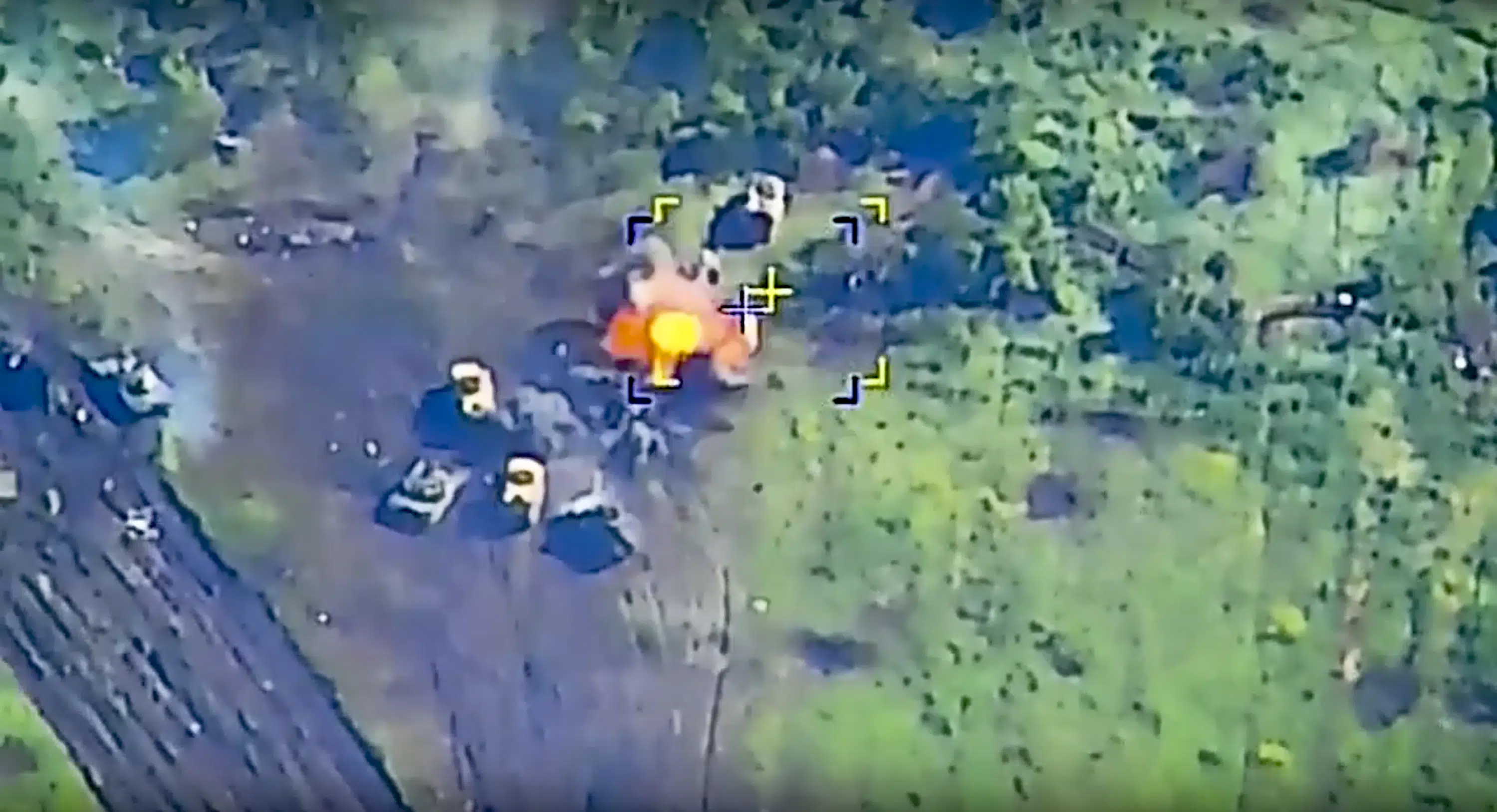
Ukraine has lost 16 US-supplied armored vehicles in the past several days, according to open-source intelligence analysis, as the country’s military announced its forces had captured three villages from Russia in an offensive in the eastern Donetsk region.

The 16 US Bradley infantry fighting vehicles either destroyed or damaged and abandoned in recent days represent almost 15% of the 109 that Washington has given Kyiv, according to Jakub Janovsky of the Dutch open-source intelligence website Oryx, which has been collecting visual evidence of military equipment losses in Ukraine since Russia’s invasion began on February 24, 2022.


Ukrainian forces made visually verified advances in western Donetsk Oblast and western Zaporizhia Oblast, which Russian sources confirmed but sought to downplay. Ukrainian Deputy Defense Minister Hanna Malyar reported that Ukrainian forces advanced 300 to 1,500 meters in southern Ukraine.[4] Malyar and other Ukrainian and Russian sources reported that Ukrainian forces made gains south of Velyka Novosilka between June 10 and 11, including liberating Makarivka, Neskuchne, Blahodatne, Storozheve, and Novodarivka.[5] Some Russian sources reported that battles are ongoing in “grey zone” or contested areas or that Ukrainian forces are operating in areas that Russian forces did not fully occupy before Ukrainian attacks in southern Ukraine.[6] Russian sources are likely referring to Ukrainian territorial advances through Russian defenses as capturing ”grey zones” in order to downplay Ukrainian gains and omit reporting on Ukrainian forces breaking through defensive lines. Ukrainian forces liberated several towns, but claims of a Ukrainian “breakthrough” are premature at this time.


Ukrainian Deputy Defense Minister Hanna Malyar stated that Russian forces are transferring their most combat-capable units from the Kherson direction to the Bakhmut and Zaporizhia directions. Malyar stated on June 11 that Russian forces are transferring elements of the 49th Combined Arms Army (Southern Military District) and unspecified naval infantry and airborne forces elements from the Kherson direction in connection with the destruction of the Kakhovka Hydroelectric Power Plant (KHPP) dam.[7] Malyar noted that Russian forces likely blew the KHPP dam in order to shorten their defensive lines in Kherson Oblast as part of the response to the start of the Ukrainian counteroffensive. Flooding downriver of the KHPP has drained the Kakhovka Reservoir, resulting in landmasses emerging from the water. It is unclear how these terrain changes will affect maneuver warfare in southern Ukraine at this time.[8] If the terrain changes from flooding in the Dnipro River do not foreclose any possible Ukrainian river crossings in coming weeks and months, Russian forces may struggle to defend Kherson Oblast with remaining or then-available units if and when Ukrainian forces choose to conduct offensive operations across the river, assuming they have the ability to do so.
 
Last edited:

That progress contrasted with less encouraging news from another counter-offensive operation taking place further south and west, in the Zaporizhia region. Full-frontal fighting along the Orikhiv-Tokmak axis there has been hard going, a military source conceded, with Ukraine taking significant losses of armour and personnel. “More than dozens” of soldiers had fallen, he said. Ukraine had attacked using its well-equipped 47th brigade, but has struggled to cope with Russia’s traditional strengths in building fortifications and in electronic warfare, a source in Ukraine’s military intelligence added.

The full shape of Ukraine’s plans is yet to become clear. The scale of the deployment along the Tokmak axis—and the town’s strategic role as both a rail hub and a gateway to strike at the Russian main road to Crimea—suggested at one point that it might grow into a main push. But a source in Ukraine’s general staff urged caution. “We haven’t committed our main forces, and the Russians haven’t committed their main forces.” Both were involved in a “chess game” to draw out each others’ reserves, he said. Ukraine’s “immediate priority” is reducing Russian superiority in artillery, by targeting its systems with long-range fire. Footage from far behind the frontline suggests that they have already achieved some success.

The role of aviation, where Russia enjoys a clear advantage on paper, is key. More of it is now being used in the Zaporizhia sector than has been deployed at any time since the opening stages of the war. But Ukrainian sources suggest that Russian pilots remain risk averse and fearful of Ukrainian air defences. These have been bolstered by mobile Western guns like the Gepard, as well as re-commissioned Pantsir missile systems abandoned by the Russians during Ukraine’s counter-offensive in the Kharkiv region in the autumn.

Where Russian forces are pushing harder is with drones—from reconnaissance to strike drones. Denys Yaroslavsky, a special-forces officer now fighting in a village north of Bakhmut, reports a massive increase in the use of such devices in that theatre. Apart from Lancet strike drones, capable of destroying tanks and artillery systems, Russian forces have acquired significant numbers of Chinese drones, he says. (Western sources are yet to observe any large-scale arms transfer).
Mr Yaroslavsky is confident that Ukraine will continue to close the circle around Bakhmut. “It’s hard going, but we are moving constantly. Within a week we will have the high ground…and Bakhmut in the palm of our hands.” Serhiy Cherevaty, the spokesman for Ukraine’s eastern group of forces, said Ukrainian troops were advancing by anything from several hundred metres to two kilometres a day, a far higher rate of advance than that of Russia over the past year. A breakthrough in Bakhmut would certainly be an embarrassment for Russia, which has invested heavily in taking the town. But what Ukraine intends to do from there is unclear.

As Russian planners ponder the possibility of yet another direction of attack, one unexpected variable could be the situation in the flooded plains of Kherson. The partial collapse of the Nova Kakhovka dam on June 6th created a humanitarian disaster. But it also upended Ukrainian military plans. The destruction of the bridge alongside the dam has almost certainly put an end to any crossing of heavy weaponry. That said, Ukrainian military sources hint at a different type of operation. Flooding has washed away Russian defences on the eastern side of the Dnieper, one said; and that has created opportunities. “The conditions are arguably better for a limited assault using speedboats and special forces,” one said.

Nature could also play a part. Rain is predicted for much of the next week, which could stall some of Ukraine’s advances, while also making Russian air operations and reconnaissance more difficult. Ukraine will only go as fast as the conditions allow, an intelligence source said. “We need to hurry, but slowly.”


Raytheon Technologies, the Patriot’s main contractor, is increasing production to 12 a year and plans to deliver five more to Ukraine by the end of next year, said Chief Executive Greg Hayes.

“We have been very surprised at its effectiveness,” said Hayes of the Patriot, which he said alongside other air-defense systems has intercepted as many as 90% of incoming threats in Ukraine. He said Ukraine has tweaked the Patriot’s software to enable it to track and destroy hypersonic missiles flying twice as fast as it was designed for.
Yaremenko said officers in Ukraine’s partner countries have told him, “We are learning from you right now.”


“It’s hard for civilians to imagine the amount of support needed” for a mobile attack force, said retired Brig. Gen. Peter “Duke” DeLuca, who served in the U.S. Army Corps of Engineers. He likens the “menagerie of equipment” to Noah’s Ark because, unlike armadas of identical weaponry, it is a collection of oddball vehicles used in small numbers.

“How you generate tempo and operational reach is a function of logistics,” said Benjamin Jensen, a professor of strategic studies at the School of Advanced Warfighting in the Marine Corps University in Quantico, Va.

“Combat engineering equipment will be critical in breaching Russian defenses,” said Ben Barry, a former British tank commander who is now a land-warfare specialist with the International Institute for Strategic Studies in London.


Positive reports start gradually shifting for the Russian side currently on the defensive in the Zaporizhzhia region. Just yesterday, we found that Makarivka in Velyka Novosila direction was apparently liberated by Ukrainian forces, and today, WarGonzo already says the Ukrainians are closing in on Staromlynivka, which has not been confirmed by Ukrainians yet.


Russia has built heavily fortified defenses along the 1,000-kilometer (600-mile) front line, honed its electronic weapons to reduce Ukraine’s edge in combat drones, and turned heavy bombs from its massive Cold-War-era arsenal into precision-guided gliding munitions capable of striking targets without putting its warplanes at risk.

The changing Russian tactics along with increased troop numbers and improved weaponry could make it challenging for Ukraine to score any kind of quick decisive victory, threatening to turn it into a long battle of attrition.

Sir Richard Barrons, a retired general who led the U.K. Joint Forces Command, said the Russian military has built “textbook” defensive lines and adjusted its tactics following its hasty retreat from wide swaths of the Kharkiv and Kherson regions last fall under the brunt of a swift Ukrainian campaign.

He pointed at the improved Russian ability to both counter and use drones and also noted that Moscow has learned to keep key assets like command headquarters and ammunition dumps out of artillery range.

“And they have sharpened up how they can fire at Ukrainian artillery and tanks when they spot them,” he told AP. “So if you add all that together, everybody knows this will be a harder fight than for Kherson or Kharkiv in the autumn of last year.

“People are still using those two successes, and they were successes, as benchmarks, which I think is unfair, unreasonable in the circumstances,” he said.


this is the post I'm referring to.

This CSIS article also describes Russian defenses quite thoroughly.
 
Last edited:

"I can confirm that the next Presidential Drawdown Package (expected tomorrow) contains roughly two dozen Bradleys and Strykers," a U.S. official said in a statement to The War Zone.


Ukrainian forces are taking advantage of Western-supplied night-vision equipment to attack under the cover of darkness, seizing villages and territory.

Kyiv has launched repeated night-time assaults since its counter-offensive in the Zaporizhzhia region began a week ago, triggering alarm among Russian war correspondents reporting the losses.


On Monday morning, Ukraine claimed to have captured Storozhov, a village near Velyka Novosilka. It came a day after it claimed to have liberated the villages of Neskuchny and Blahodatne and Makarivka, in the same area.

Later on Monday Ukraine said it has retaken seven villages in total from Russian forces.

Meanwhile, a Russian train carrying fuel to the front lines appeared to have been blown up in a possible attack by partisans working behind enemy lines.

Nato countries, including the US and Norway, have included night-vision devices in military aid packages since the full-scale invasion began last year, but have not specified the number or particular models provided.

But they have remained relatively scarce on the battlefield, with those available concentrated in a handful of select units in both the Russian and Ukrainian armies.

Ukraine’s apparent preference for night fighting in the Zaporizhzhia area may reflect the broader move to Nato equipment and tactics.


As a result, the military alliance’s training exercises are designed to reflect the fact that most combat missions are undertaken under the cover of darkness.

The cover of darkness also diminishes one of Russia’s most potent defensive weapons – its superior artillery and deep-fire capabilities.

While Moscow has an array of military-grade drones, its forces have relied largely on commercial unmanned aerial vehicles, such as the Chinese-made DJI Mavric, for reconnaissance.

Such drones are not fitted with night-vision capabilities, rendering them useless at night.

“This offers more opportunity to build surprise, with vehicles then pulling back and going to ground during the daytime to avoid an artillery response,” Justin Crump, of Sibylline, an intelligence and geopolitical risk firm, said.

However, according to some Ukrainian soldiers, the equipment is still a rarity on both sides.

“One group we worked with had a thermal scope, that’s it,” said a soldier in a special forces unit who has been involved in patrols behind Russian lines.
 

Ukraine has asked Australia about the condition of an estimated 41 retired F-18 fighter jets, the country’s ambassador has said.

Vasyl Myroshnychenko told news agency AFP that “there has been a request for information” about the jets, stored at an air base north of Sydney.


“Ukraine is looking at fighter jet capabilities, including this one,” he added.

Ukraine’s interest in Australia’s planes is the first time that F-18s have been publicly discussed, as several Western countries have discussed supplying F-16 jets to Ukraine.

A deal would require the diplomatic and logistical cooperation of Kyiv, Canberra and Washington. Robert Potter, an Australian who advises the Ukrainian government, told AFP: “The specifics of any potential deal are not yet finalised.

“There are multiple formal approvals required to conclude a procurement of these planes but it is likely an idea whose time has come.”


The Biden administration is expected to provide Ukraine with depleted-uranium rounds following weeks of internal debate about how to equip the Abrams tanks the U.S. is giving to Kyiv, U.S. officials said Monday.
A senior administration official told The Wall Street Journal there appear to be no major obstacles to approving the ammunition.
The Pentagon has urged that the Abrams tanks the U.S. is providing Ukraine be armed with depleted-uranium rounds, which are regularly used by the U.S. Army and are highly effective against Russian tanks. Fired at a high rate of speed, the rounds are capable of penetrating the frontal armor of a Russian tank from a distance.
“The projectile hits like a freight train,” said Scott Boston, a defense analyst at the Rand Corporation and former Army artillery officer. “It is very long and very dense. So it puts a great deal of kinetic energy on a specific point on an enemy armor array.”


In the southern Zaporizhzhia region, Ukrainian troops have made only small gains so far. Some units have struggled against Russian minefields and airstrikes. The 47th Mechanized Brigade, with many troops and officers freshly trained by U.S. forces in Germany over the winter, suffered heavy losses last week, including a number of German-made Leopard 2 tanks and U.S.-made Bradley Fighting Vehicles.
In next-door Donetsk, however, troops from experienced brigades such as the 68th have made steady progress, driving Russian forces out of a string of villages along the Mokri Yaly River. Starting from around the town of Velyka Novosilka, Ukrainian units are pushing south toward the Russians’ main defensive line, replete with antitank obstacles.

The early battles around Velyka Novosilka are displaying Ukrainian troops’ determination and firepower—the former driven by the country’s suffering since Russia launched its full-scale invasion last year, the latter boosted by the heavy weapons from the U.S. and European allies.
Some Ukrainian units have probed well beyond the known front lines. Two soldiers with a reconnaissance unit said they pushed deep into Russian-held territory on Thursday night, fighting against Russian marines. “They were screaming and panicking,” said one of the Ukrainians. “They are quite broken right now” in terms of morale, he said. The Russians retreated, but blew up a small dam, flooding the road and forcing the Ukrainians to pause.

Several Russian soldiers taken prisoner near Velyka Novosilka, who spoke with the Journal at a detention facility, described their discontent with their commanders’ wasteful use of men and their fear of the Ukrainians’ new weaponry.
One of them, a Russian conscript from Vladivostok in Russia’s far east, said his unit knew exactly when the Ukrainians were coming, having intercepted radio traffic, but could do nothing about it. “Among ourselves, we were saying we won’t be able to withstand the counteroffensive,” he said.
The softly spoken former warehouse worker described a Ukrainian assault near the village of Staromaiorske with a trembling voice. First, mortars and artillery pounded their positions. When U.S.-made MaxxPro armored vehicles opened fire, “it was so intense that you couldn’t raise your head,” he said.
The men to his right fled. Those to his left had gone silent on the radio. He and three comrades remained in a trench. One of the men shot himself. The Vladivostok conscript and another man surrendered. As Ukrainian troops lay them on the ground and bound their hands, the fourth Russian attacked with hand grenades, wounding several Ukrainians before being killed, the Russian prisoner said.
“The combat spirit of fighters at the front line has fallen,” said a rifleman with Russian paramilitary group Storm Z. Russia tried to press its own offensive in Donetsk throughout the winter, but heavy casualties outweighed its meager territorial gains. “We were advancing by quantity, not by quality,” he said. “We were exchanging 10 of our lives for one of theirs.”

A former soldier from St. Petersburg, the rifleman was serving a prison sentence for drug-dealing when Storm Z signed him up with the promise of a pardon if he fought in Ukraine for six months. On the Donetsk front, he and his comrades were threatened with being shot by an antiretreat unit if they refused to advance, he said. He heard one such shooting ordered over the radio, and reported as carried out. “They treat us like livestock,” he said.


A Russian warship in the Black Sea fired four missiles at the Ukrainian port city of Odesa, killing three people and injuring 13 others, as Moscow launched an overnight barrage across Ukraine.

The Ukraine Armed Forces South command said that a business centre, an educational institution, residential complex, food establishments and shops in the city centre were damaged “as a result of air combat and blast waves” from the strike, as two missiles were destroyed before hitting their targets.

The three victims were working at a retail chain’s warehouse when it was struck by a missile, as it was set on fire.


Senior Chechen commander wounded​

A senior commander of Russia's Chechen forces has been wounded, according to the Russian defence ministry TV channel, Zvezda.
Adam Delimkhanov is widely seen as the region's second in command behind Ramzan Kadyrov.
He is a member of the Russian parliament and commander of the Chechen division of the Russian national guard.


Putin hints at another attempt to take Kyiv​

Vladimir Putin has hinted at another attempt to take the Ukrainian capital as he threatened a new Russian offensive.
Despite Russia's botched attack on Kyiv that turned a "three-day special military operation" into months of full-scale war, Mr Putin suggested to military bloggers and war reporters invited to the Kremlin that he was considering a second attempt.
Russian troops "already were near Kyiv", he said, adding: "Should we come back there or not? Only I could give an answer."
He said Moscow could seek to carve out more Ukrainian territory to prevent shelling into Russia, after attacks on the Kursk and Belgorod regions.
Calling it a "sanitary zone" at the border, he said how much territory Russia could take depends "on potentials that emerge after the so-called [Ukrainian] counteroffensive".


Russia launched cruise missiles and drones at targets across Ukraine overnight, Ukraine's air force said Wednesday.

In a statement, the air force said 12 out of 20 missiles and drones fired by Russia were intercepted by Ukrainian air defenses.

Russia fired four Kalibr cruise missiles from the Black Sea in the direction of Odesa, three of which were shot down, it said. Ukrainian authorities said earlier that at least three people were killed and 13 others were wounded in the attack on the southern port city.

Russian forces also launched six Kh-22 air-launched cruise missiles from Tu-22M3 long-range bombers targeting Donetsk from Russia's Rostov region, according to Ukraine's air force.

The impact of those missiles is unclear at the moment.

Russia also launched 10 Iran-made attack drones on southeastern Ukraine, nine of which were shot down, the air force said.


Ukrainian military officials have claimed "partial success" in attempted advances in Zaporizhzhia, as Kyiv stepped up its sweeping counteroffensive across southeastern parts of the country.

Fighting is ongoing in several areas including towards the coast of the Sea of Azov near Berdiansk, the contested village of Makarivka, as well as near the villages of Novodanylivka and Novopokrovka, according to Ukrainian military spokesperson Andriy Kovalov.

Kyiv's officials claimed Moscow's troops are stealing grain from Ukrainian farmers and loading into onto cargo ships in the port city of Berdiansk, to be shipped to Russian territory.

Ukrainian defense forces have advanced 200 meters to 1.4 kilometers (650 feet to 0.8 miles), and liberated about 3 square kilometers (one square mile) of territory, Kovalov said.
 

Vladimir Putin has backed a drive to bring Russia’s irregular forces fighting in Ukraine under the authority of the defence ministry, appearing to side with the army in its long-running dispute with the Wagner paramilitary group.
Russia’s president told a group of pro-war bloggers on Tuesday that he supported defence minister Sergei Shoigu’s initiative, unveiled last weekend, to bring the irregular groups under central control — an edict Wagner’s founder Yevgeny Prigozhin has pointedly refused to obey.
The move to require contracts with the defence ministry is ostensibly aimed at providing members of Russia’s volunteer battalions and semi-private militias with benefits currently only available to members of the military.
“This is the only way to ensure social guarantees, because if there’s no contract with the state, no contract with the defence ministry, then there is no legal basis for social guarantees from the state,” Putin said. “We need to do this and do it as soon as possible.”

As he rejected the proposed contracts on Sunday, Prigozhin said Shoigu was unable to “run military units properly” and claimed Wagner would continue to answer to Putin directly.
Such criticism is highly unusual in a country where “discrediting the armed forces” carries a maximum 15-year prison sentence. It exposed deep rifts among Russia’s forces and led many of the country’s elite to doubt Putin’s capacity for managing them, according to a person close to the Kremlin.


“Prigozhin’s making a monkey out of Putin, not Shoigu, at the end of the day. Putin looks like someone who can’t keep his house in order,” the person said. “Putin doesn’t understand that because he’s loyal. [Prigozhin] has got a fire in his eyes, he clicks his heels, and that’s what [Putin] likes.”


Russian President Vladimir Putin met with 18 prominent Russian milbloggers and war correspondents to discuss the progress of the Russian invasion of Ukraine on June 13.[8] Putin largely met with milbloggers closely associated with the All-Russia State Television and Radio Broadcasting Company and other state-owned outlets, notably excluding milbloggers who have been more critical of Putin’s war effort.[9] Putin addressed several key milblogger concerns relating to the Ukrainian counteroffensive, Russian objectives in Ukraine, Russian mobilization and the possibility of imposing martial law, the formalization of private military companies (PMCs), and hostile incursions into Belgorod Oblast.

Putin discussed the progress of the Ukrainian counteroffensive and signaled that he believes Russia can outlast Western military support for Ukraine. Putin stated that Russian objectives have not fundamentally changed, reiterating boilerplate rhetoric and false narratives accusing Ukraine and NATO of initiating the war.[10] Putin added that the West can push Ukraine into negotiations with Russia by stopping the supplies of military aid to Ukraine.[11] Putin noted that Ukrainian forces launched a ”massive” counteroffensive on June 4 and noted that Ukrainian forces attacked in southwestern Donetsk and Zaporizhia oblasts, claiming they suffered significant losses. Putin claimed that Ukraine has lost 160 tanks and claimed that 30 percent of Ukraine’s casualties are killed in action, whereas Russian forces have lost only 54 tanks. Putin may be attempting to systematically amplify and misrepresent Ukrainian losses of Western military equipment to portray Ukraine’s counteroffensive as failed and discourage the West from continuing to support Ukraine. Former Russian officer and ardent ultranationalist Igor Girkin observed that Putin’s comments indicate that the Russian Ministry of Defense (MoD) continues to misinform him about the true situation on the battlefield.[12]

Putin indicated that he is unwilling to announce a second wave of mobilization or declare martial law, despite maintaining his maximalist objectives in Ukraine. Putin acknowledged that some Russian “public figures” are discussing the urgent need for mobilization but noted that there “is currently no need today” for mobilization. Putin boasted about Russian contract service recruitment efforts using rhetoric consistent with ISW’s previous assessments that Putin is disinterested in announcing another mobilization wave and is instead prioritizing volunteer recruitment.[13] Putin also downplayed milbloggers’ concern over the Kremlin’s decision to not declare full-scale martial law throughout Russia, stating that Russia needs to expand its law enforcement rather than declare martial law. ISW continues to assess that Putin is a risk-averse actor who is hesitant to upset Russian society by ordering another mobilization wave or establishing martial law throughout Russia, indicating that Putin has not yet decided to fully commit to fighting a total war. Putin’s statements likely aim to reassure his constituencies that he does not intend to expand the “special military operation” further.

Putin is likely continuing to publicly engage with, and platform select pro-Kremlin milbloggers to further leverage the community to expand his support among Russian ultranationalists. Putin previously held a closed-door meeting with milbloggers on June 17, 2022, to defuse growing discontent about Russian setbacks in Ukraine, and has occasionally interacted with the pro-Kremlin milblogger community since.[20] ISW previously assessed that the milblogger community rose to prominence likely as a direct result of the Kremlin’s failure to establish an effective social media presence as well as its general failure to prepare the Russian public for a serious and protracted war.[21] The Kremlin has protected Russian milbloggers from criticism and calls for censorship and has rewarded select milbloggers with official positions to co-opt their audience and gain access to their close ties to prominent nationalist and pro-war groups.[22] Putin’s highly publicized meeting with the milbloggers is reflective of the Kremlin’s promotion of this group in the previous year and suggests that Putin intends to further elevate their standing. Putin is likely setting information conditions to prevent potential lines of attack against the Kremlin in the event of Russian failure. Putin may also be increasingly aware that committed pro-war figures are his key constituency as he calls on the Russian public to prepare for a protracted war in Ukraine. The Kremlin is likely aware that key pro-war figures will be crucial to rallying the rest of society to that effort, and Putin’s engagement with these milbloggers may suggest that the Kremlin will increasingly rely on the wider ultranationalist community to maintain support for the war effort.
 
The bizarre situation with Adam Delimkhanov appears to be connected to a number of outcries in Z-channels today complaining about Russian commanders concentrating infantry near the frontline. The reports seem to suggest that a HIMARS arrived at a location near Kreminna recently, killing hundreds of Russians preparing for an assault against Ukrainian positions, and Delimkhanov could be among the wounded. Here are some excerpts from Russian channels:


The fighting so far has been tough. Russia’s initial fighting positions constituted fox holes and hand-dug trenches, but behind these were complex minefields of anti-tank and antipersonnel mines, covered by Russian UAVs and artillery. The main defence line, still 15–20 km from Ukrainian positions, has properly dug trenches and concrete-reinforced firing posts, tank obstacles, ground-laid cable to coordinate artillery strikes, and even more mines. Behind that are the reserve fighting positions of the third defence line.

The fighting will likely get tougher. As Ukrainian forces penetrate deeper into the defences, they will come into range of more Russian artillery firing posts. Moreover, their own artillery will be able to deliver fewer counterbattery missions, and the Ukrainian lines of advance will become more predictable, as they must follow the breaches identified in the minefields. As Ukrainian troops push forwards, they will also be covered by fewer air defences, and will likely come under greater attack by the Russian Aerospace Forces and aviation.

Given these threats, the Ukrainian military is currently trying to achieve three things. Firstly, there is an intense counterbattery duel being fought, with both sides trying to strike each other’s logistics, command and control, reconnaissance, and artillery systems. The Russians are hunting for Ukraine’s artillery with Lancet UAVs. The Ukrainians are utilising Storm Shadow and GMLRS to try to destroy Russian command and control and munitions stockpiles.

Secondly, the Ukrainians are trying to get the Russians to commit their reserves, moving troops from the third defence line to bolster sectors under pressure. Once these troops are pulled forwards, it will become easier to identify the weak points in the Russian lines, where a breakthrough will not be met by a new screen of repositioned forces.

Thirdly, the Ukrainian military is trying to put pressure across the front to advance through the first line of defences in as much breadth as possible. The reason for this is to increase the options for attacking the main defence line and to keep Russian forces uncertain as to where the main effort will be launched. Furthermore, with such a long front, stretching out Russian troops limits their ability to stack units in depth, pulling more forward.

At some point, the Ukrainians will have to decide where to commit their main assault units, and the offensive will enter its decisive phase. This decision must be conditions-based. It isn’t about adhering to some fixed timeline. When these units are committed, the offensive will either achieve a breakthrough or fail. Success is binary, not linear. The line is either broken or it is not, and Kyiv must shape the battlefield to maximise the probability of a breach.

The extent of a success will be determined by how much progress is made on the other side of the breach. If a breach can be achieved, then the critical question will be how many units Ukraine has in reserve to surge forward and exploit the success. If operations are currently methodical, once a breach in the line occurs, speed will be of the essence.

Retired MG Mick Ryan with a good read here: https://www.smh.com.au/world/europe...military-path-to-victory-20230613-p5dg4f.html

The initial phase of this offensive will also be designed to prod the Russians to act. In their early attacks, the Ukrainian armed forces will be wanting to prompt the Russians to unveil units and headquarters that the Ukrainians haven’t found in their pre-offensive activities, or to force the Russians to move their reserve forces and allow them to be targeted. Russian headquarters and logistics will be important targets as these provide the unified command, and supporting wherewithal, for the Russian defences in the south and the east of Ukraine.
As has been the case for the war so far, there is a profusion of information about these activities provided by an array of sources. As the Ukrainian offensive proceeds, I would propose several principles for those who wish to observe this war from afar.

First, understand that in military operations first reports are almost always wrong. In combat, people experience tunnel vision and often misunderstand what they are experiencing. Most participants in warfare have a limited view of what is actually occurring. For this reason, initial reports are always listened to but treated with caution until additional verification is available. There have been many initial reports about success or failure in this offensive. We should remain wary of these in the short term and not rush to judgment about the overall success or otherwise of the Ukrainian offensives.

Second, it is impossible to assess the progress of a war, or even a single battle, from a picture or video. While amazing technologies bring us a deluge of images from the war, they are poor tools for assessing the operational or strategic situation at any given time. A single photo on social media is like viewing the war through a very narrow straw. One photo over the weekend, showing multiple Ukrainian armoured vehicles damaged and stationary, was used as evidence for a multitude of different assessments. It was just a snapshot of a single Ukrainian company at a single place and time. When observing the war at a distance, time is required to assemble many different data sets from varying sources to ascertain the direction of the conflict.

Third, avoid the fallacy of certainty. Despite the enhanced transparency of the modern battlefield provided by a meshed network of military and civilian sensors, human will cannot be viewed remotely or through social media. When events are viewed in real-time, it does not mean we understand the reason they are being conducted or the level of resistance or courage that either side possesses. The fog and friction of war, explored by Carl von Clausewitz in On War, is every bit as relevant today as it was two centuries ago when Clausewitz wrote his book. There are no certainties in war; beware of those who predict definitive outcomes.


Finally, strategic patience is essential. These kinds of operations often unfold slowly at first, and then, as they generate tempo, can evolve very rapidly.
We must be patient over the coming weeks. In saving their nation, the Ukrainians are attempting the most difficult form of military operation possible. They are not working to the comfortable timelines of the Western media or commentators.

There have been many comparisons between the Ukrainian offensive and Allied offensives in the Second World War. In August and September 1944, British General Bernard Montgomery proposed to Supreme Commander Dwight Eisenhower that they eschew the agreed plan for a “broad front” assault on Germany and instead adopt a single, narrow thrust into northern Germany. It would be led by Montgomery and employ almost all the available Allied combat divisions.

Eisenhower did not approve of this plan, primarily for logistical reasons. But adopting this narrow front approach would also have meant the Allies had limited ability to exploit opportunities elsewhere. Eisenhower’s decision proved correct; the Allies were able to exploit opportunities across the front and they won the war. The Ukrainians will be hoping their current broad-front strategy for their offensives also delivers them victory. But only time will tell.
 
Russian Telegram channels are saying that a Russian unit was struck by HIMARS this morning on the Kreminna front with ~100 KIA and ~100 WIA. They were reportedly waiting near the front for a speech from a commander for hours.
 

Absolutely amazing. I feel for these Russians. Forced to fight and they know if they turn back they will be shot and then you are this guy who is the last of his unit being hunted by Ukrainians. Your only chance left is to surrender to a drone.... cross no mans land and dodge your own country's artillery shells trying to stop you.

He says he wants to go into a prisoner exchange but it is almost assured he will be jailed (I think the chance of him being executed is not out of the question due to the now high level exposure of his surrender) and he is fine with that- he just doesn't want to go back to fighting.

I also saw a video of what appears to be a group of Russians retreating and then a group of Russians coming up and shooting retreating Russians.
 
I also saw a video of what appears to be a group of Russians retreating and then a group of Russians coming up and shooting retreating Russians.
I saw a link to that video, but did not have the heart to click it :(
Yea, I didn't link it when I saw it... the particular one that I saw blurred out the Russians when shot but it was heartbreaking. I mean, can you imagine? You have no hope. You are dead. Either the Ukrainians are going to kill you or maybe if you are lucky you can surrender because otherwise, if you try to retreat, you are killed by your own countrymen. I get executing someone who is deserting but retreating isn't deserting. It is the old Russian way of thinking of humans as cannon fodder tools like the old WWII.... every 5th soldier gets a rifle.... all of you charge.... if someone shoots the guy with the rifle, pick it up and keep going and if you don't we have machine guns behind you that will cut you down. The battle morale has to be zero and think about the psychological impact on society for those who survive (this long history of things like this I think has harmed Russia for literally centuries).
 
Russian missiles hit two industrial facilities in Volodymr Zelensky’s hometown of Kryvyi Rih in the early hours of Thursday, the city’s mayor Oleksandr Vilkul said.

Three rockets hit the central Ukrainian city injuring one 38-year-old man, he said. One car was damaged with debris of missiles downed by air defenses.

“The destruction is significant,” Mr Vilkul wrote on Telegram messaging app.

It comes after at least 12 people were killed in the city after a Russian missile strike hit an apartment building on Tuesday.


They’re part of a shadowy tapestry of units falling under various Ukrainian intelligence organizations. They operate in the crepuscular landscapes in the war against Russian occupation on and beyond the front lines.

Other groups run by Ukrainian intelligence include the Russian Volunteer Force and Freedom for Russia Legion, formed of Russian citizens fighting to rid their homelands of President Vladimir Putin, which are currently carrying out raids inside Russia from Ukraine.

But Brabus and his group are entirely homegrown. Former soldiers with specialist skills, they coalesced around an ex-officer from the Ukrainian forces in the first days of Russia’s invasion last year.

“At the beginning of the war there was a big role for small groups who could fight covertly against the Russians. Because Kyiv region, Chernihiv region, Sumy region are forested areas. So, the role of small groups was important and grew fast,” said Brabus’ boss from inside a camouflage balaclava.

In those early days and weeks, small bands of men in pickups, armed with anti-tank rockets like NATO-supplied NLAW and Javelins, ambushed, trapped, and picked off invading Russian columns down main arteries running in from the north.

Bold, fast-moving and insanely brave, they preyed on Russia’s military Leviathan – eventually, north of Kyiv and Sumy, stopping the invasion in its tracks.

While they were scratched together into “reconnaissance units” back then, some have since been absorbed into the formal army structures.

But all have clung to the freewheeling, partisan-style of warfare with higher risks but greater autonomy.

Those who’ve survived – and many have not – are now often set to work at tactical tasks aiming for strategic effect. Crudely put: killing Russian officers to collapse Russian morale.

That was a good read.


Ukrainian forces continued counteroffensive operations in at least three directions and made gains on June 14. Ukrainian Deputy Defense Minister Hanna Malyar stated on June 14 that Ukrainian troops have advanced between 200 to 500 meters in unspecified sectors of the Bakhmut front and 300 to 350 meters in unspecified parts of the Zaporizhia direction.[1] Russian milbloggers reported that Ukrainian forces are continuing counterattacks on the northwestern, northeastern, and southwestern outskirts of Bakhmut.[2] Ukrainian and Russian sources additionally reported that fighting continued in western Donetsk Oblast, particularly around Makarivka (directly south of Velyka Novosilka), and in western Zaporizhia Oblast south of Orikhiv.[3] Russian milbloggers speculated that heavy rain and poor weather in southern Ukraine may have decreased the tempo of Ukrainian attacks, but Malyar emphasized that weather conditions do not always have an impact of Ukrainian offensive actions.[4] Ukrainian Tavrisk Group of Forces Spokesperson Valery Shershen noted that Ukrainian forces in the Tavrisk (Zaporizhia) direction are prioritizing strikes on Russian electronic warfare (EW) systems, and ISW has previously assessed that Russian EW capabilities have been critical in complicating Ukrainian attacks on this sector of the front.[5] US Deputy Pentagon Press Secretary Sabrina Singh affirmed the United States’ commitment to partially replacing Ukrainian losses of the US-provided equipment used in counteroffensive operations but noted that there may not be a one-for-one replacement ratio.[6]

Russian sources claimed that Ukrainian forces struck a division of the 20th Combined Arms Army (Western Military District) near Kreminna, Luhansk Oblast while they were waiting for the commander of the 20th CAA to give a speech, prompting typical discontent among milbloggers about Russian commanders. ISW has observed both of the 20th CAA’s divisions, the 144th and 3rd Motorized Rifle Divisions, operating in the Kreminna area for the past several months and could not confirm which division was struck by the Ukrainian forces.[7] Russian sources claimed that the division waited two hours in one location while waiting for 20th Combined Arms Army Commander Major General Sukhrab Akhmedov to arrive and deliver a speech before the division conducted offensive operations.[8]One milblogger suggested that the reported Ukrainian HIMARS strike killed around 100 Russian personnel and wounded another 100, although ISW has not observed any visual confirmation of the strike or its aftermath.[9]

Milbloggers rightfully criticized the poor decision to concentrate a large number of Russian forces within range of Ukrainian fire for such a long time and used the situation to reiterate longstanding critiques of ineffective Russian command.[10] The outrage is reminiscent of previous instances of notable irresponsible Russian military actions resulting in dramatic losses, particularly the December 31, 2022, Ukrainian strike on a large Russian force concentration in Makiivka, Donetsk Oblast.[11] Russian milbloggers previously urged for Russian officials to hold the Russian military leadership accountable for the Makiivka strike, and milbloggers have routinely attempted to place the blame for large scale Russian military failures on individual commanders.[12] Milbloggers complained that Akhmedov and similar commanders continue to occupy key positions instead of being held accountable, a longstanding complaint that is indicative of widespread disdain for the traditional Russian Ministry of Defense (MoD) establishment.[13] One milblogger even called for the responsible commanders to be shot in front of their formations, whether they are colonel or generals.[14]


Ukrainian momentum has come to a halt and nobody knows why, according to a military analyst.

Konrad Muzyka, based in Poland, said the counteroffensive "initially did quite okay" but he has become concerned that after almost a week "progress appears to have stopped".

"The momentum that they built up over the first couple of days is essentially now gone and we don't know why this is," he said.

But other analysts believe it is too early to assess the success or failure of the counteroffensive, with only three of their 12 assault brigades deployed so far.

"Ukraine's got choices," said Ben Barry, senior fellow for land warfare at International Institute for Strategic Studies.


"It can't achieve strategic surprise but it will try its damnedest to achieve operational and tactical surprise.

"That will involve concealment, camouflage, deception, misinformation which they used quite successfully last autumn."


Last edited:
I also saw a video of what appears to be a group of Russians retreating and then a group of Russians coming up and shooting retreating Russians.
I saw a link to that video, but did not have the heart to click it :(
Yea, I didn't link it when I saw it... the particular one that I saw blurred out the Russians when shot but it was heartbreaking. I mean, can you imagine? You have no hope. You are dead. Either the Ukrainians are going to kill you or maybe if you are lucky you can surrender because otherwise, if you try to retreat, you are killed by your own countrymen. I get executing someone who is deserting but retreating isn't deserting. It is the old Russian way of thinking of humans as cannon fodder tools like the old WWII.... every 5th soldier gets a rifle.... all of you charge.... if someone shoots the guy with the rifle, pick it up and keep going and if you don't we have machine guns behind you that will cut you down. The battle morale has to be zero and think about the psychological impact on society for those who survive (this long history of things like this I think has harmed Russia for literally centuries).
Totally agree with what you’re saying about the Russian attitude toward its soldiers. I’m close to finishing a second, excellent book on Russian history by Figes, and he stated in the book that Russia treats their personnel as just another “raw material.”

A fact he stated in the book (on the multi-phase revolution from 1891-1991) - in WW II, from 1941-1945, Russia’s daily personnel losses were twice as high as the US losses on D-Day. Amazing. As traumatic as D-Day was for us, Russia lost twice as many lives every day throughout the war.
 
I also saw a video of what appears to be a group of Russians retreating and then a group of Russians coming up and shooting retreating Russians.
I saw a link to that video, but did not have the heart to click it :(
Yea, I didn't link it when I saw it... the particular one that I saw blurred out the Russians when shot but it was heartbreaking. I mean, can you imagine? You have no hope. You are dead. Either the Ukrainians are going to kill you or maybe if you are lucky you can surrender because otherwise, if you try to retreat, you are killed by your own countrymen. I get executing someone who is deserting but retreating isn't deserting. It is the old Russian way of thinking of humans as cannon fodder tools like the old WWII.... every 5th soldier gets a rifle.... all of you charge.... if someone shoots the guy with the rifle, pick it up and keep going and if you don't we have machine guns behind you that will cut you down. The battle morale has to be zero and think about the psychological impact on society for those who survive (this long history of things like this I think has harmed Russia for literally centuries).
Totally agree with what you’re saying about the Russian attitude toward its soldiers. I’m close to finishing a second, excellent book on Russian history by Figes, and he stated in the book that Russia treats their personnel as just another “raw material.”

A fact he stated in the book (on the multi-phase revolution from 1891-1991) - in WW II, from 1941-1945, Russia’s daily personnel losses were twice as high as the US losses on D-Day. Amazing. As traumatic as D-Day was for us, Russia lost twice as many lives every day throughout the war.
It isn't a new thing from WWII. It probably goes back to the Rus Vikings but certainly through the various Czars and then into the Soviet era and continued to now. It is really a part of their national psychology. Once you understand that, I think you understand a lot about not only the history of Russia but also the current state of Russia. It is blatantly obvious in all things military from the lack of care for causing civilian casualties to shooting their own men who are retreating to abandoning comrades to die. I saw a couple of videos yesterday of a Russian falling off a boat or vehicle when the driver gets spooked and they just take off leaving the guy. That kind of thing is just not in American DNA. We are better for it.
 

Russia is putting up a “powerful resistance” on the southern front, Kyiv has warned.

Ukraine reported progress in its newly-launched counteroffensive despite contending with strong resistance from Russian troops, including on the southern front.

“There is a gradual but steady advance of the armed forces... At the same time, the enemy is putting up powerful resistance” on the southern front, Ganna Malyar, the Ukrainian Deputy Defence Minister, said in a briefing, adding the troops had advanced in the east as well.

Around Bakhmut, “the enemy is pulling up additional reserves and is trying with all its might to prevent the advance of Ukrainian forces,” she said, noting that despite this they had advanced more than three kilometres in the area.

Ukrainian forces have recaptured seven settlements and more than 100 square kilometres of territory, said Oleksiy Gromov of the Ukrainian armed forces’ general staff.


The United States, the United Kingdom, the Netherlands and Denmark will deliver "high priority" air defense equipment to Ukraine, the nations announced in a joint statement on Thursday.

Hundreds of short- and medium-range air defense missiles and associated systems are included in the initiative, according to the statement.

Delivery of the equipment has begun and "should be complete within several weeks," it added.

The aid was announced ahead of the meeting of the US-led Ukraine Defense Contact Group in Brussels, Belgium.


More than 100 square kilometers of territory have been liberated "in the Zaporizhzhia direction" over the last week in southeast Ukraine, a senior figure in Kyiv's military has claimed.

"Over the past week, our troops have advanced into the enemy's depths to 3 kilometers (1.8 miles) near Mala Tokmachka and 7 kilometers (4.3 miles) south of Velyka Novosilka," said Oleksii Hromov, deputy chief of the Ukrainian general staff in a briefing in Kyiv.
He echoed other Ukrainian officials who claim that seven settlements in the area have been retaken — most of the settlements are small villages.

The Russian Defense Ministry says that its Vostok group of forces in the area had used "air strikes, artillery fire and heavy flamethrower systems" to repel two attacks in the area.

Meanwhile, Russia is attempting to advance in other areas, with assault operations in the Kharkiv region and along parts of the Donetsk front, but it is on the back foot around Bakhmut, Hromov said. His comments are consistent with claims made by other Ukrainian officials.

On the Donetsk front, Ukraine's Tavria group of forces claimed to have advanced by up to 1 kilometer (less than a mile) in an effort to improve their tactical position near the town of Vuhledar, which has been on the frontlines since the invasion began, Hromov said.

Interesting thread (if Russian source is true) on Lancet drone and AI: https://twitter.com/sambendett/status/1669008642518007809


The UK MOD published a video of drones that will be delivered to Ukraine: British Malloy T150 quadros; Dutch DeltaQuad Pro VIEW reconnaissance VTOL UAV; Danish Astero ISR reconnaissance UAV; and several others.


Ukraine’s deputy prime minister for innovation shared video showing a drone dropping care packages to Ukrainians stranded on the Russian-occupied side of the Dnipro.

Terrible: https://twitter.com/yarotrof/status/1669295441740201984


A wave of cyberattacks hitting Ukrainian government agencies and information-technology vendors has been traced back to hackers associated with Russia’s military intelligence service, the GRU, an official with Microsoft said in a blog post.


I also saw a video of what appears to be a group of Russians retreating and then a group of Russians coming up and shooting retreating Russians.
I saw a link to that video, but did not have the heart to click it :(
Yea, I didn't link it when I saw it... the particular one that I saw blurred out the Russians when shot but it was heartbreaking. I mean, can you imagine? You have no hope. You are dead. Either the Ukrainians are going to kill you or maybe if you are lucky you can surrender because otherwise, if you try to retreat, you are killed by your own countrymen. I get executing someone who is deserting but retreating isn't deserting. It is the old Russian way of thinking of humans as cannon fodder tools like the old WWII.... every 5th soldier gets a rifle.... all of you charge.... if someone shoots the guy with the rifle, pick it up and keep going and if you don't we have machine guns behind you that will cut you down. The battle morale has to be zero and think about the psychological impact on society for those who survive (this long history of things like this I think has harmed Russia for literally centuries).
Totally agree with what you’re saying about the Russian attitude toward its soldiers. I’m close to finishing a second, excellent book on Russian history by Figes, and he stated in the book that Russia treats their personnel as just another “raw material.”

A fact he stated in the book (on the multi-phase revolution from 1891-1991) - in WW II, from 1941-1945, Russia’s daily personnel losses were twice as high as the US losses on D-Day. Amazing. As traumatic as D-Day was for us, Russia lost twice as many lives every day throughout the war.
It isn't a new thing from WWII. It probably goes back to the Rus Vikings but certainly through the various Czars and then into the Soviet era and continued to now. It is really a part of their national psychology. Once you understand that, I think you understand a lot about not only the history of Russia but also the current state of Russia. It is blatantly obvious in all things military from the lack of care for causing civilian casualties to shooting their own men who are retreating to abandoning comrades to die. I saw a couple of videos yesterday of a Russian falling off a boat or vehicle when the driver gets spooked and they just take off leaving the guy. That kind of thing is just not in American DNA. We are better for it.
Yup. That national psychology, too, involves their centuries-long paranoia as a rather backwards Asian land not quite on par with western development, culture, etc. Sadly, this Ukrainian kerfuffle will only set them back ...once again.
 

Ukraine dismissed Russian claims that its head of military intelligence was wounded in a missile strike as “Putin’s propaganda”.

On Thursday, Russian state-controlled news agency RIA Novosti reported that Major-General Kyrylo Budanov had been wounded in an attack on his office in Kyiv last month.

The report said Mr Budanov, one of Zelensky’s closest officials who is said to be in charge of attacks on Russian soil, was in a critical condition being treated in a foreign hospital.

His spokesman, Andriy Yusov, said there was no need to respond to the disinformation, according to a report by local media.

A second Ukrainian source told the Telegraph the claim was “a fake”.


Two residents evacuated from a Russian village that borders Ukraine in the Belgorod region have alleged to authorities that Russian soldiers looted their homes.

In public comments to regional Gov. Vyacheslav Gladkov, the two residents said that the Russian military sent to guard their village of Novaya Tavolzhanka had instead robbed their houses.

Several thousand people were evacuated from the area when Russian volunteers opposed to the rule of President Vladimir Putin launched cross-border raids late in May.

One of the residents, Natalya Chemerchenko, told the governor in a post Thursday on the VK social media site: "Military personnel of the Russian Federation break into many houses (although the state of emergency has not been introduced and they do not have the right to enter private homes)."

"They live in our homes, lead an ugly lifestyle, alcohol and other things remain in the form of garbage and dirt, toilets and houses are polluted, personal belongings and property are stolen," she wrote.
"We do not want our houses, which have already suffered from the actions of the Armed Forces of Ukraine, to be now still a haven for the outrages of our defenders!" she added.

Vladimir Zhdanov, the head of the administration of the Shebekino district, told Chemerchenko in a reply that her "appeal has been forwarded to the Security Council."

Another comment, which was written Wednesday, claimed that Russian soldiers were living in a home that a family had fled.

“Two houses were broken into, one door was broken with a crowbar, windows were broken," according to a comment from local resident Danil Bilych.

"All things were turned over, they were looking for small precious things, some of them were stolen, there were acts of vandalism in one of the houses, TVs were broken, furniture was ripped up. Soldiers obviously live in the house," he added.
Other comments in response to the governor have focused on an alleged lack of social support that had been pledged to residents who were evacuated.

"We are located outside the Belgorod region, in the city of Zelenograd. For a week I have been trying to get answers, how can we receive the payment? We have two children, we do not live, we survive! Thanks to the volunteers from Moscow, at least they bring food!" according to one.



When Russia invaded Ukraine last February, Capt. Vladyslav Savieliev, a Ukrainian Air Force pilot with deep experience flying MiG-29 fighter jets against Russian forces, desperately wanted to fight for his country.
But Savieliev, who at the time was enrolled in a two-year selective pilot training course run by the U.S. military at a Mississippi Air Force Base, still had another year to go before completing the program.

Savieliev, known by his call sign “Nomad,” finally returned to Ukraine after graduating in March from the U.S. military’s Aviation Leadership Program, an undergraduate pilot training course designed to boost military relationships with foreign nations. He died weeks later on a combat mission June 2, the Ukrainian Air Force announced last week.

“For most foreign pilots, it’s a dream come true, U.S.-funded language training and flight school,” said retired Air Force Col. Jeffrey Fischer, a former senior defense attaché and military aviator who heard Savieliev’s story through his network of international pilot contacts. “For Vladyslav, it was frustrating. He’d rather have been in Ukraine, fighting for his nation.”

When Russia invaded Ukraine last February, the U.S. government took the unusual step of bringing Savieliev’s wife and young daughter over from Ukraine to the U.S., according to Fischer and a U.S. official who is familiar with the situation but was granted anonymity because they weren’t authorized to speak on the matter. The base community rallied to help the family get established in Mississippi, posting messages on Facebook asking for clothes and furniture for them, the official said.

A Ukrainian pilot going only by his call sign “Nomad” spoke last summer with Air Force Magazine, which reported he was the only Ukrainian pilot at that time going through the program.

Savieliev finally completed the course in March and returned to Ukraine after not flying in his old jet, the MiG-29, for at least two years.

He died on one of the first combat missions he flew after returning from the United States, Fischer said.


Ukraine will reportedly receive an additional 14 Leopard 2 main battle tanks. Denmark and the Netherlands financed the purchase of the tanks from Rheinmetall.


.
@SecDef: “Quite frankly, the Ukrainians still have a lot of combat capability, combat power.”

 
Last edited:
Talk about nerve-racking! How would you like to man a Patriot missile battery, only to discover that there are incoming missiles and YOU are the main target. Don't screw up!

I'm always proud of my subordinates, but this time even I was shocked by their endurance. People understood that ballistic missiles were heading straight for them. They didn't panic for a second, acted in a coordinated and organised manner, distributed the targets across sectors, and ensured their destruction at a minimum range, high enough to reduce the likelihood of damage to infrastructure.

https://news.yahoo.com/commander-anti-aircraft-gunners-tells-095106584.html
 

British military intelligence has confirmed the first death of a Russian general this year.

General-Major Sergei Goryachev "almost certainly" died in a missile strike in southern Ukraine on Wednesday, the UK Ministry of Defence said.

"Goryachev is the first Russian general confirmed killed in Ukraine since the start of 2023," said the UK MoD.

He was the chief of staff of the 35th Combined Arms Army, elements of which were present during the massacre of civilians in Bucha in March 2022 before being largely wiped out last June.

The group's commander, General-Lieutenant Alexandr Sanchik, was reported to be filling a gap higher up in Russia's military command structure, meaning "there is a realistic possibility" Goryachev was acting commander at the time of his death, said the UK MoD.


General-majors typically command thousands of soldiers and hold senior staff appointments.


Russia bombarded Kyiv with hypersonic missiles as African leaders arrived to meet Volodymyr Zelensky on a peace mission from the continent.

Explosions were heard across the city during the attack, which Ukraine described as the largest to hit the capital in weeks.

Kyiv’s military administration said air defence systems destroyed six “hypersonic” missiles, six cruise missiles and two reconnaissance drones over the city.

Dmytro Kuleba, Ukraine’s Foreign Minister, said: “Russian missiles are a message to Africa: Russia wants more war, not peace.”

He said: “Putin ‘builds confidence’ by launching the largest missile attack on Kyiv in weeks, exactly amid the visit of African leaders to our capital.”

The African delegation, which includes leaders from South Africa, Senegal, the Comoros and Egypt, was expected to meet Mr Zelensky today and then hold talks with Russian President Vladimir Putin in St Petersburg on Saturday.

Russia mounts 'desperate resistance' near Bakhmut​

Russian forces are mounting a “desperate resistance” near Bakhmut, where Ukrainian forces are pressing the attack.
Ukrainian Colonel General Oleksandr Syrskyi said the situation in the east was tense and Russia was bringing its best divisions into the Bakhmut sector with support from artillery and aircraft.
He said: “We continue to conduct offensive actions in separate directions, occupying dominant heights, and strips of forest with the aim of forcing the enemy gradually out of the outskirts of Bakhmut. Realising this, the enemy units put up desperate resistance.”

The Ukrainian military said last week it had started to push Russian forces back in and around Bakhmut as part of its counter-offensive to recapture territory.


Ukrainian forces continued counteroffensive operations in at least three directions and reportedly made gains on June 15. Ukrainian General Staff Spokesperson Oleksandr Shtupun reported that Ukrainian forces conducted successful offensive operations north and northwest of Bakhmut.[1] Ukraine’s Tavrisk Group of Forces Press Center reported that Ukrainian forces advanced up to one kilometer in western Donetsk Oblast and are continuing attempts to improve their tactical positions near Vuhledar (30km southwest of Donetsk City).[2] Russian milbloggers claimed that Ukrainian troops unsuccessfully attacked southwest and south of Orikhiv in western Zaporizhia Oblast and claimed that Ukrainian forces are increasing the tempo of counteroffensive operations in the area due to improved weather conditions.[3] Deputy Chief of the Main Operational Department of the Ukrainian General Staff Brigadier General Oleksii Hromov reported that Ukrainian forces have advanced up to 3km near Mala Tokmachka in western Zaporizhia Oblast and up to 7km near Velyka Novosilka in western Donetsk Oblast and have liberated seven settlements in those areas since beginning counteroffensive operations.[4] Advisor to the Ukrainian Presidential Office Mykhailo Podolyak however stated on June 15 that Ukrainian forces have yet to launch counteroffensives “as such” but acknowledged that Ukrainian forces are conducting offensive actions, a likely clarification that Ukrainian forces have not yet begun their main effort.[5] ISW assesses that ongoing Ukrainian offensive operations are likely setting conditions for wider Ukrainian counteroffensive objectives that are not immediately clear and therefore represent the initial phase of an ongoing counteroffensive.

Russian milbloggers continue to credit alleged superior Russian electronic warfare (EW) capabilities and defensive doctrine for Russian forces’ successful defenses against Ukrainian counteroffensive operations in southern Ukraine. A prominent Russian milblogger claimed that Russian forces are implementing a “strategic defense” that seeks to attrit advancing Ukrainian forces in extended positional battles along a first line of defense before later launching counterattacks against weakened Ukrainian assault units.[6] ISW continues to assess that Russian forces are maintaining doctrinally sound defensive operations in this sector in which a first echelon of forces repels or slows attacking forces before a second echelon of forces counterattacks against any enemy breakthrough.[7] Another prominent Russian milblogger claimed that Russian EW complexes prevent Ukrainian forces from using precision-guided munitions guided by GPS coordinates and heavily disrupt Ukrainian radio communication.[8] The milblogger specifically claimed that Russian forces use “Murmansk-BN” EW complexes to disrupt sensors on Ukrainian aerial reconnaissance equipment and “Krasukha-4” EW complexes to suppress connections with satellite signals within a radius of 300km.[9] ISW has previously assessed that Russian EW capabilities have been critical in complicating Ukrainian attacks in the Zaporizhia direction, although it is unclear if continued successful Russian EW tactics are a result of superior capacities or improved Russian employment of these systems. ISW has previously noted that initial Ukrainian assaults and Russian defensive operations should not be extrapolated to predict the outcome of all Ukrainian counteroffensive operations.[10]

Mapping Out Ukraine’s Counteroffensive Strategy


Good read here on the situation in southern Ukraine: https://rochanconsulting.substack.com/p/ukraine-conflict-monitor-82a
 

Ukraine has yet to commit the bulk of its reserves, including troops trained in Europe over the winter and spring, and equipped with weaponry from NATO countries, meaning it can bring still more force to bear. But with each step forward, its soldiers become more vulnerable — removed from the safety of their own trenches, closer to Russian artillery, maneuvering through minefields and unprotected from airstrikes.
Ukraine is engaged in two main thrusts southward, where it has broken through most deeply in the string of small villages that includes Blahodatne, where the soldiers were diving for cover on Thursday.

For Ukrainian soldiers with the 68th Scout Brigade who entered the villages, the sweetness of liberating land was tempered by the panorama of ruin that greeted them and what came next: a relentless bombardment from Russian forces.

“They are attacking with rockets, howitzers, mortars, helicopters and drones,” Sgt. Serhiy Gubanov said in an interview while taking cover in a basement as explosions boomed outside.

Russia’s main defensive line, about nine miles away from the village, is a dense belt of minefields, trenches, ditches to block armored vehicles and concrete barriers — known as dragons teeth — spread in lines over fields and intended to stop tanks.
After the first week and a half of fighting, Russia’s strategy, too, is coming into focus, Rob Lee, a senior fellow with the Foreign Policy Research Institute, said in a telephone interview.


The Russians are trying to inflict as many casualties and destroy as many vehicles as possible in a battle zone ahead of the main defensive line, depleting Ukrainian forces before they reach it. In effect, it turns the area in front of the main defense line into a kill zone.

The Russian strategy, Mr. Lee said, is “to inflict attrition on Ukrainian units and pull back without taking too many losses themselves.”

If the Russian strategy proves effective, Ukraine could lose too many of its newly trained troops — which number in the tens of thousands — and too many tanks and infantry fighting vehicles to breach the main line.
Even if they get that far, the forces might be too weakened to stream south and help accomplish a major objective: severing the so-called land bridge that connects Russia to the occupied Crimean Peninsula. This would be done by reaching the Sea of Azov, about 60 miles away.

The combat taking place now is primarily in two locations about 50 miles apart, south of Velyka Novosilka and south of Orikhiv. After early uncertainty, these appear to be more than mere feints or probing attacks by Ukraine. By attacking in two places, Ukraine is forcing Russia to decide where to deploy reinforcements.

Both sides are now in a guessing game.
So far, the battle to the south of Velyka Novosilka, fought in the Donetsk region, where shadows of clouds played across fields of high green grass, wildflowers, small lakes and reedy swamps, has gone better for the Ukrainians than the fighting near Orikhiv, which is in the Zaporizhzhia region.

Soldiers in the 68th Brigade said that a company of Russian soldiers — about 100 men — had been cut off while retreating from the village of Blahodatne. The Ukrainians have been hunting for them, while trying to avoid artillery fire.
Those they have captured so far are poorly trained troops, including former convicts, suggesting that Russia had deployed more fighters it considered more expendable near the front while keeping more capable ones in reserve.

‘From Ukraine with love:’ The elite night-time drone units bombing Russian military

 
Putin's War, Week 68. The Offensive Develops, Cracks Emerge, and Never Forget the Enemy Has a Vote
The Ukraine Spring Offensive is off to a solid start. It doesn’t look like what a lot of people were hoping for but war is not a video game. Ukraine has moved about ten kilometers forward in three different areas. While they are having success, they are also having teething pains in blending infantry, armor, artillery, and air defense into a combined arms package rather than letting everybody do his own thing.
 

While Vladimir Putin played a clip of atrocities committed during World War Two by Ukrainian nationalists at his annual economic forum, a delegation of African leaders were given a glimpse of the atrocities committed in Bucha just last year.

Perhaps they will remind the Russian president what happened there when they arrive in Moscow on the second leg of their "peace mission" on Saturday.

President Putin, though, does not seem in the mood for peace.

After waxing lyrical on the supposedly robust state of the Russian economy, he reiterated his calls for the "de-militarisation and denazification" of Ukraine.

He said the Ukrainian counteroffensive stood no chance of succeeding and that US efforts to defeat Russia on the battlefield would get nowhere.

The same old paranoid rhetoric then.

Perhaps the main headline was that Russia has indeed, as the Belarusian leader has said already, moved the first part of its nuclear warheads to Belarus, and that more would follow by summer's end.

All in the name of deterrence Putin said, but somehow that poses little comfort.

Not from the man who says their use will only be for the protection of the motherland and yet continues to claim that the West is seeking to destroy his country

As for his slurs on Volodymyr Zelenskyy's Jewish roots, those were deeply offensive

But they will find a receptive audience in Russia, willing to imagine they're fighting Nazis in Ukraine rather than confront the reality of their role in this terrible war.


Putin said today that Russia has destroyed five American Patriot missile systems outside Kyiv — a remarkable feat given that Ukraine has officially received only two Patriot systems (each comprising six launchers).

BBC video report clip on St. Petersburg economic forum: https://twitter.com/BBCSteveR/status/1669814892763951104


A senior #Ukraine diplomat, @VPrystaiko, confirms to CNN's @biannagolodryga that Kyiv has not yet commenced its full counter-offensive against Russia - that it is still probing weaknesses . "We have not yet committed all the forces we have, we are probing, trying to find the best place for that time." Adds that bombing of Kakhovka HPP has changed timeline a bit


Sladkov admits that Russian convicts are fighting on the Velyka Novosilka axis, some apparently with Mosin–Nagant rifles, and mentions the role played by the 127th MRD and Russian aviation.

That is in line with the NYT article from earlier this AM

Thread on Russian morale. Says "VDV morale is stable": https://twitter.com/MassDara/status/1669811749602701315

We'll see what happens when Ukraine commits their trained brigades


This figure of "50,000" Wagner fighters keeps doing the rounds - I think it dramatically overstates the real figure (which is closer to 20,000, in my opinion). A short thread 1/


Last edited:
Good read (the number dead is certainly higher, but the fact they were able to document as much as they did is notable): https://www.bbc.co.uk/news/resources/idt-829ea0ba-5b42-499b-ad40-6990f2c4e5d0


An assault across the Dnipro River holds the prospect of significant benefits for Ukraine. An offensive in Kherson Oblast would provide Ukrainian forces with the shortest possible land route to the Crimean Peninsula, the liberation of which is one of Ukraine’s stated strategic goals for the war. Kherson Oblast is also fortified relatively sparsely compared to the neighboring Zaporizhzhia Oblast, meaning that maneuver forces would face fewer layers of entrenched defenders in the case of a breakthrough.

The destruction of the road across the Kakhovka Dam and existing damage to the Antonovsky Bridge—the only two road bridges across the Dnipro River in Kherson Oblast—means a river-crossing operation remains Ukraine’s only option for an offensive originating in Kherson Oblast. The flooding, however, will impact several variables that influence the feasibility and success of such an operation.

As a result of the flooding, the river grew wider, deeper, and faster downstream from the dam. The expanded width will require more assets to cross via bridging and expose crossing forces to potential enemy fire for longer periods of time, while the greater depth and speed of the water complicates crossing techniques. For example, near the town of Korsunka—an area that Russia had fortified prior to the breach—the width of the river expanded from 583 meters to 3,660 meters across at one section, shown below. The size and flow of the river will also continue to change as flood waters recede, altering the requirements for a crossing on a daily basis.

The flooding has also changed the conditions of the geography around the river. Floodwaters have moved the riverbanks into new areas, including in nearby towns and fields. Previously suitable staging, call forward, and bridgehead areas are also likely flooded and unusable. Even as the flood waters recede, the riverbanks will remain altered and nearby areas will be waterlogged, limiting the mobility of troops and equipment. Obstacles, including trees, infrastructure, and potentially even landmines, have also been uprooted and moved to unexpected locations. The result is that a new round of reconnaissance will be required before any attempt to assault across the river.

By delaying a potential offensive in Kherson Oblast, the dam’s breach increases pressure on ongoing offensive operations elsewhere along the front. Russia is already reportedly redeploying units from the south to reinforce defensive positions further north. These redeployments will increase the number of Russian troops available to defend against Ukrainian attacks and may free operational reserves to contain Ukrainian breakthroughs or conduct counterattacks.

Even still, a Ukrainian offensive across the Dnipro River remains possible in the coming months. Common knowledge of an operation’s difficulty can work in the attacker’s favor by generating operational surprise. The landing at Inchon in 1950 during the Korean War was initially dismissed by both UN and North Korean forces as too difficult, but the amphibious assault by UN forces against underdefended enemy positions took and created the conditions the near-total collapse of the In Min Gun within a month.

A successful crossing of the Dnipro River near Kherson is extremely unlikely to have such a dramatic strategic effect, but it could catch Russian forces off guard and allow Ukraine to bypass the defensive systems Russia has constructed further north and strike important groundlines of communication leading from Crimea.

For now, however, a Ukrainian offensive in Kherson Oblast is extremely unlikely to be viable for at least several weeks because the reconnaissance and planning that determines the success of any major river-crossing operation will need to begin again. In the meantime, Russia will continue to capitalize on the defensive advantages it gained from the breach.

Article on the 36th Separate Infantry Battalion fighting along Ukraine's eastern border around the Dvorichanskyi National Park


The Kremlin claimed Russia has begun transferring tactical nuclear warheads (under Russian control) to Belarus, in line with previously announced plans. Russian President Vladimir Putin announced on June 16 that Russia has moved the first deployment of tactical nuclear warheads to Belarus.[11] Putin stated that Russian forces will deploy the entirety of planned tactical nuclear warheads shipments to Belarus by the end of 2023.[12] ISW previously assessed that the deployment of Russian tactical nuclear weapons to Belarus is part of a longstanding effort to cement Russia’s de facto military control over Belarus and is highly unlikely to presage any Russian escalation.[13]


Russia has gained a “temporary advantage” on the key southern front in Ukraine by bolstering its attack helicopter force, which are allowing it to fire long-range missiles at Ukrainian troops, according to the UK Ministry of Defence.

Since the start of Ukrainian counter-offensive operations in the south earlier this month, Russia has deployed more than 20 extra helicopters to Berdyansk Airport, which lies approximately 100km behind the front line, the MoD said in its morning intelligence update on Saturday.

“In the constant contest between aviation measures and counter-measures, it is likely that Russia has gained a temporary advantage in southern Ukraine, especially with attack helicopters employing longer-range missiles against ground targets,” it noted.

Ukraine hopes that advances on the southern front might allow it to sever Russia’s land corridor.

There are some video clips here on that.

Shocker:

Russian Defence Minister Sergei Shoigu on Saturday called for more tanks to be manufactured “to meet the needs of Russian forces” amid a Ukrainian counteroffensive.

Shoigu, who was visiting a military factory in western Siberia, stressed the need “to maintain the increased production of tanks” and better security features in armoured vehicles. He said this was necessary to meet the needs of Russian forces carrying out the “special military operation”, the defence ministry said.

It comes after Vladimir Putin said his forces lost 54 tanks in under two weeks of the Ukrainian counteroffensive in a rare admission of battlefield casualties.


Matthew Schmidt, associate professor of national security at the University of New Haven, agrees there are more questions than answers at this early stage.

“Are the Russians reacting strategically? Are they moving troops and supplies as though they see the current focus of the fighting as the main thrust?” he says.

“Only a quarter or so of the total Ukrainian force is apparently engaged, what are the rest doing? Are the Russians confused about where they’ll be used?”

The Ukrainians will be hoping that the Russian military command under Chief of Staff Valery Gerasimov, now in direct command of forces in Ukraine, will get some calls wrong.

As Mick Ryan, a former general in the Australian armed forces observes: “There is an old saying that ‘when your enemy is making mistakes, don’t get in their way’. For some time, Gerasimov has shown an aptitude for making strategic mistakes,” not least with the ill-conceived initial assault in February 2022.

One Ukrainian officer has acknowledged the challenge, writing that “While obstacles can be effectively bypassed using mine-clearing vehicles, bulldozers, mine plows, and other engineering equipment, it becomes challenging to do so with the presence of drones” which provide real-time data to enemy artillery and aviation.

A senior Ukrainian officer acknowledged to CNN Friday that Russian air strikes and artillery were making it hard to advance.

“Their aviation works in waves, as it was in Vietnam, Afghanistan. Continuously, all day long, they work either by helicopters or by airplanes and they work all day,” a deputy battalion commander with the Separate Territorial Defense Brigade told a CNN team near Zaporizhzhia.

He also underlined Ukraine’s lack of aerial assets.

“Aviation support is sorely lacking,” he said.

Schmidt says the Ukrainians will have to learn fast. “Are troops learning the tricks they need to successfully breach Russian lines so they can teach and lead the next wave of the offensive? This learning effect is crucial to the success of the main thrust of the counteroffensive.”

The Ukrainian commander told CNN, “We are advancing, knocking the enemy out of positions, not as quickly as we would like, but we are moving forward. In places, the enemy is already panicking, throwing reserves [in] here.”

If this is true and widely replicated, Russian forces may be pulled in too many directions to sustain a coherent defense.

Mick Ryan, who also writes the blog Futura Doctrina and follows the conflict in detail, says that “if they can limit fuel and ammunition availability for Russian combat forces, the Ukrainians will restrict Russian responses to their tactical or operational penetrations and constrain the mobility of Russian reserves.”

Nor will we able to see the counteroffensive evolve in real time. There will be scraps of information, geolocatable video that’s often several days old, but secrecy will be paramount for both sides. Added to which, as one Ukrainian officer says: “Operational success isn’t just capturing positions, but also maintaining momentum and advancing after breaching enemy defenses.”
 

The team of soldiers had been out of their Ukrainian armored personnel carrier for only a matter of minutes when the tree line in front of them erupted in Russian gunfire. The dozen or so soldiers, sent to reinforce a trench, found themselves pinned down for hours.
“Never seen that much fire, from so many positions,” a soldier recounted in a mission report obtained by The New York Times.
One soldier fighting for Ukraine was killed and nine were wounded in the battle, which took place in March near the Ukrainian city of Bakhmut. Russian troops, the report said, showed a “high level of skill and equipment.”
The ambush was part of a patient, disciplined operation that was in contrast to the disorderly Russian tactics that marked much of the first year of the war, which began in February 2022. It was a deadly demonstration that the Russian military was learning from its mistakes and adapting to Ukrainian tactics, having grossly underestimated them initially.

Russia won ground early in the war with sheer firepower. Interviews with 17 Ukrainian soldiers, a Russian prisoner of war, officers, foreign fighters and Western officials, as well as a review of documents and videos, show that, in recent months, the Kremlin’s gains, especially in Bakhmut, have come in part because of a series of adaptations.

Russian armored columns, for instance, no longer rush into areas where they can be quickly damaged or destroyed. Troops are more often using drones and probing attacks — and sometimes just shouting — to find Ukrainian trenches before striking. And the mercenary Wagner Group has shown an ability to outpace Ukrainian defenders with a combination of improved tactics and disposable ranks.

To be sure, along a roughly 600-mile front line, Russia’s military abilities remain uneven. Prison inmates have become part of its operations, having emerged prominently in the battle for Bakhmut, despite their lack of training. The Kremlin’s increasing reliance on “kamikaze” drones or airdropped glide bombs reflects an ammunition shortage as much as an innovative strategic shift.

“They are trying to find rear command posts of companies, brigades, and destroy them at long range to disrupt communication between units as much as possible,” said Graf, a Ukrainian drone unit commander. Mostly neutered since the invasion, the Russian air force has adapted its tactics and munitions, including glide bombs, to attack Ukrainian forces without risking their aircraft.
American officials acknowledge that Russian tactics have improved. But those officials believe, based on battlefield intelligence reports, that the success in Bakhmut was largely because of Wagner’s willingness to throw prisoners into the fight, no matter the cost in lives.
But the soldiers on the ground saw something else happening.

Soldiers fighting for Ukraine in Bakhmut described a fight that ended much differently from how it began. Prisoners were not as prevalent. Instead, they said, Wagner’s professional fighters coordinated ground and artillery fire on Ukrainian positions, then quickly outflanked them using small teams.

As Ukrainian territory shrunk to a final few blocks, for example, Russian forces saturated a Ukrainian-held building with artillery. Moments after they retreated, Russian troops were inside.

“The Ukrainians just couldn’t keep up,” said one foreign legion soldier. To counter Russia’s strategy, Ukrainian forces wired buildings to explode, detonating them as they retreated.
The March mission report shared with The Times alluded to this type of enemy: “Assumed to be Wagner group,” the report read. “Evidence of being well-trained.”
“Used effective fire and maneuver,” it continued, describing “the best equipped Russian soldiers.”

But prowess in one area or during one mission has not yet translated widely. And American officials say that while Russia has adapted its tactics, its troops overall are not growing more sophisticated.

Most experienced Russian soldiers died early in the war. Those fighting today, including lesser trained recently mobilized forces, struggle to conduct offensive operations and coordinate the movements of large military units. And Russian tanks, having suffered significant losses throughout 2022, are now frequently held back from the front line for use as a sort of artillery.
“They don’t have enough tanks right now,” Graf said. “They don’t have enough artillery to create a barrage of fire.”

Around Bakhmut, Ukraine has gained territory in recent days to take key high ground. Russian forces are hemorrhaging casualties trying to defend the city that sits in a sort of bowl. Russian troops have turned to former prison inmates, a tactic first used by Wagner, to dig trenches, according to a recently captured Russian soldier who was a former inmate.
Russian trenches have frequently proved better built than their Ukrainian counterparts, Ukrainian soldiers said. The March mission report said the bunkers were akin to “Vietnam-style spider holes” and “so deep as to be undetectable by drone.”

Such defensive positions will pose formidable challenges, said one American official, and it is too soon to judge whether Ukraine can overcome them. Russian defenses are arrayed in layers and, despite months of setbacks and casualties, have shown a resolve to keep fighting.

Russia’s air defenses remain punishing, as do its abilities to jam radios and down drones. As Ukrainian forces advance, troops will be more exposed to Russian air support.
 

This article describes some of the Russian POWs Ukraine has taken in the fight near Velyka Novosilka to be a mix of professionals, conscripts, and mercenaries. Sounds like Russian forward lines have taken a beating in this area. POWs describe Russian morale as poor. One of the POWs interviewed said he doesn't want to be exchanged due to fears of the FSB.


“A senior American military official said that the United States had ruled out an external attack on the dam, like a missile, bomb or some other projectile, and now assesses that the explosion came from one or more charges set inside it, most likely by Russian operatives.”

Not surprising

Prigozhin tries to hand over letter to allegedly subordinate Wagner to MoD......he says they are not accepting the letter: https://twitter.com/s_hnizdovskyi/status/1669987649749147650


Zaporozhia: ‘“There are constant attacks from helicopters, three or four times a day,” he says, describing the Russians’ deadly use of Ka-52 attack craft in and around the frontline, and admitting they are difficult to shoot down from the ground…’

CNN video report from southeastern Ukraine: https://twitter.com/fpleitgenCNN/status/1670035582498504705

 
Last edited:
In the past week, Ukrainian armed forces have come under a spotlight as analysts pore over reports to divine how the 2023 offensive is progressing. It is much too early for such strategic judgements. It is however timely to review the Russian response. 1/25 🧵
 

Users who are viewing this thread

Back
Top