What's new
Fantasy Football - Footballguys Forums

This is a sample guest message. Register a free account today to become a member! Once signed in, you'll be able to participate on this site by adding your own topics and posts, as well as connect with other members through your own private inbox!

*** Official Russia vs. Ukraine Discussion - Invasion has begun *** (2 Viewers)


Hundreds of thousands of people fled Russia after it invaded Ukraine — and now the countries that took them in are seeing a boost in their economies​

Duh. Adding productive people without the cost to train them is usually good for an economy if you can absorb them.
 
Colonel MacGregor has never been afraid to speak his mind. Interesting take. I still don’t believe much coming out from either side


Ukrainian forces have made gains along the southern front, according to Kyiv military officials and battlefield reports.

Andrii Kovalov, spokesperson for the Ukrainian military's general staff said Tuesday that Kyiv's forces “had success in the direction of Staromaiorske,” in the Berdiansk front, south of Velyka Novosilka.

Ukrainian forces are "entrenching themselves in the reached positions,” he said, adding that Russian troops were "resisting strongly."

In an update Tuesday, the general staff said Russian forces continued to focus on preventing Ukraine’s advances along the southern front, indicating stiff resistance.

“At the same time, the Ukrainian Defense Forces continue to conduct the offensive operation, on Melitopol and Berdiansk axes, consolidating their positions,” it added.
Some of those offensive operations toward Melitopol are taking place just south of the town of Orikhiv, with some advances reported over the past 24 hours.

Battlefield reports: The Institute for the Study of War said Ukraine was reportedly able to advance 1.7 kilometers (just over a mile) toward the northeastern outskirts of the village of Robotyne.

The advancement was documented by several Russian military bloggers.

Some reported Ukraine had shifted the vector of its attack in the area by going around Russian fortifications with the support of its artillery, driving Moscow’s troops back.

“They managed to force units of the armed forces of the Russian Federation to retreat to more advantageous positions,” Russian military blogger War Gonzo said.
The Melitopol axis was one of the main thrusts of the early stages of Ukraine’s counteroffensive, where Kyiv first employed some of the Western equipment it received specifically for the push forward — meeting with notorious Russian resistance.

In the east: Ukrainian forces drove back the Russians near Andriivka, just south of the embattled city of Bakhmut, spokesperson Kovalov also claimed. The advance comes as Ukrainian troops continue offensive operations north and south of Bakhmut, he said.
 

The Ukrainians also have longer-ranged, more accurate, and more plentiful heavy howitzers, limiting Russian counter-battery fire. The US decision to provide cluster munitions will extend the duration of Ukraine’s artillery advantage. Although western support has enabled Ukraine to gain serious advantages over Russian forces, it is also important for Ukraine’s international partners to appreciate what they got wrong over the past few months and to correct these mistakes.

A couple of months before Russia’s full-scale invasion of Ukraine, I was lying on a hilltop watching a US mechanised battalion thundering down a valley, tasked with breaching a set of obstacles. The obstacles were less formidable than those in Ukraine, and the enemy in the exercise comprised a single company backed by limited artillery. Nevertheless, the US troops made a mess of things. Their reconnaissance troops failed to screen their vehicles, they went static in sight of the enemy and they were severely punished.

The fact that well-trained US troops struggle to conduct combined-arms obstacle breaching under more favourable circumstances underscores how difficult it is. Moreover, the US troops I was observing may have performed poorly, but they did so in training. If ever they have to do it for real, they will have had repeated opportunities to learn and improve. Ukrainian troops have not had that luxury.

What the Ukrainians would need in order to conduct successful offensive operations was clearly communicated to western capitals from July to September last year. The priorities were: artillery, engineering capability, tactical air defence, protected mobility, and collective and staff training. Of these, Ukraine’s partners have provided sufficient artillery and protected mobility. Engineering and tactical air defences have been less forthcoming. Collective and staff training have been slow to be set up, with Ukraine’s partners prioritising training individual Ukrainian soldiers.

There was a shift to training Ukrainian units after the decision to give Ukraine western tanks and IFVs (infantry fighting vehicles). But despite the requirement being identified in September 2022, the decision to proceed was not taken until January 2023 and has only been partially implemented. Months of delays gave Russian forces time to build their defences, significantly complicating the task for the Ukrainians. The upshot is that Ukrainian forces had around two months to master a panoply of western systems in varying states of repair, and to take new troops and try to prepare them for some of the hardest tactical tasks that can be demanded of a force.

Another problem is that much of the training provided has been poorly designed. Individual soldiers can be trained in Ukraine. What cannot be easily done there – with Ukraine’s training grounds targets for Russian strikes – is unit training above the company. For this reason, collective training has been organised on European training grounds for some Ukrainian units. However, western forces have a mantra that you should ‘‘train as you fight’’. Ukrainian troops have been clear that they have not been able to do this on western training areas. They have not been able to fly their UAVs (unmanned aerial vehicles) because of regulatory constraints, or use their own fire control software because it is not certified by Nato.

Perhaps the biggest problem is that regulations have been rigid in requiring us to teach Ukrainians how we do business, without there being adequate time to actually deliver all the relevant modules. Instead, courses need to be adapted to best amplify existing Ukrainian strengths. But to do that requires permissions to trainers to be relaxed to adapt what is taught, and a collaborative approach with Ukrainian staff to course design.

These bureaucratic constraints highlight a serious problem for Ukraine’s partners. While not actually fighting a war, the future of European security depends upon the outcome of Ukraine’s struggle. And yet western capitals continue to be process-driven and slow, applying peacetime approaches to much of their activity. Western militaries have made progress in adapting their practice since the start of the war. The rest of government has been slower to realise what must be done.

Nowhere is this more acute than in industrial policy. Although the strain on Nato stockpiles has been evident from July of 2022, Nato countries have been sluggish in expanding munitions production, let alone the production of replacement artillery barrels. Yet if this is not solved then advantages currently enjoyed by Ukraine will fade, while Nato will struggle to meet the readiness targets agreed in Vilnius. The future of European security, therefore, depends upon western capitals being able to take a longer view and making timely decisions. We are reminded every day of the cost of delay by the footage of the carnage in eastern Ukraine.
 
Short video segment with some interviews with a few Ukrainian deminers: https://www.france24.com/en/europe/...ving-landmines-slows-ukraine-counteroffensive

One said: “We need drones with thermal imagers specifically for us deminers, because the mines heat up on a sunny day, and they show up on the drone’s imager really well,” said another deminer, Oleksandr."

Another short video from Odesa: Anger grows in Ukraine’s port city of Odesa after Russian bombardment hits beloved historic sites


Anti-personnel mines have been spotted around the Russian-occupied Zaporizhzhia nuclear power plant, the UN atomic watchdog has warned.

The International Atomic Energy Agency (IAEA) has stationed officials at the site for months now after repeatedly expressing concern about the safety of the facility.

"Having such explosives on the site is inconsistent with the IAEA safety standards and nuclear security guidance and creates additional psychological pressure on plant staff," International Atomic Energy Agency director-general Rafael Grossi said.

However, any detonation of the mines, located between the site's internal and external perimeter barriers, "should not affect the site's nuclear safety and security systems", he added.

Last month, Ukraine said Russia was planning a "large-scale provocation" at the nuclear power plant and had placed suspected explosives on the roof.

Russia has alleged Ukraine is planning a false flag attack involving radioactive materials.

The IAEA statement said Russian occupiers have not granted its staff access to the roofs of the reactors and their turbine hall to check for explosives.


Russia has been using an "unusual number" of AS-4 Kitchen missiles against Odesa and other areas of southern Ukraine, the UK's Ministry of Defence (MoD) has said.

The 5.5 tonne weapon was originally designed to destroy aircraft carriers but has been used to carry out greater numbers of long-range strikes, it added.

As we've previously mentioned, several grain silos and historic monuments have been damaged in the attacks on Odesa, and last night Russia targeted docks on the Danube River.

The MoD said Russia had previously "refrained from striking civil infrastructure in the southern ports", especially when the Black Sea grain deal was in place.

"Since Russia failed to renew the deal, the Kremlin likely feels less politically constrained and is attempting to strike targets in Odesa because it believes Ukraine is storing military assets in these areas," it said in its latest update.

However, it added that Russia's strike campaign has been characterised by "poor intelligence" and a "dysfunctional targeting process".


The letter was written in a tight black scrawl, squeezed on to the page of the beaten-up notebook. It was dated December 4, 2022 and the author was a homesick soldier.
“My darling kitten,” it read. “I love you and Rusik very very much and can’t wait to see you. I want to have two more kids. To raise and to educate them. To play with our grandkids. To grow old with you . . . please wait for me.”
Five days earlier, Vitaliy Taktashov, a 31-year-old construction worker, had arrived at a Russian army encampment in Tokmak, southeastern Ukraine, along with hundreds of other mobilised soldiers — leaving behind his wife and two-year-old son in Moscow. Nearly every day for over a month, between the end of November and the beginning of January this year, he wrote letters to them in a small blue notebook, forming a diary of his time at the front.

Inside its pages, revealed for the first time today, is a unique, and desperate, insight into the life of a Russian soldier in Putin’s “special military operation” — one that demolishes the Kremlin’s propaganda that its soldiers are well-equipped, devoted to the fight and winning.
Over 33 pages, Taktashov details the Russian army’s lack of organisation and the indifference of his commanders. He considers killing himself and his comrades, and makes plans to break his own leg to get sent home. He writes about how he does not want to kill anyone, and of the terror of never seeing his family again, and dying alone in a foreign land.
“I am scared, my nerves are hammering and I write with tears in my eyes,” he wrote on November 30, his second day near the front line. “I want to come back home to you. Pray for me. I love you all so much.”
Taktashov would never see his family again. On a hot afternoon this month, fighters from an advancing Ukrainian unit on the southern front found the notebook in the pocket of a dead Russian soldier: a young man who resembled Taktashov. The soldiers gave the notebook to The Sunday Times and we discovered and verified the identity of the author and those around him.
 
Putin appeared paralyzed and unable to act in first hours of rebellion

The Russian president had been warned by the Russian security services at least two or three days ahead of time that Prigozhin was preparing a possible rebellion, according to intelligence assessments shared with The Washington Post. Steps were taken to boost security at several strategic facilities, including the Kremlin, where staffing in the presidential guard was increased and more weapons were handed out, but otherwise no actions were taken, these officials said.
“Putin had time to take the decision to liquidate [the rebellion] and arrest the organizers” said one of the European security officials, who, like others, spoke on the condition of anonymity to discuss sensitive intelligence. “Then when it began to happen, there was paralysis on all levels … There was absolute dismay and confusion. For a long time, they did not know how to react.”

The lack of orders from the Kremlin’s top command left local officials to decide for themselves how to act, according to the European security officials, when Prigozhin’s Wagner troops stunned the world by entering the southern Russian city of Rostov in the early hours of June 24, seizing control of the Russian military’s main command center there, and then moved into the city of Voronezh, before heading further north toward Moscow.
Without any clear orders, local military and security chiefs took the decision not to try to stop the heavily armed Wagner troops, the security officials said.

The disarray in the Kremlin also reflects a deepening divide inside Russia’s security and military establishment over the conduct of the war in Ukraine, with many including in the upper reaches of the security services and military supporting Prigozhin’s drive to oust Russia’s top military leadership, the European security officials said.
“Some supported Prigozhin and the idea that the leadership needs to be cleaned up, that the fish is rotting from the head,” one of these officials said.
One senior NATO official said some senior figures in Moscow appeared ready to rally behind Prigozhin had he succeeded in achieving his demands. “There seem to have been important people in the power structures … who seem to have even been sort of waiting for this, as if his attempt had been more successful, they would also” have joined the plot, this official said.

But others in the security establishment were horrified at the mutiny attempt, and at the Kremlin’s toothless reaction, convinced it was leading Russia toward a period of deep turmoil, officials said.
“There was disarray. You could argue about the depth of it, but there really was lack of agreement,” said a senior member of Russian diplomatic circles. “We heard all these statements. They were not always consistent … For some time, they did not know how to react,” he said. Putin had vowed to crush the rebellion on the morning the rebellion began but by the time he finally emerged in public more than 48 hours later, he said all steps had been taken on his “direct order” to avoid major bloodshed.
 
Really sounds like the only thing that stopped the mutiny/coup was the mutiny/coup itself and that it recognized that it could take control but then what?
 
Holy smoke there was almost a way out of this war provided by ultra-nationalists. Not that Russia sitting on a stockpile of nukes with an unstable government would have been any good, but it would have gone a long way to solving the immediate war crisis, it seems.
 
I'm Hippling here, but the land mines are just a humanitarian travesty that I don't have words for. People will be getting blown up there for a long, long time. Innocent people, much like innocent people are dying in this war. I hate it. I cannot stand the ghoulishness of these men in power that would treat human life so wantonly, so disposably. These people are evil incarnate and there's not much more to say about them other than a complete repudiation of their worldview and their tactics.
 
  • Thanks
Reactions: SWC

Always good to read what Lawrence Freedman has to say.

As these developments eat away at the morale of frontline forces, they also erode the confidence of the elite, and even Putin’s position. Past Russian setbacks, or at least those of a scale that could not be hidden, prompted major shifts in Russian strategy. After the failure of the early battle for Kyiv, there was a renewed focus on the Donbas. After Ukraine’s breakthrough in Kharkiv in September 2022, Moscow decided to raise the stakes with more ambitious war aims, mass mobilization, and a bombing campaign against Ukraine’s critical infrastructure. So far, the most substantial response has been punitive: ending the arrangement that allowed Ukraine to export grain and then striking the Ukrainian port of Odesa.
Should there be another big win for Ukraine (and nothing is guaranteed here), it is not clear what options would be available to provide Moscow with a more effective strategy. The choice would be unpalatable for Putin: he must either confirm that Russia is losing an unnecessary war or persist in waging an unwinnable war.


US intelligence officials have warned that Russia is building a drone-manufacturing facility in country with Iran’s help that could have a significant impact on the war in Ukraine once it is completed.

Analysts from the Defense Intelligence Agency told a small group of reporters during a briefing on Friday that the drone-manufacturing facility now under construction is expected to provide Russia with a new drone stockpile that is “orders of magnitude larger” than what it has been able to procure from Iran to date.


When the facility is completed, likely by early next year, the new drones could have a significant impact on the conflict, the analysts warned. In April, the US released a satellite image of the planned location of the purported drone manufacturing plant, inside Russia’s Alabuga Special Economic Zone about 600 miles east of Moscow. The analysts said Iran has regularly been ferrying equipment to Russia to help with the facility’s construction.

They added that to date, it is believed that Iran has provided Russia with over 400 Shahed 131, 136 and Mohajer drones – a stockpile that Russia has almost completely depleted, they said.


Britain has information indicating "the Russian military may expand their targeting of Ukrainian grain facilities further, to include attacks against civilian shipping in the Black Sea", Britain's UN Ambassador Barbara Woodward said on Tuesday.

British Prime Minister Rishi Sunak shared the information with Ukrainian President Volodymyr Zelensky during a phone call on Tuesday, Woodward said.

"Our information also indicates that Russia has laid additional sea mines in the approaches to Ukrainian ports. We agree with the US assessment that this is a coordinated effort to justify and lay blame on Ukraine for any attacks against civilian ships in the Black Sea," Woodward told reporters.


Germany’s armed forces have criticised the tactics adopted by the Ukrainian army in its counteroffensive against Russian positions and said that battle-hardened troops and officers were ignoring methods taught in western training, according to a leaked Bundeswehr paper.
The Bild newspaper reported that it had obtained a confidential German army assessment of the Ukrainian assault that Kyiv has admitted is making slower progress than hoped.
The Ukrainian forces were splitting their western-trained brigades into small units of just ten to 30 soldiers in some cases to attack an enemy position, which meant they weren’t putting their western training, superior weapons or large troop numbers to use, the report said.
It said this was negating the advantages that Ukrainian troops had over Russian troops in terms of western training and firepower.

Contacted by The Times, the German defence ministry said that it was preparing a statement on the Bild article that it would release later in the day.
The leaked assessment said: “Some of the troop units are divided up in so many small sections that each troop unit does something, but a joint combat leadership is not recognisable.” That increased the risk of friendly fire and undermined Ukraine’s ability to “build up one’s own momentum or establish fire superiority”.

The paper blamed a Ukrainian “operational doctrine” that it said was particularly entrenched in troops with combat experience and in officers, who weren’t internalising western tactics. The report said that in many cases soldiers with less military experience responded better to western training. “Combat experience” did not mean “that the soldier is a good leader in combat”.

The Ukrainian soldiers trained in Germany, especially the young cadets, had understood “the operational principles of fire and movement” well. However, as soon as they returned to Ukraine they were being commanded by officers who did not operate according to Western procedures.
The report said that Ukrainian commanders sometimes showed considerable deficiencies in leading and in the application of command processes, “which sometimes leads to wrong and dangerous decisions”.
“A high level of comprehension and great learning successes” of the cadets had been observed the four-week training courses, but the Ukrainian operational doctrine and Ukrainian senior officers who did not participate in the training often counteracted the successes achieved, the report said.


The lower house of the Russian parliament on Tuesday voted in favor of a bill increasing the maximum conscription age for military service from 27 to 30, in a renewed push by the Kremlin to recruit soldiers to fuel its full-scale invasion of Ukraine.

This means that starting January 1, 2024, men aged 18-30 will be subjected to compulsory one-year military service, Russian state-owned newswire TASS reported.

The bill still needs to be approved by the parliament’s upper house and signed by Russian President Vladimir Putin to become law.

Another good piece from Mick Ryan: https://mickryan.substack.com/p/gerasimovs-defensive-strategy
 
Reports from both russian and Ukrainian sources that Russian forces advanced 6km today in the svatove area capturing 3 villages.

speculation is rampant on what this means (from rout to ukraine withdrawing to a defensive position), but I can't see Ukraine giving up any territory willingly and expect reallocation of resources to stop the advance. does that impact their counter offensive in the south which is slowing anyway... time will tell.
 

“They are constantly attacking us,” said Lt. Col. Matviychuk Oleh, a 49-year-old battalion commander with Ukraine’s 100th Territorial Defense Brigade. “They are looking for a weak place and then they storm.”
Along the vast 600-mile frontline that cuts a scar across eastern and southern Ukraine, Russian forces are mostly on the defensive, hoping that their air superiority and the millions of mines they have planted will protect the fortified positions. So far they have been able to prevent a major Ukrainian breakthrough.

But in northeastern Ukraine, along a roughly 60-mile front that runs around the towns of Kupiansk, Svatove and Kreminna, the Russians are not laying back: With heavy artillery, drones and waves of ground assaults, they are once again mounting sustained offensive operations.
“On some days they shoot without stopping,” Lieutenant Colonel Oleh said.
The intensity of the fighting has ebbed and flowed in this corner of Ukraine for nearly a year and the seesaw battles have resulted in only minor shifts in frontline positions. The largely static lines on a map, however, can obscure the violence playing out in the pine forests and the toll that comes from the incessant hurling of ammunition at the enemy.

Oleg, a 50-year-old doctor who is working as a frontline medic with the 100th Brigade, said that after weeks of seeing almost no wounded soldiers, he is now racing to Ukrainian positions to tend to wounds every day — a testament to a more aggressive Russian assault.
In recent days, the Russians have claimed small breakthroughs up and down the lines from Kupiansk to Kreminna 60 miles to the south. Kyiv is sending experienced units to reinforce the lines in the area. Ukrainian soldiers near the front say that Russian gains have been marginal and that they have counterattacked and regained some lost territory.

Lieutenant Colonel Oleh’s soldiers are responsible for about a three-mile stretch of the front near the town of Kreminna, which is still controlled by the Russians. He said that the Russians are now firing two to three times as many shells as his mortar teams, which are averaging around 50 per day.

The battles fit a pattern Ukrainians have encountered many times as Russia tries to grind out small gains relying on great volumes of personnel and weaponry.

Lieutenant Colonel Oleh said that before they storm a position, the Russians will launch scores of rockets and mortars at Ukrainian positions aiming to obliterate dugouts and leave the defenders who survive in a “shellshocked” state.
“Then they send the storming units of 10-12 people,” he said. “We call them ‘Z’ units, meaning that they come from penal colonies.”

“They are not professional, just fodder,” he said.
It’s a tactic reminiscent of Russia’s assault on Bakhmut, the city it captured in the spring, but has been mostly absent in the defensive posture it has adopted since then.
In the second line of Russian trenches, Lieutenant Colonel Oleh said, are blocking units made up of Chechen soldiers who threaten to shoot those who retreat, he said.
And behind them are the more professional Russian soldiers. Fortunately, Ukrainian soldiers said, the Russians are new to the area and the attacks are more chaotic than coordinated.

The Russians would like to move back to the Oskil River that runs through the city of Kupiansk, some 50 miles northwest of Kreminna, in order to create a buffer zone around the Luhansk region. Similarly, about 60 miles to the south, they have waged repeated battles in the direction of Lyman, which Ukraine recaptured in October, trying to gain a strategic foothold for further advances into the Donbas.

With their assaults in the northeast, the Russians may be trying to draw Ukrainian forces away from that battle as they struggle to hold onto the city they spent more than 10 months destroying before finally capturing this spring.
Lieutenant Colonel Oleh noted that the Kremlin has never given up its ambition of conquering the entire eastern Donbas region. Breaking through the Ukrainian lines in the north and moving toward the city of Lyman would provide the Kremlin with something it could portray as a victory.

By contrast, if the Ukrainians can hold their lines and ultimately advance in the direction of Kreminna, they could sever a critical Russian logistical line and try to sweep around the backside of Bakhmut, Ukrainian commanders said.
As the fighting has intensified along the front from Kreminna to Kupiansk, the Ukrainian military command has dispatched units from its most highly regarded brigades to retake lost ground and reinforce defensive lines, according to soldiers from the units recently sent there.

The New York Times accompanied one of these units last Friday to a so-called “zero-line” position, only a few hundred feet from the Russians, on the condition the unit not be named, the location not revealed and the soldiers’ faces not be shown.
“It is difficult, very difficult,” said a unit commander, Oleksandr, 35. His brigade has been fighting without a break since the full-scale invasion last year. He was part of the assault team that secured positions only 800 meters from Kreminna’s outskirts in January.

The Russians attacked that position 18 times before an artillery shell exploded only a few feet away from him, he said. He was buried in dirt and remembers the frantic efforts of his fellow soldiers to dig him out. He passed out as the medics inserted a tube into his body.

The Ukrainians eventually lost the position and Oleksandr lost part of his lung. After he recovered, he returned to the front lines.


“They wanted to send me to the rear,” he said. “But my brothers in arms are here.”
Speaking outside his sleeping quarters deep in the forest, he said only eight of the 160 soldiers in his company when Russia invaded are still fighting. Some were killed, some were injured and some were simply exhausted.
The biggest challenge at the moment, he said, was for commanders to quickly assess who can handle the stresses of combat. The heart might be willing, he said, but not everyone is built for war.

“People come in with different psychological conditions,” he said. “Some are frightened by the shelling and start to go crazy.”
Still, he believes the problems plaguing the Russians run deeper.
Sometimes when the Russians try to advance, they get lost in the forest and stumble upon Ukrainian positions. And when they are forced to retreat, they just scatter since they have not been instructed how to pull back, he said.
 

But so far, Western partners have yet to even agree on a plan to train Ukrainian pilots to fly the promised jets, according to three U.S. officials familiar with the discussions. Denmark and the Netherlands are leading a coalition of 11 nations to support the training, but so far no country has publicly committed aircraft to the program.

One training proposal that has been discussed involves bringing Ukrainian pilots to the United States to receive instruction from the 162nd Air Wing, an Air National Guard unit based in Tucson, Ariz., that already trains foreign partners on the F-16.

But that idea has had little traction, according to two of the U.S. officials and a European official. They, along with others interviewed, were granted anonymity to discuss plans that have not yet been finalized.

Another plan involves sending U.S. military pilots to Europe to train the Ukrainians somewhere outside of that country.

Nothing is off the table, and no final decisions have been made, said two of the U.S. officials.

Despite the various ambitious timelines, training cannot start on the F-16s until the U.S. State Department formally approves the transfer of associated training materials, such as instruction manuals and flight simulators. That signoff, which is required under export restrictions, still has not taken place.

Realistically, U.S. officials say the jets won’t arrive until the spring at the earliest.

“We’d probably get some pilots flying, training by the end of the year, but an actual F-16 with Ukrainian colors” is not likely before the spring, said a fourth U.S. official.
 

The identity of the smiling customer isn’t clear, but there’s a fair chance he was Russian: According to customs records obtained by POLITICO, Russian buyers have declared orders for hundreds of thousands of bulletproof vests and helmets made by Shanghai H Win — the items listed in the documents match those in the company’s online catalog.

Evidence of this kind shows that China, despite Beijing’s calls for peace, is pushing right up to a red line in delivering enough nonlethal, but militarily useful, equipment to Russia to have a material impact on President Vladimir Putin’s 17-month-old war on Ukraine. The protective gear would be sufficient to equip many of the men mobilized by Russia since the invasion. Then there are drones that can be used to direct artillery fire or drop grenades, and thermal optical sights to target the enemy at night.

These shipments point to a China-sized loophole in the West’s attempts to hobble Putin’s war machine. The sale of so-called dual-use technology that can have both civilian and military uses leaves just enough deniability for Western authorities looking for reasons not to confront a huge economic power like Beijing.

The wartime strength of China’s exports of dual-use products to Russia is confirmed by customs data. And, while Ukraine is a customer of China too, its imports of most of the equipment covered in this story have fallen sharply, the figures show.

Russia has imported more than $100 million-worth of drones from China so far this year — 30 times more than Ukraine. And Chinese exports of ceramics, a component used in body armor, increased by 69 percent to Russia to more than $225 million, while dropping by 61 percent to Ukraine to a mere $5 million, Chinese and Ukrainian customs data show.

“What is very clear is that China, for all its claims that it is a neutral actor, is in fact supporting Russia’s positions in this war,” said Helena Legarda, a lead analyst specializing in Chinese defense and foreign policy at the Mercator Institute for China Studies, a Berlin think tank.


Russian President Vladimir Putin continued to manifest concern over potential threats that the Wagner Group and its financier Yevgeny Prigozhin may pose during an impromptu two-day extension of Belarusian President Alexander Lukashenko’s visit to St. Petersburg. BBC’s Russian Service reported on July 25 that Putin told Lukashenko at the beginning of their July 23 meeting that Putin was ready to adjust his schedule to prolong Lukashenko’s visit and “discuss important topics in more detail.”[1] Kremlin Spokesperson Dmitry Peskov reported on July 25 that Putin and Lukashenko intended to “’synchronize watches’ and exchange views” but not sign any agreements during their prolonged meeting.[2] Peskov also reported that Putin and Lukashenko discussed the Wagner Group, the Union State, and external threats on the borders of Russia and Belarus.[3] Putin’s decision to prolong his meeting with Lukashenko likely shows Putin’s continued concerns about Wagner, which it appears that Lukashenko did not allay.

Lukashenko likely seeks to leverage his power over the Wagner Group to gain concessions from Putin. A Russian insider source claimed that the Wagner Group was the most important topic during the Putin-Lukashenko meeting, and that Lukashenko sought more economic assistance to Belarus through Union State programs.[4] The insider source also claimed that Putin wanted Belarus to be more involved in the war in Ukraine and rejected Lukashenko’s compromise offer to have Belarusian forces conduct a show of force on Belarus’ border with Ukraine.[5] Lukashenko was likely trying to leverage Putin’s concern over the Wagner Group throughout the entire visit to Russia to gain favorable conditions in Belarusian-Russian relations while deflecting Putin’s demands for closer integration into the Union State and support for Russia’s war in Ukraine.

Putin and the Kremlin reportedly failed to respond promptly to the Wagner Group’s June 24 rebellion, leaving local Russian officials to make decisions concerning the group’s drive on Moscow. The Washington Post reported on July 25 that Ukrainian and European security officials stated that Putin did not issue orders for most of June 24 despite warnings from Russian security services about the likelihood of the rebellion at least two or three days beforehand.[25] Russian security services reportedly increased security at several strategic locations, including the Kremlin, in the days before the rebellion but took no other actions.[26] Regional Russian officials reportedly had to decide how to respond to the rebellion, and regional military and security officials were reportedly the ones that decided not to try to stop Wagner convoys by force.[27] The Kremlin’s and Putin’s alleged lack of response indicates that the Russian security apparatus had likely not prepared for a direct challenge to the Russian military leadership and likely did not have the capacity to quickly bring the rebellion to an end. The Kremlin is likely aware that its paralysis highlighted a degree of regime instability and appears to be consolidating Russia’s internal security apparatus in the Rosgvardia (Russian National Guard) to prepare for further internal threats and to signal resolve.[28] Putin’s failure to act quickly also suggests that he is uncertain about his ability to rally the Russian elite around him and may indicate how factional internal Kremlin politics have become. A senior NATO official reportedly stated that unspecified senior Russian political figures in Moscow appeared ready to rally behind Prigozhin in the event that Wagner’s rebellion succeeded.[29] The Kremlin is likely trying to identify Russian elites who may have been prepared to side with Prigozhin and likely views regional officials’ decisions not to stop Wagner's advance as an indicator of disloyalty. Tula Oblast Governor and former head of Russia’s Special Operations Forces Alexei Dyumin has likely drawn further suspicion due to his previous affiliations with Prigozhin and his role in the negotiations that ended the rebellion.[30]
 

A harrowing paper. "Statistics shared by Ukrainian physicians demonstrate that more than 70% of all Ukrainian combat casualties are due to artillery & rocket barrages ... which has resulted in significant polytrauma to multiple organ systems."


I traveled around Ukraine for the last few weeks visiting different drone factories & software developers and was stunned by the level of innovation taking place. AI-assisted killing is about to go mainstream in Ukraine, w/ implications far beyond the war

Link to that article here: https://www.washingtonpost.com/world/2023/07/26/drones-ai-ukraine-war-innovation/

Interesting: https://twitter.com/juliaioffe/status/1684229874393792514

Why did Prigozhin turn around? “Some of his men started getting cold feet,” CIA chief William Burns told me. “This wasn’t what they had signed up for.” My latest.

Also interesting: https://twitter.com/fabrice_deprez/status/1684105908467671041

French foreign intelligence was reportedly aware of the Prigozhin mutiny "well before" it happened, earning the intelligence service accolades from French president Macron and "the Americans".


"Estonia’s outgoing ambassador to Kyiv ... said that based on his meetings with Ukrainian military officials, the Russians are still suffering more casualties, at a ratio of six for every one Ukrainian"
https://t.co/WYMXmZI2CU


Is the UAF figure of 100,000 Russian troops around Luhansk accurate? Western official says: "if you look at the total number of Russian troops in that area" it could be roughly correct "but I don't think that's an increase in numbers." And says it can't conduct an offensive.


Western officials believe the Russian government has silenced dissent by detaining up to seven people following Wagner founder Yevgeny Prigozhin’s mutiny last month.

“We've seen up to seven individuals have been reported to have been detained,” the officials said during a briefing on Wednesday.

“What we're seeing is anybody who does actively speak up, is either removed from post or imprisoned," they added.

The officials say they have not seen any impact on the frontline in Ukraine, but believe the threat of demotion or detention has discouraged many of those critical of Putin and the Russian government from coming forward.


“What it has done is anyone who's thinking of speaking out effectively is keeping their head down now, and just getting on with it,” the officials said.

During the briefing, they also said that Prighozin is facing a “cash-flow” problem which is affecting his ability to keep his fighters under employment.

“[Prigozhin] still seems to be active but there seems to be an element of offloading financial assets, both inside Russia and outside to try and raise funds,” the officials said.

“He does seem to have a cash flow problem at the moment, which is obviously impacting his ability to continue employing mercenaries," they added.

“Everybody's still trying to work out exactly what Prigozhin is doing in Belarus,” said the officials.


Ukrainian and Russian sources have reported a push by Kyiv’s forces in Staromaiorske, along the Velyka Novosilka – Berdiansk axis in the southern frontline.

Ukrainian special forces shared footage from the village, saying they had captured paratroopers from Russia’s 247th Parachute Regiment, along with important documentation and intelligence. CNN was unable to independently verify the Ukrainian claim or geolocate the footage.

However, different video from Staromaiorske, geolocated by CNN, shows Russian fighters leaving positions and retreating, purportedly after being driven out by Ukrainian forces.


The two videos match separate accounts from two well-connected Russian military bloggers which say Ukraine has been intensifying operations in the area. Russian blogger Rybar had reported “the 36th Marine Corps of the Ukrainian Navy again tried to attack the positions of the RF Armed Forces west of the village.”

Another insider, Batalyon Vostok, said the situation around the village had “has become more complicated.”

“At Staromayorskoye (Russian for Staromaiorske) and Urozhaynoye (Russian for Urozhaine) it's not easy for the guys now - they are repulsing intensive attacks,” Vostok said. “The situation is very difficult at Staromayorskoye. There is a probability that the enemy will take control of the settlement.”

Earlier on Wednesday, Ukrainian forces said they were continuing to make advances along the Velyka Novosilka – Berdiansk axis.

“Ukrainian troops were successful in the Staromaiorske area on the southern front,” the spokesman of the General Staff of the Armed Forces of Ukraine, Andrii Kovalev, said on Wednesday. “[Ukrainian] Defense Forces are entrenched there at the achieved boundaries [of the village]."


Ukrainian forces have been able to wedge themselves in Russia’s first line of defense, with heavy and fierce fighting still ongoing amid a large offensive along the southern front in the Zaporizhzhia region, a Russian official has claimed.

“At least 100 armored vehicles have been used to attack by the enemy on the Orekhov [Russian spelling of Orikhiv] section of the Zaporizhzhya (Russian spelling of Zaporizhzhia) front,” a member of the Russian-installed Zaporizhzhia military-civilian administration, Vladimir Rogov, wrote on Telegram on Wednesday.
“At the moment, as a result of several waves of attack near Rabotino [Russian spelling of Robotyne] with more than 100 units of armored vehicles, including tanks, BMPs, APCs and AFVs, the enemy managed to wedge in three sections of our first line of defense.”
Rogov went on to say Russian forces were using their full arsenal, including aviation strikes, to push back against the Ukrainian units carrying out the assault, which he claimed were Western equipped and trained.

“The fighters of these brigades have been trained abroad, and the brigades themselves are equipped with Western military equipment, including Leopard tanks and Bradley BMPs,” he wrote. “Now there are heavy, fierce battles of high intensity going on in this area.”

Well-connected Russian military blogger Rybar says fighting in the area has slightly decreased in intensity, adding Russian forces have been able able to hold their ground.


It is possible Ukraine's reserve 10th Corps is starting to take over (or commit more of its forces) for 9th Corps, which was responsible for the beginning of the counteroffensive in Orikhiv.


Servicemen of the Russian 96th Regiment recorded a confident address to Putin complaining about the lack of water and clothing supply, accusing the command of not providing the necessary rest. A few moments later they removed the video and recorded an "apology" saying they are properly supplied and the outburst was due to mental fatigue.


Wagner Group’s forces in Belarus are led by a man named Sergey Chubko who originally hails from Ukraine and served in the Russian army, according to @alleyesonwagner. He’s led Wagner Group units in Libya and the Central African Republic.


While speaking on a panel at the conference last week, Burns said Prigozhin was "making it up as he went along."

Burns also noted Prigozhin had only 5,000 men with him — not nearly enough to actually take Moscow.
 
Last edited:
I'm Hippling here, but the land mines are just a humanitarian travesty that I don't have words for. People will be getting blown up there for a long, long time. Innocent people, much like innocent people are dying in this war. I hate it. I cannot stand the ghoulishness of these men in power that would treat human life so wantonly, so disposably. These people are evil incarnate and there's not much more to say about them other than a complete repudiation of their worldview and their tactics.
I'm in the middle of another book on Russian history (Former People), and the above is just the way the Russians have treated people. The millions that suffered and died after the 1917 revolution - including many killings of nobles and other perceived enemies as well as deaths during their civil war - and then more years of unjustified misery and murders by Stalin. Add in the way they willingly threw away human lives during WWI and WWII ..and now, Ukraine. How can a "world power" act this way?!? Baffling. Sad. Revolting.
 
It seems like the main thrust of the counteroffensive is now underway:


For more than seven weeks, Ukrainian troops have fought along three main fronts across several hundred miles in the country’s east and southeast, pressing to find a weak spot in the heavily dug-in Russian defenses to burst through.
American officials said on Wednesday that Ukrainian officials told them that Ukraine was now engaged in the main thrust of the counteroffensive, throwing more troops and equipment at the westernmost of the three fronts, near Zaporizhzhia.
The officials, speaking on condition of anonymity to discuss Ukraine’s war plans, cited three reasons.
First, Ukrainian forces have been making plodding but steady progress clearing a path through the dense Russian minefields and other fortifications. Second, they sensed an opportunity with the sacking of the regional Russian commander, Maj. Gen. Ivan Popov, to exploit turmoil in the local Russian leadership.

Last month, General Popov addressed his troops in a four-minute recording, accusing his superiors of inflicting a blow on his forces by removing him from his post in retaliation for voicing the truth about battlefield problems to senior leadership behind closed doors.
And third, Ukrainian artillery barrages have been steadily attacking Russian artillery, ammunition depots and command posts in areas well behind the front lines, creating a vulnerability to exploit if advancing Ukrainian forces can punch through the Russian defenses, and cause havoc in the rear.
“The Russians are stretched,” a Western official said on Wednesday, speaking on condition of anonymity to discuss operational details and intelligence assessments. “They are still experiencing problems with logistics, supply, personnel and weapons. They’re feeling the pressure.”


The main thrust of Ukraine’s nearly two-month-old counteroffensive is now underway in the country’s southeast, two Pentagon officials said on Wednesday, with thousands of reinforcements pouring into the grinding battle, many of them trained and equipped by the West and, until now, held in reserve.
The officials spoke on condition of anonymity to discuss details of the campaign. Their comments dovetailed with reports from the battlefield on Wednesday, where artillery battles flared along the southern front line in the Zaporizhzhia region.
And Igor Konashenkov, the Russian Defense Ministry’s chief spokesman, reported a “massive” assault and fierce battles south of Orikhiv, a town that Ukraine holds about 60 miles north of the Sea of Azov. Vladimir Rogov, an official appointed by Moscow in southern Ukraine, said the assault involved Ukrainian troops who had been trained abroad and were equipped with about 100 armored vehicles, including German-made Leopards and American-made Bradley Fighting Vehicles.
Another Russian occupation official in Zaporizhzhia, Yevgeny Balitsky, said that Ukraine had made 36 attempts to shell settlements in the region since Tuesday. Russian assertions that the Ukrainian attacks had been repelled could not be immediately verified.

Ukrainian troops along the southern front said in interviews on Wednesday that they were steadily pushing Russian troops back, but their progress had been incremental with no major breakthroughs. They have been slowed by minefields, and some said the biggest obstacles were Russia’s withering artillery fire and airstrikes.
Ukrainian officials have told U.S. officials that the enlarged Ukrainian force would try to advance south through Russia’s minefields and other fortifications toward the city of Tokmak, and, if successful, on to Melitopol, on the coast.

Their goal is to sever the so-called land bridge between Russian-occupied Ukraine and the Crimean peninsula, or at least advance far enough to put the strategically important peninsula within range of Ukrainian artillery. Russia seized Crimea from Ukraine in 2014, and uses it as the base for its Black Sea fleet as well as to supply its forces in the south.
The new operation, if successful, could take one to three weeks, Ukrainian officials have told officials in Washington.
However, little has gone according to plan since the counteroffensive started early in June, and officials at the White House and Pentagon said on Wednesday they were watching the increased activity with keen interest.
“This is the big test,” said one senior official, who spoke on condition of anonymity to discuss internal deliberations.
 
I'm Hippling here, but the land mines are just a humanitarian travesty that I don't have words for. People will be getting blown up there for a long, long time. Innocent people, much like innocent people are dying in this war. I hate it. I cannot stand the ghoulishness of these men in power that would treat human life so wantonly, so disposably. These people are evil incarnate and there's not much more to say about them other than a complete repudiation of their worldview and their tactics.
I'm in the middle of another book on Russian history (Former People), and the above is just the way the Russians have treated people. The millions that suffered and died after the 1917 revolution - including many killings of nobles and other perceived enemies as well as deaths during their civil war - and then more years of unjustified misery and murders by Stalin. Add in the way they willingly threw away human lives during WWI and WWII ..and now, Ukraine. How can a "world power" act this way?!? Baffling. Sad. Revolting.
western ideals/philosophy/etc do not exist in Russia and this is showing that once again. it happens every time and we are always horrified... we shouldn't be surprised.
 
“In fact, we emphasized that the U.S. needs, and will continue to need, a strong enough Russia to create stability along its periphery. The U.S. wants a Russia with strategic autonomy in order for the U.S. to advance diplomatic opportunities in Central Asia. We in the U.S. have to recognize that total victory in Europe could harm our interests in other areas of the world.

“Russian power,” the official concluded, “is not necessarily a bad thing.”
 
It seems like the main thrust of the counteroffensive is now underway:


For more than seven weeks, Ukrainian troops have fought along three main fronts across several hundred miles in the country’s east and southeast, pressing to find a weak spot in the heavily dug-in Russian defenses to burst through.
American officials said on Wednesday that Ukrainian officials told them that Ukraine was now engaged in the main thrust of the counteroffensive, throwing more troops and equipment at the westernmost of the three fronts, near Zaporizhzhia.
The officials, speaking on condition of anonymity to discuss Ukraine’s war plans, cited three reasons.
First, Ukrainian forces have been making plodding but steady progress clearing a path through the dense Russian minefields and other fortifications. Second, they sensed an opportunity with the sacking of the regional Russian commander, Maj. Gen. Ivan Popov, to exploit turmoil in the local Russian leadership.

Last month, General Popov addressed his troops in a four-minute recording, accusing his superiors of inflicting a blow on his forces by removing him from his post in retaliation for voicing the truth about battlefield problems to senior leadership behind closed doors.
And third, Ukrainian artillery barrages have been steadily attacking Russian artillery, ammunition depots and command posts in areas well behind the front lines, creating a vulnerability to exploit if advancing Ukrainian forces can punch through the Russian defenses, and cause havoc in the rear.
“The Russians are stretched,” a Western official said on Wednesday, speaking on condition of anonymity to discuss operational details and intelligence assessments. “They are still experiencing problems with logistics, supply, personnel and weapons. They’re feeling the pressure.”


The main thrust of Ukraine’s nearly two-month-old counteroffensive is now underway in the country’s southeast, two Pentagon officials said on Wednesday, with thousands of reinforcements pouring into the grinding battle, many of them trained and equipped by the West and, until now, held in reserve.
The officials spoke on condition of anonymity to discuss details of the campaign. Their comments dovetailed with reports from the battlefield on Wednesday, where artillery battles flared along the southern front line in the Zaporizhzhia region.
And Igor Konashenkov, the Russian Defense Ministry’s chief spokesman, reported a “massive” assault and fierce battles south of Orikhiv, a town that Ukraine holds about 60 miles north of the Sea of Azov. Vladimir Rogov, an official appointed by Moscow in southern Ukraine, said the assault involved Ukrainian troops who had been trained abroad and were equipped with about 100 armored vehicles, including German-made Leopards and American-made Bradley Fighting Vehicles.
Another Russian occupation official in Zaporizhzhia, Yevgeny Balitsky, said that Ukraine had made 36 attempts to shell settlements in the region since Tuesday. Russian assertions that the Ukrainian attacks had been repelled could not be immediately verified.

Ukrainian troops along the southern front said in interviews on Wednesday that they were steadily pushing Russian troops back, but their progress had been incremental with no major breakthroughs. They have been slowed by minefields, and some said the biggest obstacles were Russia’s withering artillery fire and airstrikes.
Ukrainian officials have told U.S. officials that the enlarged Ukrainian force would try to advance south through Russia’s minefields and other fortifications toward the city of Tokmak, and, if successful, on to Melitopol, on the coast.

Their goal is to sever the so-called land bridge between Russian-occupied Ukraine and the Crimean peninsula, or at least advance far enough to put the strategically important peninsula within range of Ukrainian artillery. Russia seized Crimea from Ukraine in 2014, and uses it as the base for its Black Sea fleet as well as to supply its forces in the south.
The new operation, if successful, could take one to three weeks, Ukrainian officials have told officials in Washington.
However, little has gone according to plan since the counteroffensive started early in June, and officials at the White House and Pentagon said on Wednesday they were watching the increased activity with keen interest.
“This is the big test,” said one senior official, who spoke on condition of anonymity to discuss internal deliberations.
Wishing Ukraine Godspeed
 
I'm Hippling here, but the land mines are just a humanitarian travesty that I don't have words for. People will be getting blown up there for a long, long time. Innocent people, much like innocent people are dying in this war. I hate it. I cannot stand the ghoulishness of these men in power that would treat human life so wantonly, so disposably. These people are evil incarnate and there's not much more to say about them other than a complete repudiation of their worldview and their tactics.
I'm in the middle of another book on Russian history (Former People), and the above is just the way the Russians have treated people. The millions that suffered and died after the 1917 revolution - including many killings of nobles and other perceived enemies as well as deaths during their civil war - and then more years of unjustified misery and murders by Stalin. Add in the way they willingly threw away human lives during WWI and WWII ..and now, Ukraine. How can a "world power" act this way?!? Baffling. Sad. Revolting.
They can act this way because this is the way that they became a world power. For the Russian people this is considered normal.
 

A U.S. official expressed caution in drawing conclusions from initial battlefield movements that the main thrust of the counteroffensive has begun.

“We are seeing signs of preparatory moves for additional forces in the Zaporizhzhia area to come into the fight. But it’s not clear what the purpose of those moves may be,” said the official, who spoke on the condition of anonymity to discuss sensitive and ongoing operations.

It could be that units were sent there for shaping operations, the official said, which are missions that help set favorable conditions for a larger battle, such as finding weaknesses to exploit or destroying enemy defenses. It could also be that fresh troops are coming in to replace soldiers exhausted from the hard fight against dug-in Russian forces, the official said.
“There is not a high sense of confidence that this is the big move,” the official said.


Ukrainian forces launched a significant mechanized counteroffensive operation in western Zaporizhia Oblast on July 26 and appear to have broken through certain pre-prepared Russian defensive positions south of Orikhiv. Russian sources, including the Russian Ministry of Defense (MoD) and several prominent milbloggers, claimed that Ukrainian forces launched an intense frontal assault towards Robotyne (10km south of Orikhiv) and broke through Russian defensive positions northeast of the settlement.[1] Geolocated footage indicates that Ukrainian forces likely advanced to within 2.5km directly east of Robotyne during the attack before Russian forces employed standard doctrinal elastic defense tactics and pushed Ukrainian troops back somewhat, although not all the way back to their starting positions.[2]

Russian sources provided a wide range of diverging claims as to the scale of both the attack and resulting Ukrainian losses, indicating that the actual results and Ukrainian losses remain unclear. The Russian MoD claimed that up to three battalions engaged in a “massive assault” near Orikhiv, but ISW has not yet observed visual evidence to suggest that such a large number of personnel (a full brigade) were involved in the attack.[3] One prominent Russian milblogger claimed that Ukrainian forces used over 80 armored vehicles, and other milbloggers more conservatively claimed that the number was closer to between 30 and 40.[4] Various Russian milbloggers additionally made disparate claims about how many armored vehicles Russian forces destroyed.[5] ISW has also not yet observed a large number of heat anomalies from NASA’s FIRMS / VIIRs sensors in this area of the frontline of the sort that have historically accompanied large, mechanized pushes.[6] The disagreement amongst several prominent Russian sources, who have generally tended to offer more mutually consistent claims about the size of and losses resulting from previous Ukrainian attacks, indicates that the situation remains less than clear and that Ukrainian forces may have been more successful than assessed by Russian commentators.

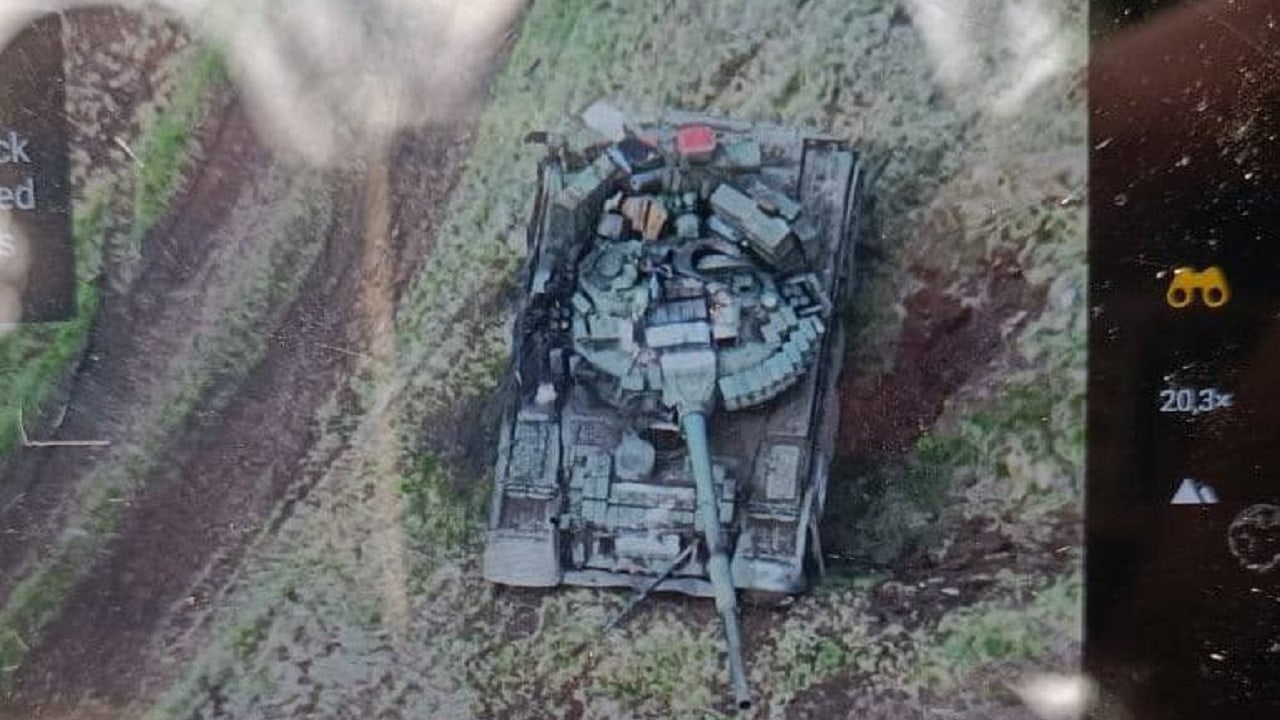
The battlefield geometry around Robotyne, as well as the force composition of the Russian elements defending there, offer important color to speculation surrounding the Ukrainian attack and gains. Geolocated footage from July 27 shows two Ukrainian Bradley infantry fighting vehicles and a T-72 tank either disabled or abandoned about 2.5km due east of Robotyne, which is a point that is about 2.5km south of the current frontline.[7] This geolocated point is beyond the forward-most pre-prepared Russian defensive fortifications in this area, indicating that Ukrainian forces managed to penetrate and drive through tactically challenging defensive positions. This kind of penetration battle will be one of the most difficult things for Ukrainian forces to accomplish in pursuit of deeper penetrations, as ISW has previously assessed. The defensive lines that run further south of Robotyne are likely less well-manned than these forward-most positions, considering that Russian forces have likely had to commit a significant portion of available forces to man the first line of defensive positions that are north and east of Robotyne.

Ukrainians appear to have rotated fresh forces into this area for the operation whereas Russian forces remain pinned to the line apparently without rotation, relief, or significant reinforcement in this sector. Russian milbloggers and unnamed Pentagon officials additionally noted that the Ukrainian units that participated in the July 26 attack are reserves that belong to older and more established Ukrainian brigades.[8] These reports indicate that Ukraine may now be employing fresh and generally more experienced units in the battle, whereas the same Russian 58th Combined Arms Army elements (particularly the 71st Motorized Rifle Regiment of the 42nd Motorized Rifle Division) have been engaged in defensive operations in this very area continually since the beginning of the Ukrainian counteroffensive in early June without relief.[9]The introduction of fresh Ukrainian reserves to the effort, together with the geometry of Russian defensive lines and the likely degraded overall state of Russian forces in this area, may allow Ukraine to begin pursuing more successful advances south of Orikhiv in the coming weeks.
 

Ukrainian forces trying to punch through Russian lines are facing perhaps their biggest test of the war as, according to two Pentagon officials, Kyiv begins the main thrust of its counteroffensive, pouring the bulk of their Western-trained reserves into the fight to sever Moscow’s hold on the south.

The task facing the advancing Ukrainian troops is monumental. Since seizing Ukrainian territory in last year’s invasion, Russia has built a dense defensive web of minefields, trenches, bunkers, tank traps and other obstacles. That has made the counteroffensive slow going, frustrating Ukrainians and international supporters.

The Ukrainians mounted a “massive” assault with three battalions, reinforced with tanks, south of the town of Orikhiv, and then another a few miles farther south near the village of Robotyne, said Igor Konashenkov, a spokesman for Russia’s defense ministry, according to Tass, a state news agency. Both were repelled, the ministry said. The area around Orikhiv is one of three main axes of assault.

Other American officials said that the most recent Ukrainian attack might be preparatory operations for the main thrust or reinforcements to replenish war-weary units.

One of Ukraine’s military objectives is to drive south from the current front line through the town of Tokmak to the city Melitopol near the coast. Both are highway and railroad hubs, and driving a wedge that deep would effectively split the Russian-held territory in two, making resupply and coordination more difficult for Moscow’s forces.

The United States and other allies have trained about 63,000 Ukrainian troops, according to the Pentagon, and have supplied more than 150 modern battle tanks, a much larger number of older tanks, hundreds of infantry fighting vehicles and thousands of other armored vehicles.

American officials, who spoke on the condition of anonymity to discuss internal deliberations, said on Wednesday that most of those reserves had been committed. All along the southern front on Wednesday, heavy artillery fire was heard as Ukrainian guns fired from hidden positions and the Russian guns responded, hitting positions their troops had recently abandoned.

Local occupation officials reported fierce battles raging south of Orikhiv, involving brigades of foreign-trained troops and armor donated by the United States and Germany.

At the same time, Russia mounted a missile barrage on Wednesday at targets across Ukraine, launching about three dozen cruise missiles and four hypersonic ballistic missiles from aircraft.

“There were a few hits, and some missile fragments fell,” President Volodymyr Zelensky of Ukraine said in his nightly address on Wednesday, without providing details.

Mr. Zelensky was vague about the counteroffensive. “Today our guys at the front had very good results,” he said. “More details later.”
 

Gen Oleksandr Tarnavskyi says his forces are struggling to overcome multi-layered minefields and fortified defensive lines.
"That is why most of the tasks have to be performed by troops."
He says Russia's military has displayed "professional qualities" by preventing Ukrainian forces from "advancing quickly".
"I don't underestimate the enemy," he adds.

Latest unconfirmed reports from the US suggest the main thrust of the counter-offensive has begun. The Institute for the Study of War says Ukrainian forces appear to have broken through "certain pre-prepared Russian defensive positions".

But so far there's little evidence that Western supplied tanks and armoured vehicles have been able to tip the balance decisively in Ukraine's favour.

Several Leopard tanks and US Bradley fighting vehicles were damaged or destroyed in the first days of the offensive, near the city of Orikhiv.
Ukraine's 47th Brigade, which had largely been trained and equipped by the West to try to break through Russian lines, were soon stopped in their tracks by mines and then targeted by artillery.
Russia released multiple videos of the incident claiming Ukraine's offensive had already failed. In reality it was an early setback rather than a decisive blow.


The British Ministry of Defence has rarely painted the capability of Russia's military in a positive light.

But in its latest update, it details "one of the single most influential Russian weapon systems" in Moscow's major offensive operations in the Zaporizhzhia region.

It says the Ka-52 HOKUM attack helicopter has "imposed a heavy cost on Ukraine" and has recently been improved to include a new anti-tank missile, the LMUR.

The missile has a range of about 15km and the MoD says Russia has "been quick to exploit opportunities to launch these weapons beyond the range of Ukrainian air defences".

The MoD says Russia has likely lost around 40 of the Ka-52 helicopters since the invasion.


In more recent months, it has "highly likely augmented the force in the south with at least a small number of brand new, Ka-52M variants: a heavily modified aircraft, informed by lessons from Russia's experience in Syria".

Sky News military analyst Sean Bell with some comments here: https://news.sky.com/story/ukraine-...t-china-12541713?postid=6221249#liveblog-body

Interpreting what's going on is complicated by the fact Ukraine does not routinely comment on progress with their operations, and Russia often over-dramatises the scale of Ukrainian operations to highlight Russian success in pushing such offensives back. But...

Russia claims that three battalions of Ukrainian soldiers conducted a "massive assault" on the Russian frontline, including over 80 Ukrainian armoured vehicles.

Evidence suggests that the Ukrainian forces did break through the first line of Russian defences as there are images of a Bradley armoured vehicle and a T-72 tank 2.5km south of the Russian frontline.

What is not clear is whether Ukraine has yet committed its main offensive forces - 10th Corps - or whether this latest attack is part of the "softening up" phase that has characterised the Ukrainian offensive to date.

Although the Russian defensive line is extensive and several kilometres deep and will therefore take some time to fully breach, it is likely that the majority of Russian forces will be manning the northern edge and thus Ukraine will be keen to capitalise swiftly on any gains made.

However, the Sea of Azov remains 60 miles further south, so the Ukrainians still have a long way to go to sever the Russian land bridge between Crimea and the Donbas.

But, in last night's address, President Zelenskyy did report that Ukrainian forces "had very good results".
 

Heavy rocket strikes slammed the critical logistics hub of Tokmak in Russian-occupied southern Ukraine on Thursday, according to a regional leader installed by Moscow.

Ukraine's military carried out the "massive" attack using multiple rocket launchers, according to Vladimir Rogov, a senior Russian-appointed official in the Zaporizhzhia region.

Three rockets exploded and a fourth fell near a railway station but did not explode, Rogov said on Telegram. One person was wounded, he added.

What's happening in the region: Tokmak is a Russian logistics headquarters located south of Zaporizhzhia city, with a rail line to the Russian-annexed peninsula of Crimea. It is about 20 to 25 kilometers (15 miles) from Ukrainian frontline positions.

It has come under regular fire from Ukrainian rocket and missile systems, including multiple rocket launchers, but is currently beyond the range of most artillery systems.

Ukraine appears to be ramping up its counteroffensive in the area, deploying thousands of extra troops to the southern front, according to Russian and US officials. Rogov admitted this week that Kyiv's forces have been able “to wedge in” three sections of Russia’s first line of defense in the Zaporizhzhia region.

Associated pictures/videos at the link here: https://news.sky.com/story/ukraine-...t-china-12541713?postid=6222036#liveblog-body

In an earlier post, it was reported that Ukrainian units had likely advanced to within 2.5km directly east of Robotyne in the south of the country, which is at the centre of the current counteroffensive.

This assessment came from the Institute for the Study of War and is based upon two pieces of geo-located footage from the front line and posts by military bloggers.

This video was posted by Russian channels yesterday and shows a Ukrainian vehicle being targeted by a drone.

Below is a screenshot from the other video.

It shows a line of Ukrainian vehicles in Robotyne.

It is possible to locate both videos by matching distinctive things like roads and woodlands in the footage to existing satellite imagery.


This map shows the currently assessed control on the front line around Robotyne.

The two videos have been plotted.

It shows that Ukrainian movements have occurred in areas currently under Russian control, which is a sign that an advance is occurring.

Two min video here: https://twitter.com/Osinttechnical/status/1684320972600406017

Footage from this morning of BMP-1-mounted Ukrainian infantry from the 118th Mechanized Brigade advancing near Robotyne.

BBC short video here: https://twitter.com/BBCWillVernon/status/1684556343888445441


Here in Komar, Donetsk oblast, Ukrainian soldiers are buzzing with the news their troops have just taken Staromaiorske from the Russians. The sound of artillery fire is constant as troops try to push south down the road. “At this rate we’ll be in Mariupol soon,” one told me.
 

After two months of painstakingly slow progress on the battlefield, Ukraine appears to be ramping up its counteroffensive, deploying thousands of extra troops to the southern front and signaling a new phase of the operation, US and Russian officials said.

Ukraine has committed more forces to the southeast of the country, a sign that Kyiv has identified potential weaknesses in Russian defensive lines, two US officials told CNN.

The Ukrainian military had been holding large numbers of trained troops, some equipped with more powerful Western weapons, back since the operation started in early June. While it still maintains some combat power in reserve, it has now deployed the “main bulk” of the forces committed to the counteroffensive forces, one of the US officials said.

The thrust appears to have brought some results. The counteroffensive has broken through some elements of Russian defensive lines in the southeast, the US official said, and the reserve units have come in to capitalize on the opportunity.


Earlier, the New York Times cited two Pentagon officials it didn’t identify as saying Ukraine has launched the main thrust of its counteroffensive. A Ukraine embassy official, who also asked not to be identified, warned against framing any part of the counteroffensive as a decisive battle, describing the war against Russia’s invasion as a long series of operations.


Another Russian channel shared a video of an abandoned Ukrainian BMP-1 (not sure if it’s the same vehicle) in an anti-tank ditch. These ditches are generally in front of the main line or strongpoints like Robotyne, suggesting Ukraine has made gains.

Most recent podcast with Michael Kofman: https://warontherocks.com/2023/07/an-inflection-point-in-ukraines-counteroffensive/
 

Ukraine’s allies do not seem troubled by the slow progress to date. “It is far from a failure, in my view,” said General Milley, when asked whether the offensive had stalled. “I think that it’s way too early to make that kind of call.” Optimists point to three factors in Ukraine’s favour. One is that it need not fear a serious Russian counter-attack, despite minor Russian gains in northern Luhansk province in recent days. “There appears now to be little prospect of the Russian forces regaining momentum,” said Richard Moore, the head of mi6, a British spy agency, on July 19th. That may be one reason why Russia has torn up a grain deal and resumed strikes on Ukraine’s ports and grain stores.
Second, Russia’s decision to defend forward, rather than falling back to prepared defences, has slowed down Ukraine’s progress but also left Russia with little mobile reserve in the rear, a point underscored by Yevgeny Prigozhin’s unhindered march to Moscow in June.
The third factor is that Ukraine has been chipping away at Russia’s combat power. On July 11th a Ukrainian strike reportedly killed Oleg Tsokov, a Russian general, in Berdyansk, suggesting that Ukraine was successfully targeting command posts. In recent days Ukraine has also used British-supplied Storm Shadow missiles to strike air bases and ammunition depots, including in Crimea. Meanwhile, America’s decision to provide cluster munitions, allows Ukraine to keep up the offensive for longer than originally planned—certainly beyond the summer if necessary.

These factors explain why General Valery Zaluzhny, Ukraine’s top general, decided to throw in fresh legs on July 26th. He has been forced to adapt his original plan. Brigades from Ukraine’s 9th Corps had been expected to fight their way to Russia’s main line of defence. Then the 10th Corps, in essence a second echelon, including three Western-equipped brigades, were to be deployed to fight their way through the strongest defences. Finally, light, fast-moving air-assault units were supposed to exploit any breakthrough, pouring through the hard-won breach.
In the event, 9th Corps struggled. Advances that were supposed to be completed in days ended up taking weeks. Ukraine was unable to deploy whole brigades, instead breaking them down into smaller units. Some experts worry that 10th Corps has now been thrown in prematurely. The main Russian line is still kilometres away and 10th Corps’s units might be worn down before they get there, leaving them too exhausted to punch through.
Western officials play down these concerns. “I think they timed it well,” says one. Ukraine is in a “very strong operational position”, says another, pointing to the turmoil in Russia’s senior ranks, including the decision in early July to sack General Ivan Popov, who commanded a big portion of Russian forces in southern Ukraine. Russian military bloggers have described heavy losses of Russian artillery pieces in recent weeks.

However, a fluid war of manoeuvre is likely to remain a stretch for a force cobbled together in a few months. The Russian verb peremalyvat (to grind through) is invoked on both sides. But Ukraine’s junior commanders, having seen their units gutted over the past 18 months, refuse to send their new citizen army into a meat-grinder in the way that Russia did in Bakhmut. As Ukraine has become more European, Ben Wallace, Britain’s defence minister, recently suggested, it has acquired “a Western European caution”.
Some American and European military officials argue that Ukrainian commanders have in fact been too slow to strike with their new brigades, a mistake that they think Ukraine committed last year in Kherson, when tens of thousands of Russian troops withdrew east over the Dnieper river with their equipment. Ukrainian commanders chafe at the idea that they should gamble their army in circumstances that nato generals have never faced.
The 10th Corps’s assault is a break with that hesitation. And the upside of the aversion to casualties thus far is that many Ukrainian units are in better shape than planners had assumed. Brigades that assaulted Russian positions were expected to be left with only a third of their original strength. Thanks in part to well-armoured Western vehicles, they have taken a lighter knock. Even so, the commitment of 10th Corps is a fateful moment for General Zaluzhny, a cautious commander with the weight of Ukrainian and allied expectations on his shoulders. “This is the last big decision for Zaluzhny to make this summer,” says the Western official. “The die is cast.”


Zelensky publishes a video of Ukrainian troops apparently in Staromaiske, a village south of Velyka Novosilka in Donetsk region. Progress in the counteroffensive.


We reported at 9.19am that President Zelenskyy was teasing "very good results" on the frontline, promising to give more details later.

Now we know what he was referring to.

He's just posted a video on Telegram with Ukrainian soldiers, who say they've recaptured the Ukrainian village of Staromaiorske from Russian forces.

The soldiers are heard saying: "35th Brigade and the volunteer Battalion "Arei" liberated the village Staromaiorske. Glory to Ukraine! Glory to Heroes!"

As recently as two hours ago, the latest update from the General Staff of Ukraine's Armed Forces reported that Russia had launched an air strike nearby today.
 
Last edited:
US intel report details increasing importance of Chinese technology to Russia’s war in Ukraine

China is providing technology and equipment to Russia that is increasingly important to Moscow’s war in Ukraine, according to a newly released report compiled by the Office of the Director of National Intelligence.

The report, titled “Support Provided by the People’s Republic of China to Russia” and dated 2023, is unclassified and largely cites open-source data and western press reporting to support its claims. But it includes the US intelligence community assessment that China “has become an increasingly important buttress for Russia in its war effort.”

The report says that as of March, China “had shipped more than $12 million in drones and drone parts” to Russia, citing a “third-party analysis” of Russian customs data.

Chinese state-owned defense companies have also been providing sanctioned Russian government-owned defense companies with other dual-use technology “that Moscow’s military uses to continue the war in Ukraine,” the report says, including “navigation equipment, jamming technology, and fighter-jet parts.”


Semiconductor exports from China to Russia have also jumped considerably since 2021, it adds, with “hundreds of millions of dollars’ worth of US-made or US-branded semiconductors flowing into Russia” despite heavy western sanctions and export controls.

The report says Chinese firms are “probably” helping Moscow to evade these sanctions – though it is “difficult to ascertain the extent” of that help. The report says the intelligence community cannot be sure whether Beijing is deliberately interfering with the US’ ability to conduct export control checks, via interviews and investigations, inside China.


The report does say, however, that China “has become an even more critical economic partner for Russia since its invasion of Ukraine in February 2022.”

The countries are using domestic payment systems more frequently for transactions in order to circumvent Western banking systems that Russia has been cut off from, the report says, and China has been increasing its imports of Russian oil and gas supplies. Those supplies have been largely banned by the US and Europe in an attempt to cut off Russia’s war chest.

The US believes that at the outset of the war, China intended to sell Russia lethal weapons for use in Ukraine, a US official previously told CNN. But China significantly scaled back on those plans as the war progressed, this person said – something the Biden administration has considered a victory.


It seems Ukrainian forces have made gains both along the Orikhiv axis east of Robotyne and the Velyka Novosilka axis retaking Staromaiors'ke.
 
About a 4 minute long video here from WSJ: How Ukrainian DIY Drones Are Taking Out Russian Tanks


American officials, speaking on the condition of anonymity, said on Wednesday that the main part of Ukraine’s counteroffensive was underway, and that most of the units trained and equipped by the West for that purpose had been committed. But Russian officials described the assaults as considerably smaller, though aggressive and intense, and on Thursday, Ukrainian officials, also given anonymity, said that most of their reserve units were not yet in use.
One U.S. military official appeared to step back a bit from the earlier claim, saying on Thursday, “It remains to be seen what they’ll truly commit, when they’ll commit it and where.”


Ukrainian forces are continuing their push around the embattled eastern city of Bakhmut, trying to advance north and south of the city, according to the commander of Ukraine’s Land Forces, Colonel General Oleksandr Syrskyi, who described the situation as "very tense."

“The enemy is clinging to every centimeter, conducting intense artillery and mortar fire,” Syrskyi explained during a briefing on Friday. “We are gradually advancing and liberating our land.”
Syrskyi went on to say that under such difficult conditions it was important to manage the soldiers at the front carefully and support them with counter-battery fire, in order to protect them from Russia’s intensified artillery.

“To support its troops in the area of Klishchiivka, Kurdiumivka and Andriivka, the enemy has concentrated a significant amount of artillery, the destruction of which is one of the main tasks for our troops,” he explained.

According to the General Staff, Ukrainian forces also repelled a Russian counter-attack in the area.

“Ukrainian defenders successfully repelled adversary attacks in the areas west and south of Klishchiivka,” it said.

Clashes near Lyman: Ukraine also says they’ve repelled Russian attacks near the Nadiya village, near Lyman, north of Bakhmut.

“Ukrainian troops continue to hold back the Russian offensive in this area,” the spokesman for the General Staff of the Armed Forces of Ukraine, Andrii Kovalov said.

According to Syrskyi, Ukrainian troops are holding on but attacks along this line are frequent.

“The enemy is constantly attacking in the Kupyansk and Lyman directions, using its most professional units,” the colonel general said. “Every day we repel numerous assaults in these areas. Not a single position has been lost.”
 

Ukrainian forces in southern Ukraine can be seen for the first time at one of Russia's long-stretching "dragon's teeth" defensive lines in a new video circulating on Russian social media.

CNN has geolocated the video to an area just east of the small villages of Nove and Kharkove in Ukraine's Zaporizhzhia oblast.

The video was taken from a Russian military position and shows a Ukrainian military vehicle moving in a field, heading toward a ditch in front of a large row of "dragon's teeth" — concrete and rebar pyramids that can serve as barriers against tanks. The apparent driver of the vehicle appears and begins running back toward a tree line.


U.S. Abrams tanks are likely to arrive on the Ukrainian battlefield in September, according to six people familiar with the planning, as Kyiv’s forces push to retake territory in a counteroffensive that is picking up steam.

The plan is to send a handful of Abrams tanks to Germany in August, where they will undergo final refurbishments. Once that process is complete, the first batch of Abrams will be shipped to Ukraine the following month.

The initial batch will involve six to eight tanks, said the industry official and the congressional aide. In total the U.S. is planning to send 31 tanks, a Ukrainian battalion’s worth.

Before Ukrainian forces can begin operating the tanks, they have to wrap up a roughly 10-week course on 31 trainer tanks at the Grafenwoehr Army base in Germany. The Ukrainians are slated to finish that training in August, according to a separate DOD official.

The first DOD official and another person familiar with Kyiv’s thinking said the tanks could even arrive in Ukraine as early as August, but that timeline may be overly optimistic. The tanks are not new; instead, the older vehicles are being stripped of their most sensitive technology, including in some cases secret depleted uranium armor, before they can be sent to Ukraine.

While the industry official said the first batch of modifications has been completed, it’s unclear if all the necessary refurbishments can be finished by the end of August.

But the situation is more complicated than merely sending tanks and training crews. A third DOD official, who didn’t address tank timelines but instead spoke more broadly about equipping and sustaining Ukraine for the long haul, said the U.S. is “working with our European allies to establish heavy maintenance repair facilities, especially for battle damage” to the Abrams tanks and other heavy armor that has been donated to Ukraine. “At the same time, we’re assuring that they’re getting all of the appropriate training, not only for repair but spares.”
 

General Sir Richard Barrons, the former head of the UK’s joint command, said Ukraine had committed a brigade comprised of 3,000-5,000 troops and 40-80 vehicles to its attempt to penetrate Russian defences. He said, however, that Ukraine had not yet deployed the bulk of its western tanks and armoured vehicles.
He said the fighting around Orikhiv was “only an opening salvo” that had not resulted in significant success for Ukraine. “But what it did betray was how stretched the Russian forces are. The Ukrainians are trying to work out where they can strike against Russian forces that are eroded and therefore a bit brittle.”

The Ukrainian counteroffensive has been slowed by wet weather but a second wave of tanks and armoured vehicles could break through Russian defensive lines, western officials believe. “The combination of wet and heat in uncultivated areas has led to significant levels of undergrowth and bush, which has aided the defenders,” one official said.

Barrons also compared Russia’s attempt to thwart Ukraine’s advance to the allied landing in northern France in the Second World War. He said Russia had built “textbook” defences of trenches, minefields and obstacles and that Ukrainian success would depend on the speed with which Russian commanders could deploy their reserves — including some of their best armoured troops — to plug the gaps along the vast front line.
“In the days after D-Day, the Germans were too slow to get their Panzers in the right places because they were too far away. If those tanks had turned up on the day, the allies would never have got off the beach,” he said.

Jack Watling, a senior research fellow at the Royal United Services Institute defence think tank, said the Ukrainian counteroffensive was not aiming to take back land with “a single decisive breakthrough”.
“The Ukrainians tried an armoured thrust but the losses were such that they decided to pause and reset. The fighting is now attritional and aims to create weak points in the defences,” he said.
“The Ukrainians are simultaneously attacking all along the front — Bakhmut, Orikhiv, Vuhledar — to wear down the Russian reserves so they can no longer plug the gaps.”

Britain has deployed 14 Challenger 2 tanks to Ukraine and none of them are believed to have been damaged or destroyed. However, the BBC has reported seeing British-supplied Mastiff armoured vehicles that had been taken out of action by Russian forces on the southern front.
Morale among rank-and-file Russian troops remains unbroken despite the recent spate of arrests of Putin’s critics and senior military figures, western officials believe. “The ability of the Russians to grit it out should not be underestimated,” one official said. “You’re not going to see a break of Russian morale across the line, which will then see a collapse of the Russian forces.”
The official added, however, that Russian positions were thin in places: “There is no reason why the Ukrainians can’t break though.”


Have asked both #Ukraine Generals in command of South and East fronts where UK Challenger 2 tanks are - and both say they haven’t got them. Maybe if I were in their shoes I wouldn’t say either? But bit of a mystery.
https://twitter.com/bealejonathan/status/1684822961012793344


But Yuriy Sak, an adviser to the Ukrainian Defense Ministry, said the fighting did not represent a major escalation.
“This offensive has been going on for quite some time,” Sak said by telephone. “It’s no different from other days. As soon as something big happens, we’ll know very quickly.”
American officials said the movement of additional Ukrainian forces to the Zaporizhzhia region could be a sign that fresh troops are being sent to probe Russian lines or are being deployed to replace fatigued units.

Dara Massicot, an expert on the Russian military at the Rand Corp., said she was concerned that Ukraine could be deploying troops it had held in reserve before breaking through Russia’s first line of defense.
“The reserves were intended to exploit an opening, not be a battering ram to create one,” Massicot said, cautioning that Ukraine had not achieved a “major breakthrough” anywhere along the front line since the counteroffensive began in early June.

Massicot added, however, that there were signs that Russian troops in Orikhiv had been worn down after weeks of fighting. One of the most experienced Russian units there, the 58th Combined Arms Army, recently lost its commander after he criticized Moscow’s military strategy, according to an account by the commander posted to Telegram.

“If the Ukrainians are putting new fresh troops and if they can break through, then they can use their advantage in armored vehicles to gain a lot of territory,” said Mark Cancian, a retired Marine officer and defense expert with CSIS, referring to the more advanced vehicles that Ukraine has received from its Western allies.
 

Ukrainian forces continued counteroffensive operations on at least three sectors of the front on July 27 and made gains in some areas, although Ukrainian forces appear not to have continued significant mechanized assaults south of Orikhiv in western Zaporizhia Oblast. Ukrainian President Volodymyr Zelensky posted footage on July 27 showing that Ukrainian forces liberated Staromayorske (9km south of Velyka Novosilka) in western Donetsk Oblast following heavy fighting in the area.[1] Geolocated footage published on July 26 indicates that Ukrainian forces also made marginal advances north of Klishchiivka (7km southwest of Bakhmut).[2] Geolocated footage published on July 26 suggests that Ukrainian forces made additional advances east of Robotyne (10km south of Orikhiv) during offensive operations on July 26.[3] Ukrainian Director of the Department of Application Planning at the Main Command of the National Guard Mykola Urshalovych stated on July 27 that Ukrainian forces achieved tactical victories in the Melitopol (western Zaporizhia Oblast) direction.[4] Russian sources claimed that Ukrainian forces continued assaults at a lower tempo and with far less manpower near Robotyne on July 27 after Ukrainian forces launched an intense mechanized frontal assault that broke through Russian defensive positions northeast of the settlement on July 26.[5] Geolocated footage published on July 27 suggests that Ukrainian forces may be operating in areas well forward of where ISW assesses Ukrainian advances to be as a result of ISW’s intentionally conservative assessments about control of terrain (covered in more detail in Southern Axis text).[6]


Ukrainian commentators have warned that talk of a new phase in the counter-offensive is premature. Military expert Oleksandr Kovalenko said Ukrainian forces were getting closer to breaking through Russia's defensive lines in the south but it might be too early to suggest they had fully done so.
Ms Maliar has spoken of a "gradual advance" in Ukraine's push towards the two cities of Melitopol and Berdyansk. Any advance towards either city would mark a decisive step in the military campaign.

If Ukraine's forces are able to make further progress in Robotyne, the next settlement to the south is Tokmak, on the road to Melitopol.
One area where Ukraine has said it is advancing is south of Bakhmut, the eastern city captured by Russian forces after a long and ferocious battle that reduced it to ruins.
Ms Maliar said Ukrainian forces were gradually moving forward and fighting was taking place in three villages on the front line directly south of the city. "The fighting is pretty harsh. Enemy fire is intense," she said.


Video here of an interview with retired Major General Mick Ryan discussing Ukraine and the offensive: Ukraine intensifies counteroffensive, commits more troops to southern front
 
It should be up to the Ukrainians on when and how to seek peace, not their allies whose military isn't being put into the meat grinder, nor whose citizens are getting hit with cruise missles.
i don't disagree, but they need to realize, which they do, that their allies are footing the bill in equipment and $$. that isn't infinite.
 

Good thread based on @nicolange_ trip to the southern front this month. Key: "Russia has more and more drones and also seems better able to use drones. Ukraine's previous advantage in drones is diminishing, also as powerful Russian electronic warfare becomes more effective."

English version: https://telegra.ph/Hard-won-progress-on-the-southern-front-07-28

Ukraine, with heavy losses, achieves progress on the southern front and at Bakhmut. Russia is undertaking a relief attack in the northeast. What is the situation and what is needed?

This analysis incorporates findings from visits on the southern front in July 2023. The status reproduced is time-delayed and omits precise location and troop movement information.

After Ukraine ventured only exceedingly small advances for a long time, larger Ukrainian formations are now being deployed again east of Robotyne. Ukraine is making progress, but has not yet broken through the Russian defenses.

Ukraine continues to suffer heavy losses in its advances in the flat, heavily mined terrain, currently primarily from Russian artillery and rocket artillery.

South of Velika Novosilka, Ukraine is bringing the village of Staromajorske under control. Since the beginning of the Ukrainian counteroffensive in early June, Ukrainian forces thus covered about 12 kilometers.

The distance from Staromajorske to the strategically important only railroad line through the southern corridor is still 40 kilometers. It is 115 kilometers to Mariupol on the Sea of Azov.

In addition to the counteroffensive in the south, Ukraine continues the local counterattack near Bachmut. Ukrainian forces reach the village of Andriivka south of Bachmut on the railroad line between Bachmut and Horlivka.


Russia is conducting a relief attack in the northeast from Kreminna toward Zaritchne-Lyman, where it advanced 5-6 kilometers. It is possible that Ukraine will retreat here to the western bank of the Scherebez River in the medium term.

In southern Ukraine, the extensive and managed Russian minefields continue to be the biggest obstacle to the Ukrainian offensive. Mines are constantly being re-laid with mortars as Ukraine removes or detonates mines.

Mine removal in flat, open terrain with wide visibility and under constant surveillance by many Russian drones is difficult and dangerous for Ukraine.

The electronic warfare comment isn't surprising and we've seen it noted elsewhere. Additionally, there have also been articles out the last month or so detailing better use of drones by the Russians. The second comment describes the impact of the cluster munitions:

Russia has more drones and seems better able to use them. Ukraine's previous advantage in drones is diminishing, in part because powerful Russian electronic warfare is becoming more effective against Ukrainian drones.


The newly delivered cluster munitions put Ukraine in a recognizably better position against the expanded Russian defenses. The new Ukrainian advances in southern Ukraine and south of Bachmut are also made possible by cluster munitions.

The protracted and arduous fight against Russian artillery in recent weeks reduced the Russians' traditional superiority in artillery, improving the conditions for Ukrainian attacks.


At the same time as front-line action, Ukraine is very specifically and systematically combating Russian logistics, command, control, and communications in the rear. By apparently lifting a restriction on the use of Storm Shadow and SCALP-EG, important strikes against large ammunition depots in Crimea are succeeding.

Russia fires mortars, artillery, and drones indiscriminately into Ukrainian cities and settlements near the front lines, e.g., from Enerhodar toward Nikopol and from Russia into the Sumy region, for training purposes.


Ukraine needs more technology to remove and detonate mines. It may need entirely novel solutions for huge, managed minefields, which urgently need to be thought about in the West as well.


Ukraine continues to need more artillery ammunition and support for ammunition logistics, even though it is now able to gradually build up its own production capacity for 155mm caliber ammunition. The EU has produced paper since March so far, but unfortunately no ammunition yet.


EU and member states should think about increasingly producing ammunition, spare parts, and technology directly in Ukraine or scaling production there. Ukraine is creating the conditions for this.

Ukraine is rapidly expanding its own drone production, but needs support for critical components. Ukraine needs more drone defense systems and better electronic warfare to counter Russian drones.

Ukraine further needs more air defense systems and guided missiles. It is possible that the MIM-23 Hawk repurchased by the U.S. from Taiwan can improve the situation on the front lines in this regard.

A steady supply of accurate long-range weapons and ammunition is particularly important for Ukraine. In addition to Storm Shadow and SCALP-EG, Taurus and ATACMS should finally be delivered.


Ukraine still needs multi-role combat aircraft as soon as possible, and the planned delivery of F-16s should be accelerated to the maximum.

And: In Ukraine, many schools, if they have bunkers, want to resume classroom operation in September after an extended period of online schooling. However, the school buses are now in military use. Ukraine needs school buses.

Ukraine continues to have significant resources that have not yet been used in the counteroffensive. Breakthroughs and transition to movement warfare remain possible, although the first weeks of the counteroffensive were terribly slow.

The situation could change more rapidly strategically if Ukraine brings the only rail line in the southern corridor and/or the approaches to Crimea within range of its precision weapons. In any case, long-term, systematic, and industrially backed support is needed.
 

Users who are viewing this thread

Back
Top