What's new
Fantasy Football - Footballguys Forums

This is a sample guest message. Register a free account today to become a member! Once signed in, you'll be able to participate on this site by adding your own topics and posts, as well as connect with other members through your own private inbox!

*** Official Russia vs. Ukraine Discussion - Invasion has begun *** (4 Viewers)

EU countries and Ukraine hold talks on 'drone wall' to counter growing threat

Numerous European countries are holding talks this afternoon on the bloc’s plans for “a drone wall” to counter growing threat of incursions from Russia or other actors. The issue is seen as increasingly urgent after recent Russian drone incursions into Lithuania, Poland and Romania, and recent run of so far unattributed drone sightings over Denmark. Bulgaria, Denmark, Estonia, Finland, Latvia, Lithuania, Poland, Romania, Slovakia, and Ukraine are all taking part in discussions.
The talks are led by EU defence commissioner Andrius Kubilius, with Nato also involved “at the technical level.”
 
Week of Military Brinkmanship: Kremlin Throws Down to NATO, Ukraine, NORAD

A pretty good chronology of the last week or 2.
Russian military actions during the Trump diplomatic offensive have been consistently aggressive and arguably insulting, a Kyiv Post review of recent security incidents in the NATO region and Ukraine found. NOTE: All Russian military flights approaching or entering NATO airspace and listed here were reportedly flown with transponders turned off and without filing a flight plan. Counts of Russian bomb, missile, and drone attacks were published by the Ukrainian military.

Friday, Sept. 19
NATO:
Three Russian MiG-31 fighter-bombers violate Estonian airspace for about twelve minutes; NATO forces scramble and intercept. Two Russian fighter aircraft, type unidentified, buzz a Polish oil drilling rig in the Baltic.
Ukraine: Russia launches massed drone strike against targets inside Ukraine with 86 lethal UAVs. Russian tactical air forces conduct 55 aerial attacks, dropping 98 guided bombs.

Saturday, Sept. 20
Ukraine:
Russia launches one of the biggest mass strikes against Ukraine of the war, with 579 strike drones, 8 ballistic missiles, and 32 cruise missiles, primarily targeting Kyiv, Mykolaiv, and Dnipro, killing at least three and injuring at least 36.

Sunday, Sept. 21
NATO:
German Air Force Eurofighter Typhoons scramble to intercept a Russian Il-20M reconnaissance aircraft that entered neutral airspace over the Baltic Sea. One Il-20 conducts two low-level passes over a German navy frigate.
Ukraine: Russia launches drone strikes against Ukraine with 54 weapons. Russian tactical air forces over the previous 24 hours conducted 94 aerial attacks, dropping 191 guided bombs. One person was killed by a bomb in the Kharkiv region.

Monday, Sept. 22
NATO:
Drones of unknown origin spotted near Copenhagen and Oslo airport forcing flight diversions and air defense activity.
The UK, Poland, and Estonia at a UN Security Council meeting formally accuse Russia of reckless military behavior. The Russian ambassador calls the accusations “hysteria.”
Ukraine: Russia launches mass drone attacks against targets inside Ukraine with 141 weapons. The Russian Air Force, over the previous 24 hours, launched 67 aerial attacks, dropping 136 glide bombs. The target focus is in the Donetsk and Zaporizhia regions. Bombs kill three in the Zaporizhzhia region, two in the Donetsk region.

Tuesday, Sept. 23
Ukraine:
Russia launches mass drone strikes against targets inside Ukraine with 115 weapons. Russian tactical air forces, over the previous 24 hours, conducted 31 aerial attacks, dropping 55 guided bombs. Russian bomb kills one in the Zaporizhzhia region.

Wednesday, Sept. 24
NORAD:
Two Russian Tu-95 bombers escorted by 2 Su-35 air superiority fighters approach US airspace in the Alaskan ADIZ (air defense identification zone); met by US Air Force assets, including one E-3 Sentry AWACS already airborne and on station conducting a routine flight. As the Russian aircraft approached Alaska, four F-16Cs and four KC-135 air refueling tankers on quick reaction alert were scrambled, likely anticipating the oft-repeated Russian rendezvous with the US fighters operating as part of NORAD, the Combined US-Canadian North American Defense Command. The F-16s conducted the routine intercept and visual identification (VID), and the Russians depart without entering US or Canadian airspace.
NATO: Two Russian Su-35 air superiority fighters execute, without warning, a low-altitude flyby (within 50 meters) of a British destroyer in the Black Sea. NATO’s Joint Force Command Naples reports Russian jamming of Atlantic Alliance forces in the vicinity and calls the Russian actions “an unacceptable escalation.”
Drones spotted in vicinity of Aalborg joint-use civilian/military airport in Denmark.
Russian Ambassador to France Alexei Meshkov states that any NATO shoot-down of a Russian aircraft, even over alliance airspace, would trigger “immediate war.”
Ukraine: Russia launches mass drone strikes against targets inside Ukraine with 152 weapons. The Russian Air Force, over the previous 24 hours, conducted 53 aerial attacks, dropping 105 glide bombs. The target focus was on the Kharkiv and Donetsk regions.

Thursday, Sept. 25
NATO:
Five Russian fighter planes (one Su-30, one Su-35, three MiG-31s) approach Latvian airspace; NATO forces scramble and intercept.
Drone or drones spotted in the vicinity of Aalborg, Billund, Skrydstrup, Esbjerg, Sønderborg, Holstebro military airports; Danish officials say it was a hybrid warfare operation conducted “professionally.”
Drone or drones spotted in the vicinity of Mourmelon-le-Grand military facility, Marne region, France, officials said an investigation was in progress.

Overnight into Friday
Ukraine:
Russia launches massed drone strikes against targets inside Ukraine with 176 weapons. Russian forces conduct air strikes. The Russian Air Force, over the previous 24 hours, launched 38 aerial attacks with 71 glide bombs. The focus was on the Kherson and Sumy regions. Ukrainian air defense forces shoot down a Russian Su-34 fighter-bomber conducting an air strike against Ukraine’s Zaporizhzhia region.

Friday, Sept. 26
NATO:
Drones spotted in the vicinity of Aalborg airport, report not confirmed by midday.
Ukraine: Russia launches mass drone strike with 154 weapons, hitting the Sumy and Dnipropetrovsk regions, targeting rail and energy infrastructure. A seven-ship of Su-34 fighter-bombers hit Kherson city with glide bombs, 70 homes and 11 apartment buildings damaged.
The Ukrainian Air Force had not yet made public the overall air assault and glide bomb counts for the day when this article was published.

 

The IAEA said it had been told by the Russian operators that there was enough diesel to power the generators for 20 days without fuel resupply. But Grossi said loss of external power “increases the likelihood of a nuclear accident”.

Seven out of 18 available generators are powering cooling on site but if they were to fail, Ukrainian sources said, there would be a risk that the nuclear fuel in the six reactors would heat uncontrollably over a period of weeks, leading to a meltdown.
 

Ukrainian Operations in The Russian Federation​

The Ukrainian General Staff reported that Ukrainian forces, including elements of the Unmanned Systems Forces, struck the Afipsky Oil Refinery in Krasnodar Krai overnight on September 25 to 26.[19] The Ukrainian Unmanned Systems Forces reported that Ukrainian drones struck one of the main crude oil processing units, which has a processing capacity of three million tons of crude oil per year — roughly half the Afipsky Oil Refinery’s total processing capacity of 6.25 million tons per year.[20] Geolocated footage published on September 25 shows a fire at the Afipsky refinery.[21] The Krasnodar Krai Emergency Headquarters claimed that drone debris caused the fire.[22]


The Ukrainian General Staff updated on September 26 the battlefield damage assessment of a Ukrainian Special Operations Forces (SSO) strike on August 9, 2025, against the Russian 448th Missile Brigade’s hangars in Kursk Oblast.[23] The General Staff reported that the SSO destroyed one Iskander missile launcher, five 9T250 transport-loading vehicles, a Pantsir-S1 air defense system, warehouses, and automotive equipment.
 
'I'm Kenyan, don't shoot' - the athlete who says he was duped into the Russian army

With tears in his eyes, a young Kenyan athlete now captive in Ukraine pleads not to be sent back to Russia. "I will die there," Evans Kibet says, waving his hands in the air towards the unseen interviewer on the video released on Wednesday by a Ukrainian army brigade. The 36-year-old prisoner-of-war is wearing a red sports top. The brigade's flag is pinned up behind him. The aspiring long-distance runner says he was tricked into joining the Russian army and is desperate to go home to see his 16-year-old daughter.
Citizens of Somalia, Sierra Leone, Togo, Cuba and Sri Lanka , among others, are currently held in Ukrainian prisoner-of-war camps, Petro Yatsenko, Ukraine's spokesperson on the treatment of prisoners of war, told the BBC. "Most of these individuals come from poorer countries and end up on the Russian side in different ways. Some are deceived – promised jobs at factories – while others join the war voluntarily. It is important to understand that very few are captured alive; most are either killed or seriously injured," he added.
 
Ukraine’s front line grows bigger as Russia shifts tactics, top commander says

The front line on the battlefield in Ukraine has grown in length to nearly 1,250 kilometers (800 miles), stretching Kyiv’s defenses, while Russian forces employ a new tactic of sending swarms of small assault groups to infiltrate Ukrainian lines, Ukraine’s top military commander says. The line of contact has grown by roughly 200 kilometers (120 miles) over the past year, and Ukrainian forces are averaging between 160 and 190 combat engagements every day with Russia’s bigger army, Gen. Oleksandr Syrskyi said in a review of the battlefield situation.

At the same time, Russian tactics have switched since the start of the summer from costly large-scale offensives to deploying small assault groups in a new approach that Syrskyi called the “thousand cuts” tactic. His version of events could not be independently verified, and Russian officials made no immediate comment.
 

Persistent Russian shelling is preventing the repair of power lines and “the restoration of basic safety”, Zelensky said. “This is a threat to everyone – no terrorist in the world has ever dared to do to a nuclear plant what Russia is doing.”

One generator has failed, according to reports


A security incident occurred at the German Airbase in Lower Saxony last week, when unidentified individuals shot pyrotechnics at a Bundeswehr C130 transport aircraft shortly after takeoff. The pilots were not hit and immediately alerted the control tower, Spiegel reported on September 30.

The Bundeswehr and police have launched investigations into the event. The pyrotechnic device appeared to be a firework rocket, with reports of a flash of light followed by a loud bang. The incident took place around noon, raising the possibility of a deliberate act.
 

Ukrainian drones have struck at the heart of Russia’s energy sector, knocking nearly 40% of its oil refining capacity offline and forcing Moscow to confront its worst fuel crisis in decades.

Ukrainian drone strikes have crippled Russia’s oil refining industry, forcing an unprecedented wave of refinery shutdowns and triggering a nationwide fuel crunch, The Moscow Times reported on September 30.

By late September, nearly 38% of Russia’s oil refining capacity—around 338,000 tons of crude per day—was offline, according to data from the analytics firm Ciala.

Output of gasoline and diesel plunged by 6% in August and another 18% in September, with downtime at refineries hitting levels “without historical precedent.” The disruptions eclipsed the previous record set just a month earlier, when 23% of refining capacity was knocked offline. The latest figures also surpass earlier peaks in May 2022 and May 2020.

Ciala estimates that around 70% of the outages stem directly from drone strikes, which by the end of September had knocked out roughly one-quarter of Russia’s total refining capacity—about 236,000 tons per day.

In September alone, four major refineries were forced to halt operations after drone attacks, including the Kirishi “Kinef” plant in Leningrad region—the second-largest in Russia—and Rosneft’s Ryazan refinery, which ranks among the country’s top five.

The Kinef plant went offline on September 14, while the Ryazan facility was hit on September 5. Novokuibyshevsk refinery stopped processing on September 20, followed two days later by Gazprom’s Astrakhan gas processing plant.

The impact on Russia’s domestic fuel market has been severe. Gasoline output dropped by 1 million tons in September, while shortages grew to cover as much as 20% of national consumption.

The hardest-hit regions are the Far East and occupied Crimea, where fuel stations this week limited sales to no more than 30 liters per customer. In total, more than 20 regions across Russia, from Sakhalin to Nizhny Novgorod, are now facing shortages.

Russian oil companies have little ability to stabilize the situation, economist Vladislav Inozemtsev noted. Repairs could take months, especially under sanctions that block access to Western equipment used to modernize refineries during the 2010s. “Chinese substitutes cannot easily replace this technology,” Inozemtsev said.

To contain the crisis, Moscow banned gasoline exports and moved to secure emergency imports, temporarily scrapping import duties on gasoline, diesel, and jet fuel within the Eurasian Economic Union. Authorities may even lower environmental standards to allow domestic refineries to produce more fuel.

The fuel crunch is already feeding inflationary pressures, warned Vladimir Chernov, an analyst with Freedom Finance Global. Wholesale fuel prices have surged more than 40% since January, while retail prices are climbing at 11–12% annually—the sharpest rise in seven years.

“The rising cost of fuel inevitably drives up expenses in agriculture, transportation, and logistics, translating into higher prices for food and essential goods,” Chernov explained.

Earlier, another major fire was reported at an oil refinery in Feodosia, located in Russian-occupied Crimea.
 

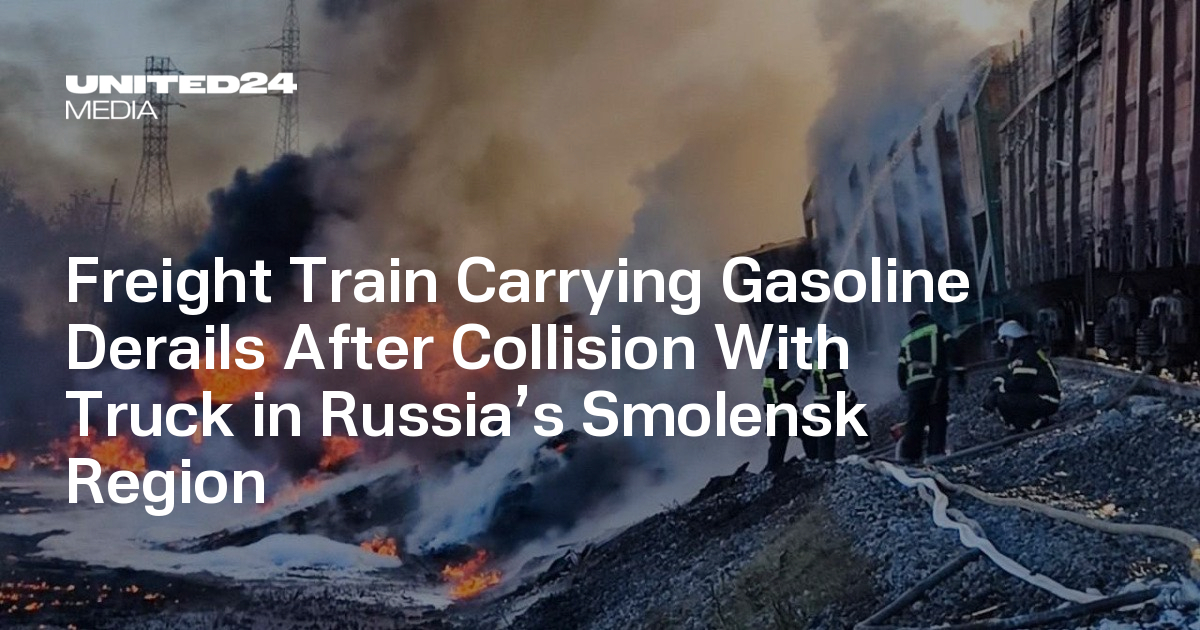
Fiery Train Disaster in Russia: Gasoline Convoy Derails After Truck Collision in Smolensk Region

A major rail incident occurred in Russia’s Smolensk region on September 26 when a freight train carrying gasoline collided with a truck at a railway crossing.

The crash caused the locomotive and 18 tank cars to derail, with several igniting and producing a large fire.

According to Russian media reports, the truck entered the crossing in front of the oncoming train. The locomotive driver applied emergency brakes, but the collision was unavoidable. Both the driver and his assistant were hospitalized with moderate injuries.

The Moscow Railway confirmed that six tank cars caught fire following the derailment. Emergency services, including three firefighting trains and four recovery teams, were dispatched to the scene to contain the blaze and manage the fuel spill.

Rail traffic on the affected section has been suspended while an operational headquarters coordinates the response.

Earlier, on September 22, drones targeted the Kanivska traction substation in Russia’s Krasnodar region. The strike, involving at least five drones, caused multiple explosions and a fire at the facility, which powers key electrified railway lines. Russian state media confirmed debris from drones ignited the blaze, disrupting both passenger and freight operations.


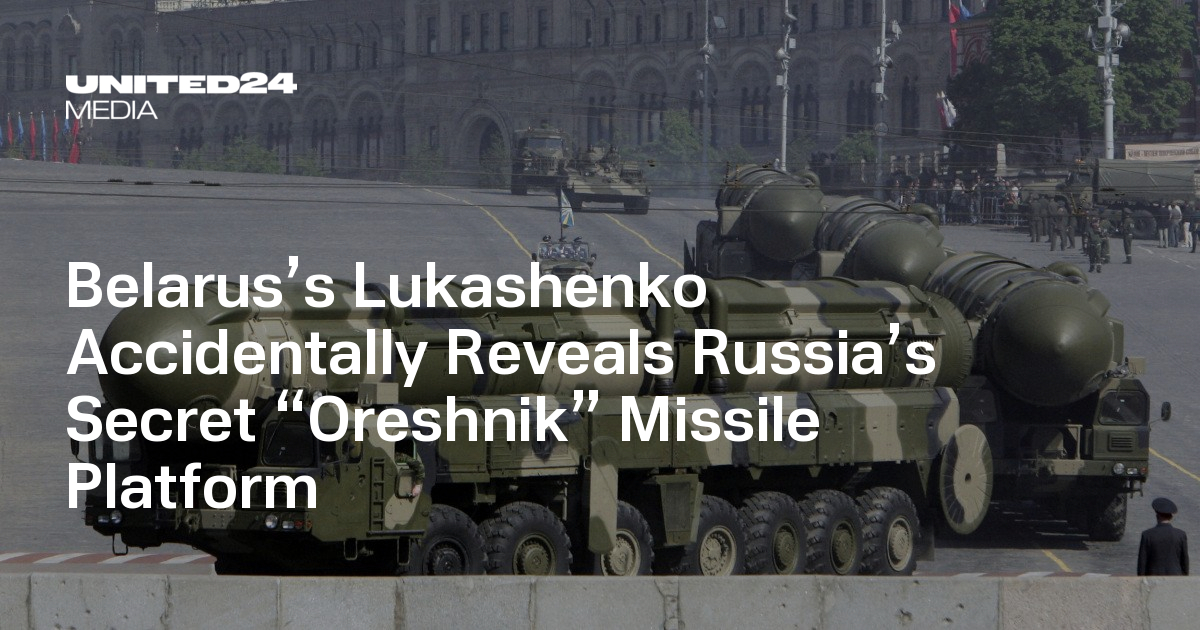
Belarus’s Lukashenko Accidentally Reveals Russia’s Secret “Oreshnik” Missile Platform

Belarusian leader Alexander Lukashenko has inadvertently revealed the appearance of Russia’s latest medium-range ballistic missile system, known as “Oreshnik” (also referred to as “Kedr”), according to Defense Express on October 1.

Images published by the Belarusian state-run outlet “Pul Pervogo” showed a model of the missile system placed inside Lukashenko’s office during his meeting with the Prime Minister of Kyrgyzstan.

The positioning of the model, turned toward television cameras, allowed details of the launcher to be seen.

According to Defense Express, the launcher is mounted on the MZKT-79291 chassis, a heavy vehicle produced by the Minsk Wheel Tractor Plant in Belarus.

This chassis, with a 12×12 wheel configuration, has previously been used for Russian intercontinental missile systems such as the RT-2PM2 Topol-M and the RS-26 Rubezh.

The publication notes that the vehicle is capable of carrying a payload of roughly 60 tons, similar to earlier Soviet-era missile platforms like the MAZ-547, which supported the RSD-10 Pioneer system.

Based on visual analysis of the model and comparisons with previous missile systems, Defense Express estimates the launch weight of the “Oreshnik” missile, together with its container, at approximately 45–48 tons. Without the container, the missile itself is believed to weigh around 40–43 tons.

Earlier reporting suggested that Russia had deployed the “Oreshnik” system to Belarus, presenting the move as necessary for “security” rather than a step toward escalation.

The RS-26 Rubezh, which many analysts associate with the “Oreshnik” project, has been under development for more than seven years and was previously criticized in the West as a violation of the now-defunct Intermediate-Range Nuclear Forces (INF) Treaty.

Belarus’s role is central because the MZKT-79291 chassis is one of the few platforms capable of carrying Russia’s largest mobile missile systems. As Defense Express highlighted, Russian efforts to replace Belarusian heavy chassis with domestic KamAZ designs have struggled, with the Russian alternative proving about 10 tons less capable.
 
Russia extends ban on gasoline exports, limits diesel shipments amid Ukrainian fuel disruptions

Russian authorities introduced new measures on Sept. 30 in an attempt to stabilize domestic fuel supplies, Russian state media reported. The new measures comes amid a wave of Ukrainian drone attacks on Russian oil refineries, which have strained supplies and forced Moscow to cut shipments.

The Russian Cabinet decree extended the ban on the export of gasoline outside of Russia for both exporters and producers until Dec. 31, 2025, Interfax reported. In addition to the export ban on gasoline, Russian authorities also introduced a ban on diesel, marine fuel, and gasoil exports for non-producers, according to a Cabinet statement, noting that the temporary ban will begin on Oct. 1. The ban, which does not apply to direct producers, is also set to last through to the end of 2025.

Russia initially banned gasoline exports in July 2025 stemming from a spike in price caused by Ukrainian disruptions. Ukrainian strikes have targeted at least 16 of Russia's 38 oil refineries since August 2025, according to the Financial Times, pushing Russian diesel exports down to their lowest level since 2020.
 
'It's ingenious and going to work' — Finland's Stubb bullish on EU's frozen Russian assets plan

He said his recent visit to Kyiv had left him with the impression that Ukraine was "probably in a better place than it has been at any time during this conflict."
He stressed that support for Ukraine was not "a one-way street," noting that Ukraine now fields "the most experienced and modern army in Europe," able to teach its allies how best to counter drone warfare.
Asked by the Kyiv Independent whether he would sense any appetite for closing the sky at least over western Ukraine to prevent incursions into NATO territory and protect the defense industry production based in that part of the country, he was cautious: "If we get a ceasefire, then it's a different story. That's why I've been calling for a two-phase solution: first a ceasefire by air, sea, and land; then negotiations on a peace framework. And of course, the Americans have the best equipment to do that," he said. For now, he warned, Russia was likely to target Ukraine's energy infrastructure ahead of winter.
Stubb praised EU plans to mobilize Russian frozen assets as "ingenious." A recent proposal, which has been gaining ground over the past few weeks, even among skeptical countries like Germany, would see the bloc borrow around 140 billion euros ($164 billion) on behalf of all EU member states, with each country sharing risk based on its gross national income (GNI) share. Rather than a "blank check" to Kyiv, the scheme would frame the support as war compensation, he explained: effectively an interest-free loan, to be repaid only if Russia itself pays reparations. "It is my understanding that the proposal is something to the effect that instead of giving a blank check to Ukraine, you frame it as war compensation," Stubb said. "Which basically means that you give the money out as an interest-free loan to Ukraine."
 
Analysis: How Russia uses Western reporters to launder propaganda
Russia's war propaganda has a broad array of tools – including enticing foreign reporters to help "launder" its narratives for international audiences. Pearson Sharp, a foreign correspondent for the far-right U.S. outlet One America News Network (OAN), stirred controversy earlier this month after announcing he had been reporting from inside Russia and Russian-occupied Donbas. His self-styled "independent" coverage closely echoed Russia's longstanding narratives on Ukraine and was promptly amplified by Russian state propaganda and affiliated voices on social media.
In a Sept. 17 post on X, Sharp published a photo of himself flanked by four heavily armed Russian soldiers, announcing he had "spent the past week traveling through Donbass in Russia (sic) and visiting the people and cities in the region being ravaged by this pointless war." Casting himself as an independent observer who relayed only the views of the locals, the OAN reporter stated that the residents assured him they were grateful to Russian President Vladimir Putin for "saving" them from the "Zelensky regime." Sharp is far from the only self-described "independent journalist" to cover the war from the Russian side of the front while echoing Moscow's narratives. Brit Graham Phillips, American Patrick Lancaster and German Alina Lipp have done so for years, even since before the outbreak of the full-scale invasion.
These reporters are then given prominent airtime on Russian state media, which presents them as "impartial voices" seeking the truth — a propaganda method described as a "third-party effect" by Alyona Hurkivska, a political scientist at the Kuras Institute of Political and Ethnic Studies of the National Academy of Sciences of Ukraine. Between September 8 and 17, pro-Russian Telegram channels and state media-linked actors amplified 178 posts about the presence of foreign journalists, garnering more than 13.1 million cumulative views, according to the disinformation monitoring team at LetsData. Depicted as "neutral witnesses exposing alleged Ukrainian crimes," these reporters help Russia bolster its credibility while eroding Western narratives, LetsData analyst Joseph Roche told the Kyiv Independent. Sharp has already appeared on the Russian propaganda channel RT and state news agency RIA Novosti. TASS, in the meantime, covered his meeting with "U.S. volunteers in the Russian Armed Forces" in Nizhny Novgorod Oblast.
 
Ukrainian delegation heads to US for joint drone production talks

A Ukrainian delegation departed for the U.S. on Sept. 29 to attend a meeting on joint drone production, the Defense Ministry told Suspilne. The news comes as Kyiv moves to finalize agreements to purchase American weapons and export domestically produced drones, President Volodymyr Zelensky said after his recent visit to the U.S., where he met with U.S. President Donald Trump.

The delegation, led by Deputy Defense Minister Serhii Boyev, is expected to focus discussions primarily on technical issues, according to Suspilne. Ukraine is planning both a "Mega Deal" — a major agreement on the purchase of American weapons — and a "Drone Deal," to sell Ukrainian unmanned systems to the U.S., Zelensky said on Sept. 27.
 
Russian territorial gains in Ukraine drop sharply in September, monitoring group says

The pace of Russia’s territorial advances in Ukraine slowed significantly in September, with Russian forces seizing 44% less land compared to August, the Ukrainian monitoring group DeepState reported on Oct. 1. Russian troops captured approximately 259 square kilometers (100 square miles) of Ukrainian territory during the last month, just 0.04% of Ukraine’s total area. This marks the smallest monthly gain since May. In total, Russia now occupies around 19.04% of Ukraine’s territory.
 

Users who are viewing this thread

Back
Top